wayground logo

Free Printable Worksheets

Font size

S
M
L
XL
Worksheets

S22 Biol S Final

Total questions: 77

Worksheet time: 1hrs 23mins

Name
Class
Date
1.

Where do plants get the energy for photosynthesis to take place?

a)

nutrients in the soil

b)

the sun

c)

chlorophyll

d)

bee pollination

2.

True or False: Plants make their own food and use the energy from the food that is made.

a)

True

b)

False

3.
What are the 3 key ingredients needed for photosynthesis
a)
glucose, oxygen, carbon dioxide
b)
carbon dioxide, water, glucose
c)
water, soil, sunlight
d)
sunlight, water, carbon dioxide
4.
What are the two products of photosynthesis?
a)
Oxygen and Carbon Dioxide
b)

Oxygen and Sugar

c)
Sunlight and Sugar
5.

What are the reactants for cell respiration?

a)

Carbon dioxide and water

b)

carbon dioxide and glucose

c)

glucose and water

d)

glucose and oxygen gas

6.

What are the products of cell respiration?

a)

water, light, and sugar

b)

water, carbon dioxide, ATP

c)

oxygen, water, sugar

7.

Photosynthesis _________ the energy that cell respiration ______.

a)

builds ; breaks

b)

breaks ; build

c)

eats ; builds

8.

Carbon dioxide levels will _______ during exercise.

a)

increase

b)

decrease

c)

see no change

9.

What is the one component in photosynthesis that is not recycled and must be constantly available?

a)

sun

b)

glucose

c)

water

d)

oxygen

10.
Why are Respiration and photosynthesis opposites?
a)
Plants and living things trade what they make to what they give away as waste.
b)
They are not opposites, they are the same thing.
c)
Plants only do respiration not photosynthesis.
d)
Animals make their own food which is photosynthesis.
11.

How are fossil fuels formed?

a)

They are made in factories

b)

Dead plants and animals died millions of years ago and were buried under heat and pressure

c)

Dead plants were buried under heat and pressure

d)

Dead animals were buried under heat and pressure

12.

What runs of fossil fuels?

a)

Cars

b)

Electricity

c)

Outdoor Grills

d)

All of the Above

13.

What are the 3 main fossil fuels?

a)

Coal, Oil, and nuclear fuel

b)

Coal, Oil, and Natural Gas

c)

Electricity, Gas, Petroleum

d)

Coal, Oil, Non-renewable Resources

14.
Fossil fuels are classified as nonrenewable because they.......
a)
require expensive equipment
b)
take millions of years to replace
c)
can be found all over 
d)
provide all the energy we use
15.
What is the definition of a renewable resource?
a)
things that don't run out
b)
things that do run out
c)
stuff that makes things happen
d)
none of the above
16.
What is a problem that is linked to the burning of fossil fuels?
a)
Global Warming
b)
geothermal energy
c)
solar power panels
d)
none of the above
17.

5. The Earth provides humans with an unlimited amount of fossil fuels. They are considered renewable.

a)

True

b)

False

18.

Why are fossils fuels so widely used?

a)

They are renewable so they won't run out.

b)

They pollution they produce is less compared to renewable energy sources.

c)

They are easy to obtain and process.

d)

They don't disrupt the environment when mined from the earth.

19.
Very slight increases in the acidity of seawater __________  marine organisms that make shells.
a)
doesn't bother
b)
has no effect on 
c)
is unhealthy and stresses
20.
Carbon dioxide levels in the air have changed throughout earth's history.  The difference today is how ______ the change is happening.
a)
rapidly 
b)
slowly 
c)
wide spread
21.

Which molecule makes water acidic?

a)

Carbonate Ions

b)

Carbon Dioxide

22.

According to this slide

a)

CO2 is causing marine life to die by "poisoning' the water

b)

CO2 is destroying sea shells

c)

CO2 is formed from the combustion of Octane

23.

This image demonstrates that

a)

There is a direct correlation with the atmospheric CO2 and the CO2 in seawater

b)

That pH of the ocean increases as the atmospheric CO2 increases

c)

That there is no correlation between pH of the ocean and atmospheric CO2

24.
As the ocean becomes more acidic, the pH of the water
a)
increases
b)
decreases
25.
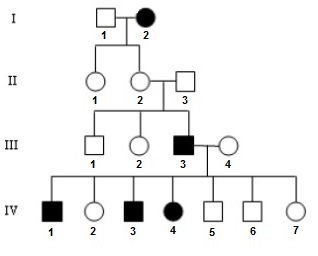
What does a filled in square represent?
a)
Not affected Female
b)
Not affected Male
c)
Affected Male
d)
Affected Female
26.
How many generations are shown in this pedigree?
a)
1
b)
2
c)
3
d)
4
27.
How many kids did the mother and father from the first generation have?
a)
2
b)
4
c)
5
d)
6
28.
This pedigree represents the inheritance of hemophilia in this family. How many of the females have the hemophilia trait?
a)
8
b)
5
c)
2
d)
3
29.
What do half colored symbols represent?
a)
The individual is a carrier (heterozygous).
b)
The individual expresses the trait.
c)
The individual has both recessive alleles.
d)
The individual has both dominant alleles.
30.
What does an open circle represent?
a)
Not Affected Male
b)
Not Affected Female
c)
Affected Male
d)
Affected Female
31.
Is this trait (the shaded individuals) dominant or recessive?
a)
dominant
b)
recessive
32.

Segments of chromosomes that contain coded information for an organisms trait

a)

cells

b)

genes

c)

alleles

d)

genotypes

33.

The outward expression, or appearance, of a genetic trait is its

a)

allele

b)

pedigree

c)

phenotype

d)

inheritance

34.

A model that is used to show possible outcomes of cross breeding is a

a)

ratio

b)

coin toss

c)

pedigree

d)

Punnett square

35.
Of sixteen rabbits just born, thirteen have brown fur and three have white fur. The trait for white fur is considered to be 
a)
recessive
b)
bossy
c)
stronger
d)
dominant
36.
 Which term correctly describes an individual with a pair of the same alleles for a trait? 
a)
homologus
b)
heterologus
c)
homozygous
d)
heterozygous
37.
 Look at the Punnett square.
If the two parents represented in the Punnett square have four offspring, what does the Punnett square tells you? 
a)
Two of the offspring will definitely have the genotype Aa.
b)
It is more likely that two of them will have the genotype Aa than the genotype aa.
c)
There is a 50% chance for each of the four offspring to have the genotype Aa.
d)
It is less likely that two of them will have the genotype Aa than the genotype aa.
38.
Phenotype refers to the _________ of an individual
a)
genetic makeup
b)
actual physical appearance
c)
recessive alleles
d)
dominant alleles
39.
When the genotype consists of a dominant and a recessive allele, the phenotype will be like the ______________ allele.
a)
dominant
b)
recessive
c)
both
d)
neither
40.
the base that pairs with Thymine in DNA
a)
adenine
b)
guanine
c)
helicase
d)
nucleotide
41.
nitrogen base that pairs with guanine
a)
adenine
b)
cytosine
c)
nucloetide
d)
deoxyribose
42.
the process of making a copy of DNA
a)
transcription
b)
double helix
c)
DNA replication
d)
replication fork
43.
The shape of DNA.
a)
double helix
b)
nucleotide
c)
DNA polymerase
d)
single stranded
44.
If we think of DNA as a ladder, which parts are the steps of the ladder?
a)
the nitrogenous base pairs
b)
the phosphate-sugar backbone
c)
the genes
d)
the phospholipid bilayer
45.
If we think of DNA as a ladder, which parts are the sides of the ladder?
a)
the nitrogenous base pairs
b)
the phosphate-sugar backbone
c)
the genes
d)
the phospholipid bilayer
46.

A code is a set of rules and symbols used to carry ___________.

a)

DNA

b)

information

c)

structure

d)

function

47.

In a ________ mutation, a base is left out.

a)

substitution

b)

insertion

c)

deletion

48.

Mutations are mistakes that become part of ___________________.

a)

history

b)

genetic code

c)

proteins

49.

In a(n) ____________________ mutation, an extra base is added.

a)

substitution

b)

insertion

c)

deletion

50.

A code is a set of rules and symbols used to carry ___________.

a)

DNA

b)

information

c)

structure

d)

function

51.
What is the significance of the sequence (order) of the Nitrogen Bases in DNA?
a)
The order of the Nitrogen Bases determines the number of chromosomes present in an organism.
b)
The order of the Nitrogen Bases determines the traits that an organism will possess (have).
c)
The order of the Nitrogen Bases determines the gender of an organism.
d)
The order of the Nitrogen Bases determines whether an organism is abiotic biotic.
52.
Assume that you have straight hair and your sibling has curly hair. What accounts for this difference?
a)
You have DNA and your sibling does not.
b)
The your sequence of nitrogen bases is different than your sibling.
c)
Your sibling has a weave. 
d)
Your sibling has a genetic mutation. 
53.
How does RNA differ from DNA?
a)
RNA contains uracil and deoxyribose
b)
RNA contains ribose and thymine
c)
RNA contains uracil and ribose
d)
RNA contains adenine and ribose
54.
How would the DNA sequence GCTATA be transcribed to mRNA?
a)
GCUAUA
b)
CGATAT
c)
CGAUAU
d)
GCUTUT
55.

What is the correct order to make a protein?

a)

Protein, DNA, RNA

b)

RNA, DNA, Protein

c)

DNA, RNA, Protein

d)

Protein, RNA, DNA

56.
Where does transcription take place?
a)
nucleus
b)
cytoplasm
c)
ribosome
57.

WHERE does TRANSLATION occur?

a)

ribosome

b)

cytoplasm

c)

nucleus

d)

cell

58.

Which organelle makes proteins?

a)

ribosome

b)

nucleus

c)

mitochondria

d)

chloroplast

59.

The triplets of mRNA read by a ribosome are called _____.

a)

anticodons

b)

coded gene

c)

codons

d)

rRNA

60.

What is translation?

a)

the process in which DNA is copied to make another molecule of DNA

b)

the process in which DNA is coded into mRNA

c)

the process in which mRNA is decoded into a protein

d)

the process in which enzymes break down mRNA

61.

The DNA sequence ATC-AGC-GCT-GGC is part of a gene. how many amino acids are coded for by this message?

a)

4

b)

8

c)

3

d)

12

62.

Which amino acid matches with the following codon:

GAU

a)

GLU

b)

SER

c)

ASP

d)

ILE

63.
Change over time...
a)
Evolution
b)
Nucleotide 
64.
How does embryology support the Theory of Evolution?
a)
It shows that they have a common ancestor because of their similarities.
b)
         I'm not sure.
c)
Animals change over time. 
65.
The most recent ancestral form or species from which two different species evolved is known as ________________________.
a)
a common ancestor.
b)
an embryonic stage.
c)
development.
d)
evolution.
66.
Common ancestry relates to evolution because
a)
evolution only happens when there are common ancestors.
b)
Common ancestors make evolution happen more quickly.
c)
evolution can never take place with common ancestors.
d)
the more two organisms have in common, the more recent is their common ancestor during their evolution.
67.
In stage one (top row) of these embryos, most of the embryos________
a)
look very similar.
b)
have very different features.
c)
show different stages of development.
d)
have only a tail if they are non-human.
68.

What type of evidence is represented in the picture above:

a)

Fossils

b)

Vestigial Structures

c)

DNA

d)

Homologous Structures

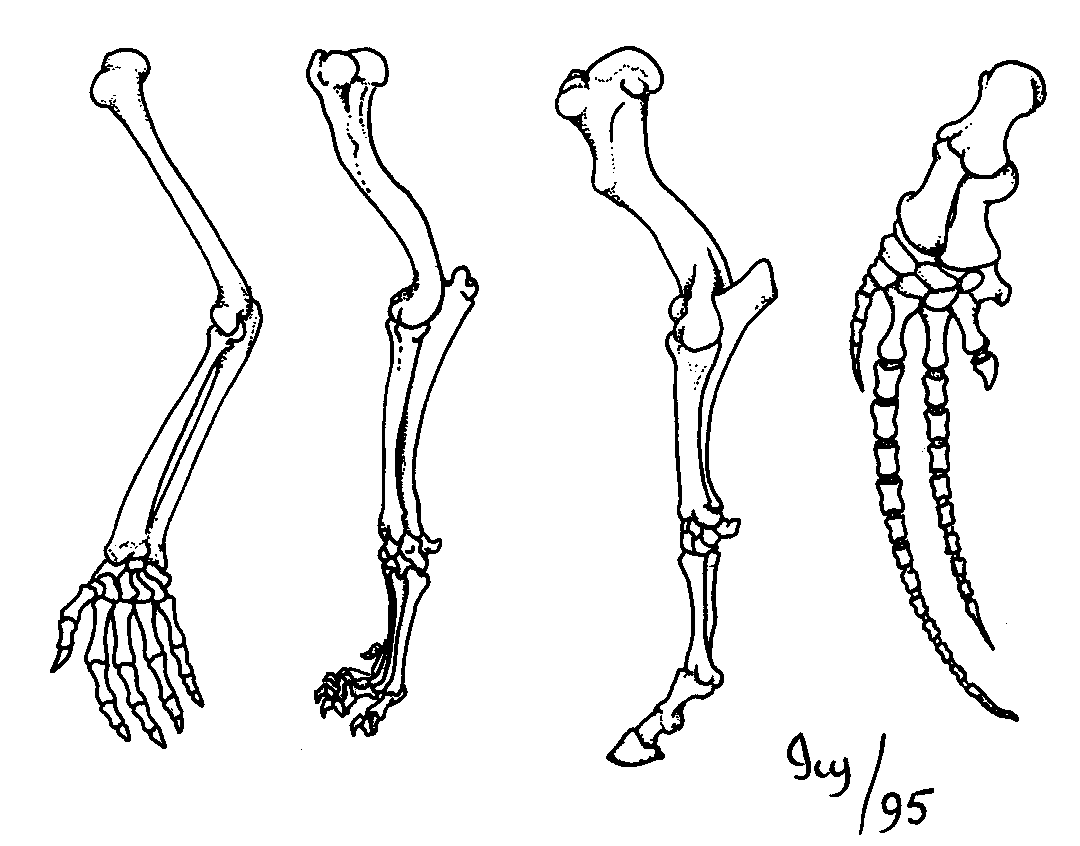
69.

What type of evidence is shown in the image above?

a)

Fossils

b)

Vestigial structures

c)

Homologous Structures

d)

DNA

70.
The similarities of the bones in the diagram provide evidence that---
a)
The organisms shown lived in the same natural envionrment
b)
The organisms shown may have developed from a common ancestor
c)
The organisms shown have the same genetic diseases
d)
All vertebrate species have identical forelimbs
71.
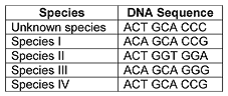
According to this data, the unknown bacterial species is most closely related to: 
a)
Species I
b)
Species II
c)
Species III
d)
Species IV
72.
The diagram shows fossils in different rock layers. Which of these statements about the age of these fossils is most likely correct?
a)
Fossil A and C are the same age
b)
Fossil B is older than fossil C
c)
Fossils A is older than fossil B
d)
Fossil D is older than fossil C
73.
Which of the following pieces of evolution evidence deals with comparing similar structures in various species?
a)
fossil record
b)
comparing embryology
c)
comparing biochemistry
d)
comparing anatomy
74.
Whales are aquatic mammals that contain a pelvis bone.  Even though it does not aid in its movement, the function must have been used by a common ancestor of the whale.  Thus, the pelvis is referred to as a(n)
a)
vestigial structure
b)
analogous structure
c)
homologous structure
75.
Structures with the same parts have different functions; suggests that organisms share a common ancestry
a)
vestigial structures
b)
homologous structures
c)
adaptive radiation
d)
fossil
76.

A category of structures that have a similar function, but are structurally different.

a)

Homologous structures

b)

Analogous structures

c)

Vestigial structures

d)

Common core structures

77.

What are the most important characteristics of analogous structures?

a)

Structures that perform the same function

b)

Structurally different

c)

Structurally the same

d)

Structures that perform different functions