wayground logo

Free Printable Worksheets

Font size

S
M
L
XL
Worksheets

Evolution Unit Vocabulary

Total questions: 66

Worksheet time: 48mins
Name
Class
Date
1.
What is the term for a feature that allows an organism to survive in its environment?
a)
adaptation
b)
variation
c)
homologous structure
d)
vestigial structure
2.
a)
analogous structures
b)
homologous structures
c)
vestigial structures
d)
none of the above
3.
What is the process of which humans breed organisms for certain traits?
a)
artificial selection
b)
descent without modification
c)
inheritance of acquired characteristics
d)
natural selection
4.
The remnant of an organ that had a function in an early ancestor is known as a(n)
a)
vestigial structure
b)
analogous structure
c)
homologous structure
d)
fossil structure
5.
What is the study of the distribution of organisms around the world?
a)
geology
b)
biogeography
c)
paleontology
d)
geography
6.
Vertebrate embryos pass through similar stages of development is evidence for
a)
use and disuse
b)
homologous structures
c)
common ancestry
d)
acquired characteristics
7.
Why are advantageous traits more likely to be passed onto offspring?
a)
Because they are more likely to survive and reproduce.
b)
Because they come from dominant alleles.
c)
Because they come from recessive alleles.
d)
Because the trait is an acquired phenotype.
8.
Where the better adapted organisms survive to pass traits along to offspring.
a)
Evolution
b)
Natural Selection
c)
Extinction
d)
Artifical Selection
9.
Some organisms that share a common ancestor have features that have different functions, but similar structures.  These are known as
a)
vestigial structures
b)
analogous structures
c)
homologous structures
d)
fossil structures
10.

Vocab check:

The theory that organisms have slowly changed over time...

a)

fossil record

b)

relative dating

c)

evolution

d)

adaptation

11.
European rabbits were introduced to Australia in 1859. The rabbits reproduced rapidly in their new habitat, displaced other animals, and overgrazed vegetation. In an attempt to reduce the rabbit population, a virus was introduced in 1951. This virus is usually deadly to European rabbits. When the virus was first introduced, the rabbits died in large numbers, but the death rate decreased over time. Which of the following best explains the decrease in the rabbit death rate? 
a)
Young rabbits learned to avoid being infected with the virus.
b)
The lifespan of the virus was too short to affect rabbits over a long period of time.
c)
Natural selection favored rabbits that were resistant to the virus. 
d)
No correct choices.
12.
The Asian shore crab invaded parts of the eastern coast of the United States about 15 years ago. The Asian shore crab preys on blue mussels. In the time since the Asian shore crab arrived, the average shell thickness of the blue mussel population has increased. Which of the following is the most likely reason that this increase in shell thickness has occurred? 
a)
Blue mussels with thick shells attract more crabs that mussels without thick shells.
b)
Blue mussels with thick shells grow in larger colonies than mussels without thick shells.
c)
Blue mussels with thick shells catch more food per day than mussels without thick shells.
d)
Blue mussels with thick shells survive and reproduce more successfully than mussels without thick shells.
13.
Structures with no function that are remnants of an organism’s evolutionary past are
a)
Not visible organisms.
b)
Vestigial
c)
Young in origin
d)
Useful to the organism
14.
The hypothesis that evolution of a species occurs in periods of rapid change separated by periods of little or no change is called
a)
divergence
b)
gradualism
c)
punctuated equilibrium
d)
isolation
15.
The formation of new species is a process known as ____________________, which is typically the product of divergence. 
a)
gradualism
b)
speciation
c)
reproductive isolation
d)
subspecies
16.
The hypothesis that evolution of a species occurs gradually over time as a slow and constant process is known as
a)
speciation
b)
punctuated equilibrium
c)
gradualism
d)
microevolution
17.
A biological ____________ is a group of interbreeding populations that is reproductively isolated from other groups.
a)
species
b)
family
c)
phylogeny
d)
hybrid
18.
______ _________ explains how two or more organisms could evolve similar traits even though they are not related to each other.
a)
convergent evolution
b)
reproductive isolation
c)
derived characters
d)
hybrid vigor
19.
A __________ is a branching diagram that shows evolutionary relationships.
a)
cladogram
b)
table
c)
derived character
d)
relationship tree
20.
__________ characters are similar characteristics that have evolved separately in two unrelated organisms.
a)
analogous
b)
homologous
c)
cladistic
d)
phylogenic
21.
Scientists DO NOT classify organisms based upon
a)
geographic isolation
b)
structure
c)
breeding patterns
d)
DNA
22.

Gigantopithecus were very large primates that lived 500,000 years ago. Since none of these mammals are still today, they are said to be....

a)

Extinct

b)

Threatened

c)

Endangered

d)

Declining

23.

Scientists have collected millions of fossils of different organisms, and have developed a timeline of life on Earth. What do we call this?

a)

Mutation

b)

Natural Selection

c)

The theory of evolution

d)

Fossil Record

24.

Scientists have collected millions of fossils of different organisms, and have developed a timeline of life on Earth. What do we call this?

a)

Mutation

b)

Natural Selection

c)

The theory of evolution

d)

Fossil Record

25.

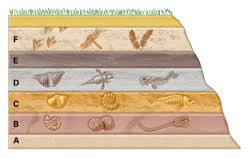
Which rock layer contains the newest fossils?

a)
F
b)
E
c)
B
d)
C
26.

Images of the embryo and adult stages of three different organisms are shown.


Which of the following is the best conclusion that can be drawn from this evidence?

a)

Having similar embryos indicates that these organisms eat the same types of food.

b)

Having similar embryos indicates that these organisms live in a similar environment.

c)

Having similar embryos indicates that these organisms share a recent common ancestor.

d)

Having similar embryos indicates that a certain protein controls how many legs the adult organisms will have.

27.
All the individuals of a species that live in a particular area are called a
a)
variation
b)
population
c)
fossil
d)
group
28.
A remnant or trace of an organism from the past is called a _______.
a)
Ancestor
b)
Skeleton
c)
Fossil
d)
Imprints
29.
The ability of an organism to survive and reproduce in its specific environment 
a)
diversity.
b)
evolution
c)
adaptation
d)
 fitness
30.

Occurs when a catastrophic event changes the environment suddenly.

a)

Gradual extinction

b)

Mass extinction

31.

A number of different species arise from one common ancestor.

a)

Adaptive Radiation (aka, Divergent Evolution)

b)

Gradualism

c)

Coevolution

d)

Speciation

32.

Speciation is the outcome of:

a)

Population growth

b)

Reproductive isolation

c)

Extinction

d)

Sexual reproduction

33.

Leopard frogs and wood frogs reach sexual maturity at different times in the spring and hence cannot interbreed. This is an example of:

a)

Behavioural isolation

b)

Geographic isolation

c)

Gene pool isolation

d)

Temporal isolation

34.

Males of different species of the fruit fly Bactrocera that live in the same parts of the Fijian Islands have different elaborate courtship rituals. These rituals involve fighting other males. What does this represent?

a)

Habitat isolation

b)

Temporal isolation

c)

Behavioral isolation

d)

Gametic isolation

35.

the total genetic information available in a population

a)

population genetics

b)

microevolution

c)

gene pool

d)

allele frequency

36.

determined by dividing the number of a certain allele by the total number of alleles of all types in the population

a)

population genetics

b)

microevolution

c)

gene pool

d)

allele frequency

37.

The emergence of new rivers or streams is a type of ____________ isolation.

a)

Temporal

b)

Mechanical

c)

Behavioral

d)

Geographic

38.
Happens only in small populations, and is the change in the frequency of a gene variant (allele) in a population due to random sampling of organisms.
a)
Extinction
b)
Genetic Drift
c)
Bottleneck Effect
d)
Founder Effect
39.
What does the picture represent?
a)
Founder Effect
b)
Mutations
c)
Bottleneck effect
d)
Gene Flow
40.
What does the image represent?
a)
Founder effect
b)
Bottleneck effect
c)
Mutation
d)
Natural Selection
41.

Fossil records show that black bears increased in size during the Ice Age and decreased in size with warmer temperatures. What type of selection do these changes in size represent?

a)

Allopatric

b)

Directional

c)

Disruptive

d)

Stabilizing

42.

Babies birth weight is an example of

a)

Disruptive selection

b)

Adaptive radiation

c)

Stabilizing selection

d)

Directional selection

43.

Allele frequencies in a gene pool do not change, this is

a)

random change

b)

random genetic make up

c)

genetic equilibrium

d)

punctuated equilibrium

44.

When a species environment favors one dominant type of characteristic to the point that the other variations of the trait start to disappear is called _____.

a)

disruptive selection

b)

directional selection

c)

stabilizing selection

d)

unstabilizing selection

45.

The proliferation of black or white moths instead of grey moths in regions is an example of:

a)

Disruptive selection

b)

Directional selection

c)

Stabilising selection

d)

Geographical selection

46.
What type of inheritance is determined by multiple genes located at different loci on different chromosomes and there can be a range of traits?
a)
Codominance
b)
Incomplete dominance
c)
Polygenic traits
47.

Blood type is an example of a trait that is controlled by

a)

a single gene with 2 alleles

b)

a single gene with multiple alleles

c)

many genes working together

d)

sex-linked gene

48.

The picture shows a male and female pheasant. What type of selection occurred for them to have these adaptations?

a)

Natural Selection

b)

Evolution

c)

Sexual Selection

d)

Random Selection

49.
The graph shows how a finch population changed during the past 50 years. What can you infer based on the graph? 
a)
Thin-beaked finches prey on wide-beaked finches.
b)
Wide-beaked finches are better suited for life in an ocean environment.
c)
Thin-beaked finches are better suited to the environment in Burke Lake.
d)
Wide-beaked finches are better suited to the environment in Burke Lake. 
50.
Why are advantageous traits more likely to be passed on to the offspring?
a)
Because parents with those traits can teach their offspring
b)
Because parents with those traits can surive and reproduce better
c)
Because parents with those traits care more about their offspring
51.

The picture shows a male and female pheasant. What type of selection occurred for them to have these adaptations?

a)

Natural Selection

b)

Evolution

c)

Sexual Selection

d)

Random Selection

52.

Binomial nomenclature means

a)

Latin naming system

b)

Two name naming system

c)

Special names naming system

53.

The first word in the scientific name of an organism is its'

a)

Genus

b)

species

c)

Family

d)

Order

54.

What is Binomial Nomenclature

a)

The Genus and Species names

b)

Family and Kingdom

c)

Domain and Kingdom

d)

Kingdom and Order

55.
a scientist who studies fossils
a)
geologist
b)
biologist
c)
paleontologist
d)
chemist
56.

Length of time for half the atoms of an isotope to decay

a)

Isotope

b)

Half-Life

c)

Radiometric Dating

d)

Absolute Dating

57.

Scientists use radiometric dating (radioactive decay) to measure...

a)

relative time (dating)

b)

absolute time (dating)

c)

half-lives

d)

time of day

58.
By saying: "I am older than my sister," is an example of which type of dating used in Geology:
a)
Relative Age/Dating
b)
Absolute Age/Dating
c)
Chronological Sibling Timelies
d)
Fossil Age/Dating
59.

This is the extinction of a species one by one, not a sudden loss of many species

a)

background extinction

b)

mass extinction

c)

fragmentation

d)

biotic potential

60.
a)
A=convergent B=divergent C=adaptive radiation
b)
A=adaptive radiation B=convergent C=divergent
c)
A=divergent B=convergent C=adaptive radiation
d)
A=divergent B=adaptive radiation C=convergent
61.

The second broadest category of geologic time is______________?. The Cenozoic is one of them.

a)

era

b)

eon

c)

epoch

d)

period

62.
The geologic time scale is a record of....
a)
the history of fossils only
b)
the history of rocks
c)
the history of rock layers and fossils
d)
geologist notes
63.

The Endosymbiotic Theory explains

a)

the origin of prokaryotes

b)

how bacteria lives

c)

the origin of eukaryotes

d)

how species develop

64.

The science of classification is known as ________.

a)

taxidermy

b)

taxonomy

c)

organization

d)

dichotomy

65.

This principle states that allele frequencies in a population should remain constant unless one or more factors cause those frequencies to change.

(a)  

66.

a group of closely related species; the first part of the scientific name in Binomial nomenclature.

(a)