
 Worksheets
Quizizz Review Transcription and Translation
Total questions: 63
Worksheet time: 1hrs 6mins
How does the process of DNA replication impact mutations in an individual?
All DNA replication stops when there is a mutation, so the mutation won't hurt the
individual.
Replication only produces new DNA strands, so the old stand with the mutation is
destroyed.
Since replication keeps the old strands as templates, mutations may be carried into future
strands.
Mutations are often lost since the cell will die during the replication process if the DNA is
mutated.

Which step is incorrect?
Step 1 is incorrect because DNA doesn’t unwind in the nucleus, instead it unwinds in the
cytoplasm.
Step 2 is incorrect because the complementary base pairs are used as a template and not
deleted.
Step 3 is incorrect because the DNA remains unwound to be transcribed into RNA.
Step 4 is incorrect because the resulting DNA molecules are not identical.

What is the most likely effect this could have on genetic information going forward?
There will be no change in the genetic information that gets transmitted because the
complementary strand will never be used as a template.
There will not be a change in the genetic information that gets transmitted because the
cells having the new section of DNA will correct any mutations.
There will be a change in the genetic information that gets transmitted due to the
complementary strand being used as a template in future DNA replication.
There will be a change in the genetic information that gets transmitted because the
sections of DNA with mistakes will be passed on to make future generations stronger.
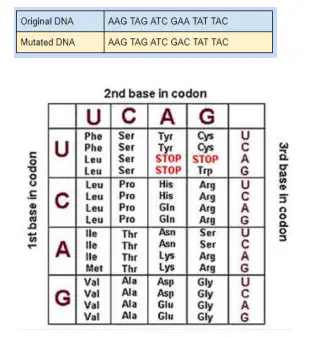
An original DNA sequence retrieved from the gametes of a female Golden Retriever and
a mutated DNA sequence from her puppy are found. How will this mutation affect the offspring of this puppy?
The mutation will cause a genotypic change in this puppy, but its offspring will not inherit
this mutation.
The mutation will not cause a genotypic change in the puppy and its offspring, but will
cause a phenotypic change.
The mutation will cause a genotypic and phenotypic change in the puppy, but the
offspring are not affected by this mutation.
The mutation will cause a genotypic change in the puppy, but will not cause a phenotypic
change in the puppy and its offspring.
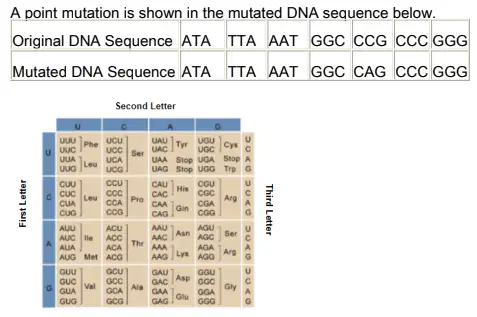
Will this mutation affect the protein resulting from this gene sequence?
Yes, because an amino acid change has occurred.
Yes, because all mutations change the resulting protein.
No, because the amino acid sequence has not been changed.
No, because mutations in the DNA do not affect the mRNA sequence.
Which of the following conclusions can be made about the potential effect of genetic mutations
on physical characteristics?
If a genetic mutation occurs, then it will cause a physical change in a person.
If a genetic mutation occurs, then it will not cause a physical change in a person.
If the genetic mutation causes a change to the protein sequence, then a person’s physical
traits will be affected.
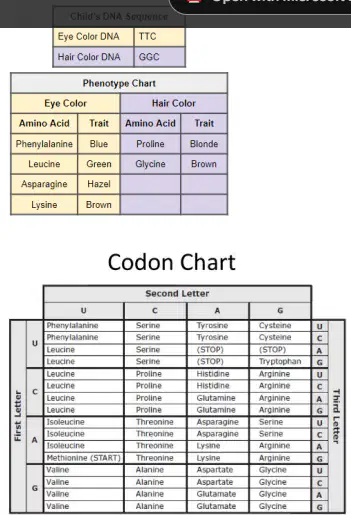
A couple would like to know the eye and hair color of their child when it is born. They go to a
geneticist to determine what phenotype is coded in their DNA. The DNA sequences for the
child's eye and hair color, phenotype chart, and a codon chart are shown. What would the geneticist tell the parents about the appearance of their child?
Their child will have blue eyes and brown hair.
Their child will have green eyes and brown hair.
Their child will have hazel eyes and blonde hair.
Their child will have brown eyes and blonde hair.
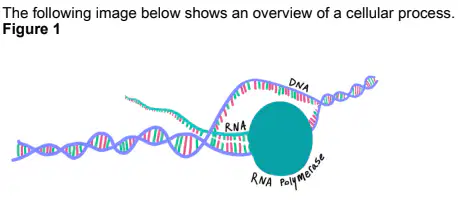
Which statement explains the result of the process shown in Figure 1?
This process generates RNA that can then be translated into proteins that express
specific genes.
This process creates mutations in a cell's DNA sequence that leads to an increased
variation in the gene pool.
This process uses RNA as a template to assemble different proteins for gene expression
for traits for cellular functions.
This process leads to DNA nucleotides being matched with their complementary DNA
base pairs to conserve genetic information.
DNA evidence is used by scientists to support the theory of evolution. In this theory, all
organisms originate from one common ancestor and developed into the different species that
we see today. Which statement best explains why DNA evidences can support the theory of
evolution?
All living organisms share an identical genetic sequence.
All living organisms hold their genetic information in a nucleus.
All living organisms have genetic similarities due to similar habitats.
All living organisms share the same components in their genetic information.
Due to limited availability of human tissue donors, doctors are trying to find new ways to use
animal tissues, such as pigs, to treat their patients. What is the best explanation of why animal
tissues could successfully be used to treat humans?
The organisms contain identical DNA sequences.
There is an increase in genetic mutations in organisms.
The organisms contain similarities in their genetic sequence.
There is an increase in genetic variation between organisms.
Why can the codo chart be used for all organisms?
All organisms are genetically different.
All organisms have homologous structures.
All organisms share a common genetic code.
All organisms come from a different ancestor.
Recently, scientists have been able to create a complete sequence of mammoth DNA from
frozen samples found in Siberia. This discovery will allow scientists to clone a mammoth by
inserting the mammoth DNA into an cell that does not contain genetic material, which will then
develop inside a female Asian elephant. The Asian elephant is a relative of the mammoth and
has been on the endangered species list since 1986. What would be an ethical concern
associated with using an endangered Asian elephant to grow the embryo containing the cloned
mammoth DNA?
Changing the DNA of the embryo would cause the mother elephant to mutate, as well
causing it harm.
Using an endangered elephant for study could further reduce the ability of the elephants'
population to recover.
Introducing a new mammoth species would decrease biodiversity for the already declining
elephant population.
The cloned DNA of the mammoth could mix with the DNA of the scientists working on the
project, making a new species.
Gene therapy is a field of medical research that develops treatments that modifies a person's
genes to help treat disease, replace genes that are missing, or turn off genes that are causing
problems. This therapy has the potential to prevent, treat, and cure certain inherited disorders,
such as cystic fibrosis, hemophilia, sickle cell disease, or cancers. What is an ethical issue that
could arise from gene therapy?
Gene therapy will cure all diseases which could increase life span.
Gene therapy will lead to a decrease in the need for medical professionals.
Gene therapy will eliminate the nucleus found within the cells of the human body.
Gene therapy will allow parents to choose the ideal traits they want in their babies.
ATG TGA CAG

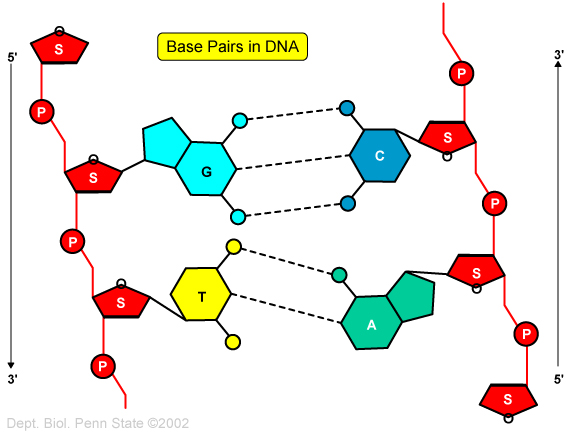

AATCATGGA


Which process is used to make mRNA from the DNA in the nucleus?
transcription
translation
replication
Where does transcription take place in EUKARYOTIC cells?
nucleus
cytoplasm
ribosome
ATG GGA ACT CCA

Transcribe the following DNA sequence into RNA:
AAT TAG GGC TCG
AAT TAG GGC TCG
TTA ATC CCG AGC
UUA AUC CCG AGC
TTU UTC CCG UGC
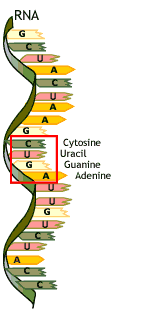
Where does transcription take place in PROKARYOTIC cells?
nucleus
cytoplasm
ribosome
After transcription mRNA goes from the nucleus to the _________.
Ribosome
Mitochondria
Endoplasmic Reticulum
Vacuoles
If the mRNA codon is AUG, what would the matching tRNA anticodon be?
UAC
AUG
TAC
GUA


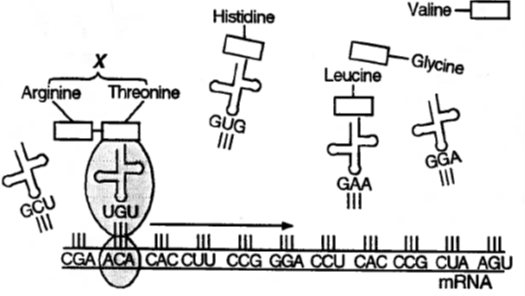

What is the order for Protein Synthesis?
Transcription -> Translation -> Protein
Translation - > Transcription -> Protein
Protein -> Transcription -> Translation
Translation -> Protein -> Transcription
An mRNA molecule is produced in which step of protein synthesis:
replication
transcription
duplication
translation
. What are the building blocks of proteins called?
nucleotides
proteins
amino acids
carbohydrates

AUG-CCA-GUA-GGG-UAA
A point mutation is usually what type of mutation
Frameshift
Insertion
Deletion
Substitution
A frameshift mutation is which of the following?
Point mutation
Insertion
Deletion
Subtitution
Which mutation would be more harmful for an organism?
Point mutation (substitution)
Frameshift (insertion/Deletion)
Why would a frameshift be more harmful?
It changes all the code downstream
Only one nucleotide is changing
All mutations are harmful
It can't correct iself
What mutation has occurred here?
T-G-A-C-C-A
T-G-A-G-C-A
Substitution
Deletion
Insertion
Frameshift
Which of the following would result in a frameshift mutation?
Insertions only
Substitution only
Deletion only
Insertions and Deletions
DNA molecule segment is : TTACGCAAG
The mutated DNA segment is TTCGCAAG. This is an example of ___ mutation.
Substitution
Deletion
Insertion
Inversion
A mutation is defined as:
A change in the cell's structure
Anything that changes in an embryo
Any change in the physical features of a human
A change in the DNA sequence
ATTTGAGCC- Original
ATTGAGCC - Mutated
The example above is an example of a
Insertion- Frameshift
Deletion- Substitution
Deletion -Frameshift
All of the above
What mutation has occurred here?
T-G-A-C-C-A
T-G-A-G-C-A
Substitution
Deletion
Insertion
Frameshift
Why are insertion and deletion (frameshift) mutations so harmful?
They change all of the codons from the mutation on down the line, which changes the amino acid sequence
They insert things that an organism doesn't need.
They often delete things that organisms need.
Insertion and deletions are not any more harmful than substitution mutations.

Which mutation will cause translation to stop?
Mutations 1 and 3 only
Mutation 1 only
Mutation 2 only
Muations 1, 2, 3

Which type of mutation does the model demonstrate?
Deletion
Substitution
Insertion
Translocation

