
Font size
 Worksheets
Final Quizziz 2023
Total questions: 83
Worksheet time: 1hrs 27mins

Which letter represents the most recent common ancestor of sponges and mushrooms?
A
B
C
D
E

Which trait(s) do conifers have?
vascular tissue only
vascular tissue and seeds
vascular tissue, seeds and flowers
seeds only

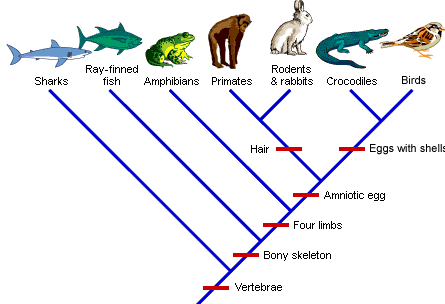
According to the cladogram, which organism is most distantly related to the chimpanzee?
salmon
salamander
lizard
hamster

Which trait should go where A is on the cladogram?
eyes
feet
lips
hat
Which Hardy-Weinberg factor represents the frequency of heterozygous individuals in a population?
p2
2pq
q2
p2 + 2pq
Which of the following is an example of natural selection?
Bald Eagles are hunted until near extinction, population recovers.
Small group of iguanas floats to an island, starts a new population.
Red fox pups are more likely to survive in a snowy environment if they are born white.
Farmer chooses seeds from largest apples to plant next year. This results in larger apples from year to year.
Group of organisms all of the same species, living in the same place at the same time.
gene pool
population
species
evolution
founder effect
bottleneck
genetic drift
photosynthesis
A balanced polymorphism exist through disruptive selection in seed cracker finches from Cameroon in which small and large billed birds specialized in cracking soft and hard seeds, respectively. If long term climatic change resulted in all seeds becoming hard, what type of selection would then operate on the finch population?
Sexual selection
Stabilizing selection
Directional selection
Disruptive selection
Choose the correct order of lytic cycle steps
attachment, injection, assembly, synthesis, lysis
attachment, injection, synthesis, assembly, lysis
attachment, injection, assembly, lysis, synthesis
attachment, lysis, assembly, synthesis, injection
Viruses are non-living because
they cannot reproduce on their own
they do not evolve
they have no DNA
they cannot be destroyed
mRNA vaccines work by
introducing inactivated virus into the body to start an immune response.
having your own cells make a protein from the virus' material so your immune cells will recognize the virus.
changing the DNA of your cells to protect you from infection from the virus.
using a carrier virus to start an immune response.
Vaccines can be used to prevent viral infection by:
creating an immune response in the host
destroying any viruses that enter the host
creating a blocking protein on the cell
preventing replication of the virus
ATG TGA CAG

The picture below shows an enzyme unwinding and unzipping DNA.
What is the name of this enzyme?
DNA Helicase
DNA Ligase
DNA polyermase
RNA Polymerase
Which enzyme is responsible for adding the free nucleotides to the replicating DNA?
DNA Helicase
DNA Ligase
DNA polyermase
RNA Polymerase

Which letter in the picture below depicts the lagging strand in DNA replication?
A
C
B
None of the above
GTAGTCA
The DNA sequence ATCAGCGCTGGC is part of a gene. How many amino acids are coded for by this message?
4
8
12
20

A polypeptide is a sequence of ____________________ held together by a ______________ bond.
amino acids; peptide
fatty acids; ionic
proteins; hydrogen
fatty acids; covalent

TRANSLATE this RNA sequence: AUGCAAUGA
Met-Glu-Stop
Met-His-Stop
Thr-Glu-Stop
Thr-Pro-Stop
A _______ is an alternative form a gene.
chromosome
sister chromatid
allele
telomere
a trait that is masked unless 2 copies are present is ________________________
recessive
dominant
weak
hidden
alleles for a trait that are the different
Homozygous
Heterozygous
Quasizygous
Juxtazygous
What genotype is homozygous dominant?
RR
Rr
rr
What genotype is heterozygous?
RR
Rr
rr

(E= 3 eyes, e= 1 eye)

The diagram shows the sex chromosomes of a woman and of a man. Their genotypes for a recessive sex-linked condition are also shown.
What are the chances that their daughter will show the sex-linked condition?
0%
25%
50%
75%

A black male and white female produced this grey offspring:
Incomplete dominance
Codominance
Complete dominance


What percentage of the offspring would be BLUE (g)?
25%
50%
75%
100%

What goes in box 3
Aabb
AABB
AAbb
aaBb

A white mouse with red eyes is crossed with a black mouse with brown eyes. The white mouse is recessive for both of its traits. The black mouse is dominant for both of its traits.
This cross would be
BBEE x bbee
BBEe x BbEe
BbEE x BbEe
BBee x BBEE
In a cladogram, what occurs at a node?
A derived trait appears.
Evolution is stopped.
An ancestor dies.
The cladogram ends.
When nature provides genetic variation, but humans select the variations which they find useful.
natural selection
artificial selection
stabilizing selection
directional selection
Similarities in arrangement (developed the same and look alike, but different functions).
homologous structures
analogous structures
vestigial structures
embryology
Similarities in the earliest stages of growth and development.
homologous structures
analogous structures
vestigial structures
embryology
Body structures that have no present-day function.
homologous structures
analogous structures
vestigial structures
embryology

Look at the image. Which phase of Mitosis do you see?
Prophase
Metaphase
Anaphase
Telophase

Look at the image. Which phase of Mitosis do you see?
Prophase
Metaphase
Anaphase
Telophase
What is the purpose of Mitosis?
Growth of an organism and Repair of damaged tissue
To help the body get rid of extra cells
To increase the amount of classwork you have to do
To get rid of the nucleus
How many cells are produced at the end of meiosis?
1
2
3
4
Humans have a diploid number of 46 chromosomes in our body cells. How many chromosomes will our gametes have if they are considered HAPLOID?
46
23
92
10

CROSSING OVER TAKES PLACE DURING
PROPHASE II
PROPHASE I
INTERPHASE
METAPHASE I


Which of the following is the best definition for MEIOSIS?
the process of two haploid cells uniting
the counting of chromosomes within a diploid cell
a two-step process that reduces the number of chromosomes in half such that there is only one copy of all the chromosomes
the equational division of a cell into two identical copies
What are the 2 products of photosynthesis? The products are the things made in the process of photosynthesis.
water, sunlight
glucose, carbon dioxide
oxygen, glucose
sunlight, oxygen


What is the correct equation for cellular respiration?
6O2 + C6H12O6 -> 6CO2 + 6H2O + Energy
6O2 + C6H12O6 + Energy -> 6CO2 + 6H2O
6CO2 + 6H2O -> 6O2 + C6H12O6 + Energy
6CO2 + 6H2O + Energy -> 6O2 + C6H12O6
Explain the how the process of photosynthesis and cellular respiration cycle matter
The outputs of photosynthesis are the inputs for cellular respiration
The inputs of photosynthesis are the inputs of cellular respiration
The inputs of cellular respiration are the inputs of photosynthesis
The outputs of cellular respiration are the outputs of photosynthesis
What are the net outputs of glycolysis?
2 ATP, 2 pyruvate, 2 NADH
3 ATP, 3 pyruvate, 2 NADH
2 ATP, 8 pyruvate, 1 NADH, 1 FADH2
4 ATP, 1 pyruvate, 3 NADH


Selection that favors individuals with both extremes of trait.
disruptive selection
artificial selection
stabilizing selection
directional selection
During the process of natural selection, what determines which organism survives and reproduces?
number of adaptations
variety of adaptations
evolutionary fitness
population size

Charles Darwin's ideas concerning the causes of evolution were probably formulated in his mind:
while he was still a student at Cambridge University
before he began his voyage of exploration around the world on H.M.S. Beagle
during his voyage on H.M.S. Beagle, especially after he reached the Galápagos Islands
during the late 1880's

