Wayground logo

Free Printable Worksheets

Font size

S
M
L
XL
Worksheets

Science 10 Biology

Total questions: 74

Worksheet time: 19hrs 30mins

Name
Class
Date
1.

A system that exchanges neither matter, nor energy.

a)

Open

b)

Closed

c)

Isolated

2.

A system that exchanges only energy.

a)

Open

b)

Closed

c)

Isolated

3.

A system that exchanges both matter and energy.

a)

Open

b)

Closed

c)

Isolated

4.

Which of the following is increased by staining a specimen?

a)

Contrast

b)

Resolution

c)

Magnification

d)

Clarity

5.
molecule in which opposite ends have opposite electric charges
a)
cohesion
b)
polar molecule
c)
hydrogen bond
d)
solution
6.
What word describes when water is attracted to other substances?
a)
cohesion
b)
adhesion
c)
capillary action
d)
surface tension
7.

Describe COHESION.

a)

Water molecules attracted to other substances.

b)

Water molecules climbing upwards against the force of gravity.

c)

Water molecules dissolving many substances because of its polarity.

d)

Water molecules attracted to other water molecules.
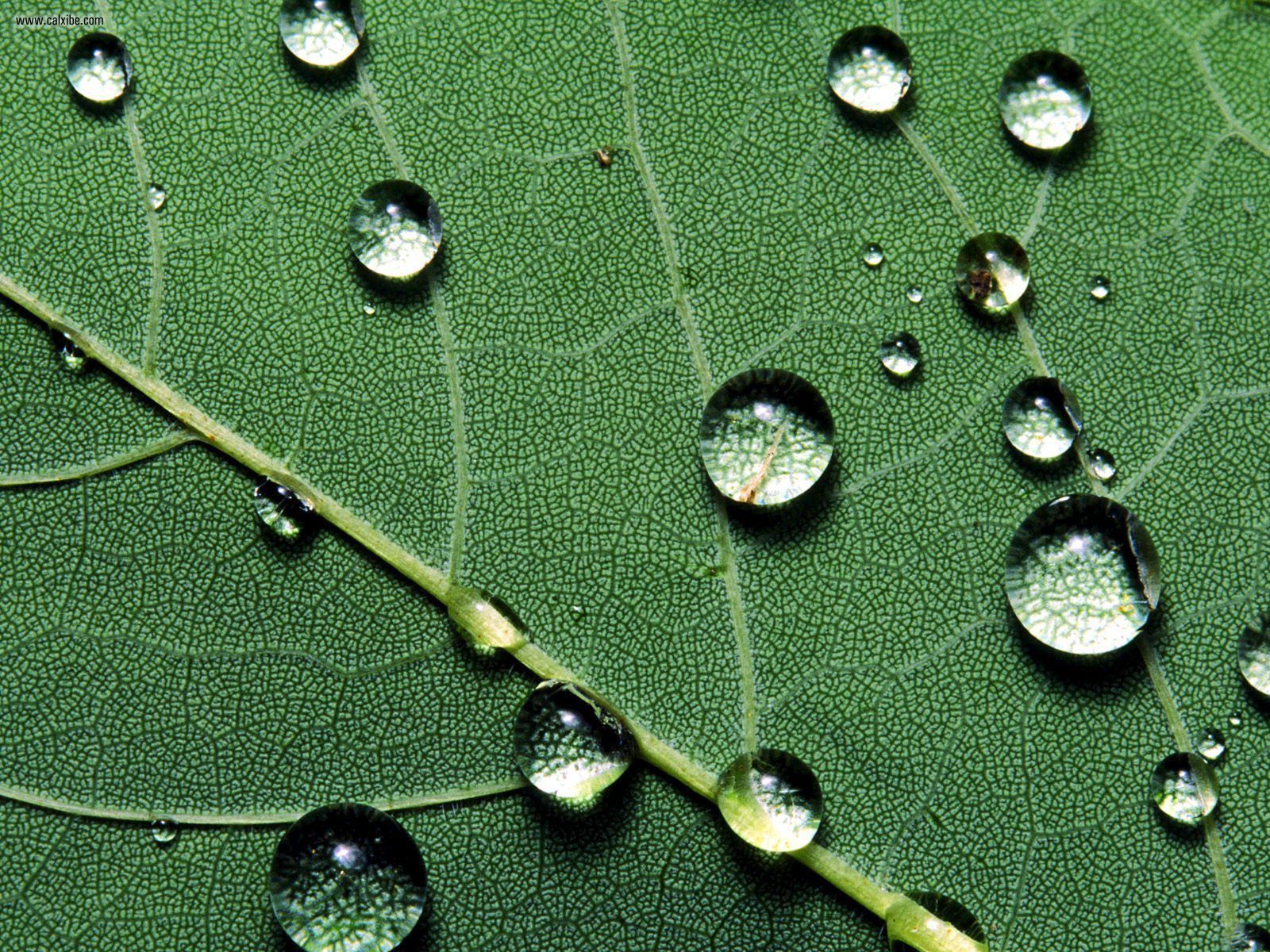
8.

Refer to the picture of water sticking to a leaf; this is occurring because of:

a)

Adhesion

b)

Cohesion

9.
When the plant responds to light, it is known as:
a)
Phototropism
b)
Geotropism
c)
Thigmotropism
d)
Hydrotropism
10.
The root of a plant growing down. 
a)
Positive Geotropism 
b)
Negative Geotropism 
c)
Thigmotropism
d)
Hydrotropism
11.
A plant growing in response to the sunlight. 
a)
Geotropism 
b)
Phototropism
c)
Thigmotropism
d)
Hydrotropism
12.
What happens to the transpiration rate as light intensity increases?
a)
It increases
b)
It stays the same
c)
It decreases
13.
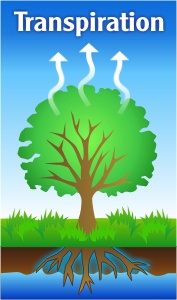
Transpiration is
a)
the movement of water through a plant from the roots up the stem
b)
the loss of water from the leaves of a plant by the process of evaporation
c)
the flow of water into plant roots by osmosis from the soil
d)
the process of minerals and sugars moving through plant veins
14.
Water vapour exits a plant leaf by
a)
the stomata
b)
the epidermis
c)
the palisade cells
d)
the spongy mesophyll
15.
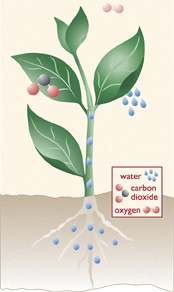
How do water enter the roots from the soil?
a)
diffusion
b)
osmosis
c)
transpiration
d)
active transport
16.
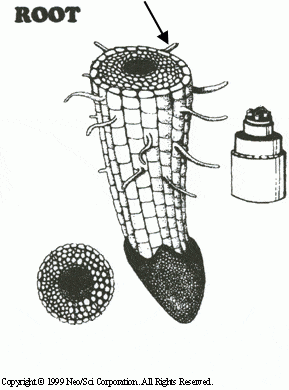
what is the function of root hair?
a)
it is place to store the food
b)
it has large surface area to absorb more water
17.
What is the name of the part of the root that allows water and minerals enter?
a)
root hairs
b)
epidermis
c)
phloem
d)
phyla
18.
Plant absorbs water through the _________. 
a)
stem
b)
roots 
c)
leaves 
d)
all of the above
19.
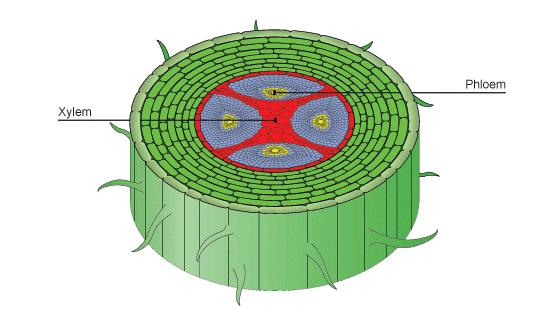
Vascular tissue that transports water and minerals UPWARDS from a plant's roots is know as ______.
a)
Chlorophyll
b)
Phloem
c)
Stomata
d)
Xylem
20.
The plant tissue that carries food materials DOWNWARD from the leaves to the rest of the pant is the ______.
a)
Phloem
b)
Stomata
c)
Chlorophyll
d)
Xylem
21.
____________________ provides the energy necessary for photosynthesis.
a)
water
b)
sunlight
c)
glucose
d)
soil
22.

Which of the following are reactants of photosynthesis?

a)

CO2 and H2O

b)

O2

c)

H2O and Glucose

d)

None of the above

23.

What are the end products of photosynthesis?

a)

Carbon Dioxide and Water

b)

Glucose and Carbon Dioxide

c)

Oxygen and Glucose

d)

Water and Glucose

24.

In which organelle does photosynthesis occur?

a)

Cell Wall

b)

Chlorophyll

c)

Chloroplast

d)

Cytoplasm

25.
Which of the following is not a reactant in photosynthesis
a)
H2O
b)
Light Energy
c)
CO2
d)
O2
26.
Which structures open and close stomata to allow gas exchange but prevent water loss in leaves?
a)
Epidermis
b)
Vascular tissue
c)
Guard cells
d)
Spongy mesophyll
27.
The important gases, carbon dioxide and oxygen, enter and leave the leaf through the
a)
upper epidermis
b)
phloem
c)
stomata
d)
guard cells
28.

#9 - Cell tissue that makes up part of each vein that transports water throughout the plant

a)

Epidermal cells

b)

Guard cells

c)

Phloem cells

d)

Xylem cells

29.

#8 - Cell tissue that makes up part of each vein that transports glucose and nutrients throughout the plant

a)

Epidermal cells

b)

Guard cells

c)

Phloem cells

d)

Xylem cells

30.

#6 - porous opening in the bottom of the leaf that allows for gaseous exchange

a)

Pallisade mesophyll

b)

Spongy mesophyll

c)

Stomata

d)

Vein

31.

#4 - layer of irregular cells with space in between the cells

a)

Pallisade mesophyll

b)

Phloem

c)

Spongy mesophyll

d)

Xylem

32.

#3 - layer of tall, columnar cells that contain many chloroplast for photosynthesis

a)

Epidermal cells

b)

Guard cells

c)

Pallisade mesophyll

d)

Spongy mesophyll

33.

#2 & #5 - outermost layer of cells; provides protection from outside elements.

a)

Epidermal cells

b)

Palisade cells

c)

Phloem cells

d)

Waxy cuticle

34.
Tissue in a plant that is neither vascular nor dermal is
a)
Vascular tissue
b)
Ground tissue
c)
Filler tissue
d)
Dermal tissue
35.
What is a tissue
a)
A group of cells that share a common goal
b)
a tissue that has a function
c)
A group of cells that share a common function, structure or both
d)
A group of cells
36.

A tissue whose cells are capable of dividing and re-dividing is called

a)

complex tissue

b)

permanent tissue

c)

connective tissue

d)

meristematic tissue

37.

Xylem and phloem are examples of

a)

epidermal tissue

b)

connective tissue

c)

protective tissue

d)

vascular tissue

38.

Sieve tubes and companion cells are present in

a)

xylem

b)

phloem

c)

cambium

d)

cork

39.

Other than transporting water, what is a function of xylem?

a)

making food

b)

transporting food

c)

helping support the plant

d)

catching light

40.

Specific type of plant tissue that transports food (sugar) made in the leaves to the entire plant

a)

vascular plant

b)

nonvascular plant

c)

xylem

d)

phloem

41.

Specific type of plant tissue that transports water and minerals from the roots, through the stems, to leaves

a)

vascular plant

b)

nonvascular plant

c)

xylem

d)

phloem

42.
Fungi, Plants, and Animals
a)
Unicellular organisms 
b)
Multicellular organisms
43.
How are single-celled organisms and multi-celled organisms similar?
a)
Both need food for energy and growth.
b)
Both have a skeletal system for support.
c)
Both require the interaction of many cells to survive.
d)
Both are able to carry out all life functions in only one cell.
44.

When a plant starts to grow towards the bright sunlight that is shining through the side of a window, which characteristic of life is being shown?

a)

ability to reproduce

b)

adapt to environment

c)

organization

d)

none of the above

45.
Which is an example of a single-celled organism?
a)
bird
b)
cricket
c)
snake
d)
bacteria
46.
Endocytosis is defined as
a)
the movement of large molecules from the inside of the cell to the outisde of the cell using channel proteins. 
b)
the movement of large molecules from the inside of the cell to the outisde of the cell membrane vesciles. 
c)
 the movement of large molecules from the outside of the cell to the inside of the cell using membrane vesciles.
d)
the movement of large molecules from the outside of the cell to the inside of the cell using channel proteins. 
47.
This picture represents which type of cellular transport?
a)
passive transport
b)
endocytosis
c)
exocytosis
d)
osmosis
48.
This picture represents what type of cell transport?
a)
endocytosis
b)
exocytosis
c)
osmosis
d)
passive transport
49.

What is the name of 'D' found on the structure below

a)

Lipid hydrophobic tails

b)

Protein

c)

Lipid bi layer

d)

Phosphate hydrophilic heads

50.

Identify the following structure

a)

Phospholipid

b)

Cell

c)

Cell membrane

d)

Protein

51.
In this image, the cell is using which type of molecular transport?
a)
Osmosis
b)
Diffusion 
c)
Endocytosis
d)
Exocytosis 
52.
The diffusion of WATER across a semi-permeable membrane is
a)
osmosis
b)
diffusion
c)
endocytosis
d)
exocytosis
53.

Against the concentration gradient

low to high uses energy/ATP

a)

facilitated diffusion

b)

osmosis

c)

active transport

d)

simple diffusion

54.
_______ regulates what enters and leaves a cell.  
a)
Cell Membrane
b)
Nucleus
c)
Mitochondria
d)
Cytoplasm
55.
Active transport requires energy because...
a)
The cell is moving something against a concentration gradient
b)
The cell is moving something with a concentration gradient
56.
In which case would a cell most likely shrink?
a)
when placed in a solution containing a high salt concentration
b)
when placed in a isotonic solution
c)
when placed in a solution containing a low pH
d)
when placed in a solution containing distilled water
57.
What type of cellular transport uses energy?
a)
Passive Transport
b)
Active Transport
58.

What is the "big idea" of the Fluid Mosaic Model of plasma membranes?

a)

the plasma membrane creates a specialized FLUID that looks like a MOSAIC.

b)

the plasma membrane is a MOSAIC.

c)

the fluid mosaic model is NOT related to the plasma membrane.

d)

a plasma membrane is a MOSAIC of components that move FREELY and FLUIDLY.

59.

Which of the following organelles is found only in a plant cell?

a)

mitochondria

b)

chloroplast

c)

centrioles

d)

vacuole

60.

Which 2 organelles are involved in the making of a protein?

a)

Ribosome

b)

Lysosome

c)

Rough Endoplasmic Reticulum

d)

Smooth Endoplasmic Reticulum

61.

What organelle does this image represent?

a)

Golgi Apparatus

b)

Ribosome

c)

Mitochondria

d)

Chloroplast

62.

Which organelle is this?

a)

Golgi Apparatus

b)

Mitochondria

c)

Nucleus

d)

Chloroplast

63.

This structure provides protection to plant cells and is made of cellulose.

a)

chloroplast

b)

cell membrane

c)

cell wall

d)

cytoplasm

64.

Ribosomes are produced here

a)

nucleus

b)

nuclear membrane

c)

nucleolus

d)

chromosomes

65.

Which of the images below represents a chloroplast?

a)
b)
c)
d)
66.

In _______ cells, the vacuole is large and located in the center of the cell.

a)

plant

b)

animal

c)

both plant and animal

d)

all

67.

What is the function of this organelle?

a)

modify and build proteins

b)

break down proteins

c)

make lipids for the membrane

d)

store extra material, like water and food

68.

This organelle makes useable energy for the cell

a)

chloroplast

b)

mitochondria

c)

ribosome

d)

nucleolus

69.

Proteins are produced at this organelle.

a)

golgi body

b)

ribosome

c)

cytoskeleton

d)

cilia

70.

What function does this organelle carry out in the cell?

a)

detoxification

b)

packaging materials for release from the cell

c)

breaking down old cellular components

d)

storing genetic material

71.

Which organelle contains DNA and controls the cell?

a)

Cell membrane

b)

nucleus

c)

nucleolus

d)

lysosme

72.

The jelly-like material inside the cell

a)

ribosomes

b)

lysosome

c)

granum

d)

cytoplasm

73.

What organelle is represented by this image?

a)

rough endoplasmic reticulum

b)

smooth endoplasmic reticulum

c)

ribosome

d)

nucleus

74.

This organelle digests dead cell parts and contains enzymes

a)

lysosome

b)

golgi body

c)

smooth ER

d)

Rough ER