wayground logo

Free Printable Worksheets

Font size

S
M
L
XL
Worksheets

Science 8 Final Review

Total questions: 100

Worksheet time: 2hrs 39mins

Name
Class
Date
1.
What is this tool called and what does it measure?
a)
Beaker, volume
b)
Flask, mass
c)
Graduated Cylinder, volume
d)
Measuring Cup, mass
2.
The base unit for mass is the
a)
meter
b)
gram
c)
milliliter
d)
liter
3.
Sabrina wants to test which brand of popcorn pops the most kernels.  She picked a store brand, Orville Redenbacher, and PopSecret.  All three bags started with the same number of kernels.  She popped each for 3 minutes in the same microwave, and then counted the number of kernels left over.  What is her independent variable?
a)
Number of kernels left over
b)
Brand of popcorn
c)
number of kernels before popping
d)
length of time cooking
4.
Kira wants to test which type of soda creates the biggest foam explosion when adding a Mentos candy.  She chose Sprite, Coke, and Mountain Dew.  One at a time, she added a single Mentos candy and measured the height of the foam eruption.  Mountain Dew created a foam eruption of 7 inches.  Coke and Sprite tied at 5 inches.  What is her dependent variable?
a)
Brand of soda
b)
Number of mentos candies used
c)
Height of foam eruption
d)
Temperature of soda
5.
What is a dependent variable?
a)
the variable that causes the change
b)
the variable that remains the same
c)
the variable that is changed on purpose
d)
the variable that the scientist measures
6.
What is a control group in an experiment?
a)
a group in an experiment that remains unchanged for purpose of comparison
b)
a group in an experiment that changes to compare the IV and DV variables
c)
the manipulated group
7.
The factor in an experiment that will be changed purposely by the scientist.
a)
dependent variable
b)
independent variable
c)
controlled variable
8.
Which of the following is a quantitative observation?
a)
The bird is very colorful.
b)
The bird has 4 different colors on him.
c)
The bird has many, many feathers.
d)
It is a bird. 
9.
When scientists collect data that is measurable with numbers, we call it...
a)
qualitative data
b)
quantitative data
c)
hypothetical data
d)
graphing data
10.
You want to collect data on the taste of apples to help a farmer grow sweeter apples in his orchard.  You have your assistants describe apples as "sweet" or "tart".   This is called ____ data.
a)
quantitative
b)
qualitative
c)
not scientific
d)
hypothetical
11.
A testable answer to a scientific question
a)
Question
b)
Observation
c)
Hypothesis
d)
Experiment
12.
When experimenting with the growth of a plant, a scientist uses three of the same type of plants, two different fertilizers, equal light, and equal water. What type of variable is the fertilizer?
a)
Dependent
b)
Independent
c)
Control
d)
Compound
13.
Research Question: Does the distance a person kicks a soccer ball effect how well they will do on their math test.  What is the dependent variable?
a)
How far they kick the soccer ball
b)
Who the person is
c)
How well they do on the math test
d)
Type of soccer ball
14.

What two words should be in your hypothesis?

a)

I think

b)

If ...then...

c)

It will

d)

No idea

15.

What is a hypothesis?

a)

the thing changed on purpose in the experiment

b)

an explanation about what you observed

c)

using your 5 senses to gather data

d)

an educated guess about the outcome of an experiment

16.
A series of steps used by scientists to solve a problem or answer a question. 
a)
scientific method
b)
recipe
c)
data collection
d)
metric system
17.

At which position (letter) do you read the volume present in the measuring cylinder?

a)

A

b)

B

c)

C

18.

State the volume of the liquid present in the measuring cylinder.

a)

45 ml

b)

40.3 ml

c)

43 ml

d)

70 ml

19.

State the volume of the liquid present in the measuring cylinder.

a)

80 ml

b)

80.5 ml

c)

85 ml

d)

130 ml

20.

What is the volume of the marble?

a)

20 cm3

b)

17 cm3

c)

5 cm3

d)

3 cm3

21.

What is the volume of the battery?

a)

20 cm3

b)

17 cm3

c)

5 cm3

d)

3 cm3

22.

What is the mass of this object?

a)

615.3 grams

b)

516 grams

c)

165.3 grams

d)

165.3 inches

23.

What is the mass of this object?

a)

421.5 grams

b)

241.5 grams

c)

1.524 grams

d)

421.5 inches

24.
Who was the naturalist that traveled the world to study plants and animals?
a)
Albert Einstein
b)
Charles Darwin
c)
Charles Barkley
d)
Isaac Newton
25.
Darwin wrote that organisms with traits that are best suited to the environment will ________________
a)

survive and pass on their traits to their offspring

b)
become extinct
26.
What characteristic did Darwin observe about the finches on the Galapagos Islands?
a)
Their feathers 
b)
Genotypes 
c)
Their beaks
d)
Their body sizes
27.
Which term refers to the process by which individuals that are better suited to the environment survive and reproduce therefore passing down their genes to their offspring? 
a)
Evolution 
b)
Variation 
c)
Adaptation
d)
Natural Selection 
28.
When an organism completely dies out, it is called.....
a)
Adaption
b)
Extinction
c)
Fossilization
d)
Mutation
29.

The white feathers of a snowy owl allow it to blend in with its environment during the winter months (snow). This is an example of an________________

a)
Species
b)
Environmental Change
c)
Adaptation
d)
Variation
30.
Darwin referred to this as survival of the fittest. Over time, it results in changes in the inherited characteristics of a population because organisms with adaptations that make them fit for their environment will survive and reproduce better than those without favorable traits.
a)
Natural Selection
b)
Genetic Variation
c)
Survival of the Fittest
31.

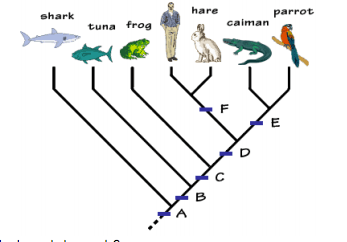
In a phylogenetic tree, the branching points represent common ancestors.

a)

Yes

b)

NO

32.

Which group on the cladogram arose FIRST?

a)

Theropods

b)

Allosaurus

c)

Robin

d)

Velociraptor

33.

On the cladogram, which organism is the closest relative of the parrot?

a)

Frog

b)

Hare

c)

Caiman

d)

Parrot

34.

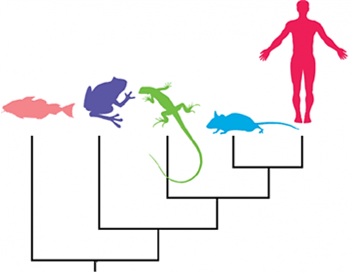
According to this phylogenetic tree, which creature is the least related out of all pictured?

a)

Fish

b)

Frog

c)

Salamander

d)

Human

35.

Why did dark moths have a survival advantage when they were near factories during the Industrial Revolution?

a)

They could hide in the birds shadow.

b)

They could push the white moths into the flames.

c)

They did not have a survival advantage.

d)

They blended in with the dark tree trunks.

36.

What

type

of structure?

a)

Homologous

b)

Analogous

c)

Embryological

d)

Vestigial

37.
Humans, birds, whales, and lizards all have similar arm bones. What is the reason for this?
a)
The function of these bones is the same in all animals
b)
They live in similar environments
c)
They have a common ancestor
d)
All organisms resemble humans
38.

How does embryology support the Theory of Evolution?

a)

It shows that embryos who develop similarly share a common ancestor

b)

It shows that embryos who develop similarly are not related to one another

c)

It shows that organisms have the ability to evolve, or change, over time

39.

According to the images shown, which species are least related?

a)

rabbit and calf

b)

fish and salamander

c)

tortoise and chick

d)

human and fish.

40.

How is comparative embryology used as evidence for evolution?

a)

The similarities in development across organisms show how they are related.

b)

The development of embryos shows evolution occurring in organisms before birth.

c)

The similarities of embryos shows that all organisms used to once look like each other.

d)

Comparative embryology is not used as evidence for evolution.

41.

What is the difference between relative dating and absolute (radioactive) dating?

a)
Relative dating provides the exact age of a rock, while absolute dating provides a rough estimate of the rock’s age
b)
Relative dating can estimate a rock’s age only in relation to other objects or events, while absolute dating can provide an actual age
c)
Relative dating uses several types of radioactive decay to determine an object’s relative age, while absolute dating only uses the halflife of uranium 235
d)
Relative dating and absolute dating can only determine the rock’s age in relation to other objects or events
42.
What is the primary purpose of index fossils?
a)
They help scientists determine the absolute age of sedimentary rocks
b)
The help scientists determine the relative age of rocks
c)
They help scientists indentify mass extinctions in Earth’s history
d)
They provide scientists with evidence for the theory of evolution by natural selection
43.

Which of the following orders the rock layers accurately from oldest to youngest?

a)

1, 2, 3, 4, 5

b)

5, 4, 3, 2, 1

c)

2, 3, 4, 5, 1

d)

1, 2, 3, 5, 4

44.
Which fossil is relatively the oldest?
a)
Trilobite
b)
Ammonite
c)
Crinoid
d)
Gastropod
45.
According to the law of superposition, the oldest fossils are found 
a)
At the top of the rock layers
b)
Near the bottom of the rock layers
c)
In the middle of the rock layers
d)
Somewhat near the surface
46.
Which is another term for selective breeding?
a)
Artificial selection
b)
Natural Selection
c)
Intelligent selection
47.
Evidence shows that the wolf is the ancestor to all of the breeds of dogs shown below. How did this variation arise in a relatively short period of time?
a)
A.  Genetic manipulation
b)
Natural selection
c)
Random chance
d)
Selective breeding
48.

Which is NOT a result of selective breeding?

a)

Large seedless watermelons that consumer demand

b)

Bright oranges that are all about the same size

c)

An insect that matches the color of the environment

d)

A dog that has been bred to have short hair

49.

Which picture shows material that is more dense?

a)

The picture of the left

b)

The picture on the right

50.

When do particles move faster?

a)

In hot water

b)

In cold water

51.

Why does ice float?

a)

Due to convection currents

b)

It is more dense than water.

c)

It is less dense than water.

52.
In convection, COOL air
a)
Rises
b)
Sinks
53.
In convection, WARM air
a)
Rises
b)
Sinks
54.

The container of boiling water has red arrows showing

a)

Conduction

b)

Convection

c)

Radiation

55.

Air moves from an Area of HIGH pressure to an area of LOW pressure

a)

True

b)

False

56.

Near which city is the high pressure system located?

a)

Seattle

b)

Minneapolis

c)

Dallas

d)

Chicago

57.

These symbols represent a/an ________

a)

cold front

b)

warm front

c)

stationary front

d)

occluded front

58.

What type of weather is generally associated with a low pressure system?

a)

fair-weather, beautiful clear skies

b)

Cloudy skies, some moist air, possible precipitation, stormy weather

c)

cloudy skies, dry air

d)

cloudy with a chance of meatballs

59.

What type of weather is associated with a high pressure system?

a)

clear skies & moist air

b)

cloudy skies & dry air

c)

cloudy skies & moist air

d)

clear skies & dry air

60.

Why does city "B" have clear skies?

a)

It is in North America

b)

There is not a front moving through city "B"

c)

Clouds do not form in the West

d)

It is located near a high pressure system

61.

Which of the following best describes weather?

a)

day to day conditions of the atmosphere at a place in regards to heat, dryness, sunshine, wind, rain, etc.

b)

long-term conditions (months/years) of the atmosphere at a place in regards to heat, dryness, sunshine, wind, rain, etc.

62.

Which of the following best describes climate?

a)

day to day conditions of the atmosphere at a place in regards to heat, dryness, sunshine, wind, rain, etc.

b)

long-term conditions (months/years) of the atmosphere at a place in regards to heat, dryness, sunshine, wind, rain, etc.

63.
The high temperature today will be near 75 C.
a)
weather
b)
climate
64.

Over the last decade we have had an increase in the amount of rain in our area. This statement describes______________.

a)

weather

b)

climate

65.
What happens when the area in which you live tilts away from the sun?
a)
It is summer.
b)
It is spring.
c)
It is winter.
d)
It is fall.
66.
Why is the Equator warmest?
a)
Because it is closest to the sun.
b)
Because it receives the most direct sunlight
c)
Because no clouds form here.
d)
Because it is far from the sun
67.
Which season is taking place in the Northern Hemisphere in Position 1?
a)
Winter
b)
Spring
c)
Summer
d)
Fall
68.
Which human activity contributes the MOST carbon dioxide to the atmosphere?
a)
Fishing
b)
Breathing
c)
Burning Fossil Fuels
d)
Farming
69.

When did climate change (CO2 in the atmosphere) increase significantly?

a)

1800s Industrial Revolution

b)

1600s Industrial Revolution

c)

1800 Crusades

d)

1600 Crusades

70.
Which of the following gases DOES NOT trap heat?
a)
carbon dioxide
b)
nitrogen
c)
water vapor
d)
methane
71.
Which of the following have been linked to climate change?  
a)
droughts
b)
flooding
c)
melting of polar ice caps
d)
all of the above
72.
Visible light reaches Earth’s surface while infrared light is trapped as heat. Which characteristic of Earth’s atmosphere causes this to happen?
a)
the hole in the ozone
b)
the greenhouse effect
c)
atmospheric pressure
d)
the inversion layer
73.
The average temperature of the surface of Earth has increased approximately 1°C in the past century. Which reason best explains this increase in temperature?
a)
lower levels of ozone in the atmosphere
b)
lower levels of nitrogen in the atmosphere
c)
higher levels of carbon dioxide in the atmosphere
d)
higher levels of oxygen in the atmosphere
74.
Which of the following is the best conclusion that can be made from this graph?
a)
atmospheric carbon dioxide levels have been decreasing since 1960
b)
Hawaii has a lot of carbon dioxide
c)
humans have been working hard to decrease carbon dioxide levels
d)
atmospheric carbon dioxide levels have increased steadily since 1960
75.

What kind of energy is natural gas?

a)

Renewable

b)

Non renewable

76.

What kind of energy is wind?

a)

renewable

b)

Non renewable

77.

What kind of energy is coal?

a)

renewable

b)

non renewable

78.

Name two disadvantages to using fossil fuels.

a)

pollution and non-renewable

b)

renewable and clean energy

79.
Which renewable resource gets its direct energy from the sun? 
a)
Geothermal
b)
Solar
c)
Wind
d)
Hydrogen
80.

TRUE or FALSE? Invasive species grow quickly due to the lack of predators. This leads to a decline or extinction of the native population.

a)

True

b)

False

81.

This invasive species came over in boats from Europe in the 1980's. They harm native fish, clog pipes and ruin beaches.

a)

Sea Lamprey

b)

Zebra Mussel

c)

Asian Carp

d)

Feral Swine

82.

Biodiversity refers to ---

a)

extinct species.

b)

the variety of species on Earth.

c)

nonrenewable resources.

d)

the rate of species decline.

83.

Kudzu has overgrown many parts of South Carolina and native ground plants have disappeared from the area. This is an example of ---

a)

Parasitism between kudzu and the native plants.

b)

A predator prey relationship between ground plants and kudzu.

c)

Competition occurring between the native and invasive species.

d)

Commesalism occurring between the kudzu and native plants.

84.

A species that plays a critical role in the health, maintenance, growth, or definition of an ecosystem.

a)

keystone

b)

invasive

c)

engineer

d)

predator

85.

A species that does not belong in a balanced ecosystem, comes in, and changes it (usually for the worse).

a)

flagnship

b)

umbrella

c)

invasive

d)

predator

86.

A species that is very sensitive to environmental changes and can help humans identify if the habitat is suffering.

a)

indicator

b)

umbrella

c)

predator

d)

mutualist

87.

A life form that is very sensitive to environmental changes in its ecosystem. They can give us early-warning messages that a habitat is suffering.

a)

Indicator Species

b)

Flagship Species

c)

Predators

d)

Ecosystem Engineers

88.
What is the greenhouse effect?
a)
the burning of fossil fuels causes gases to mix with water in the atmosphere
b)
ground level ozone and vehicle exhaust react in the presence of sunlight
c)
certain gases such as carbon dioxide act like a blanket and keep the sun's energy close to earth
89.

The largest threat to biodiversity is

a)

bacteria

b)

fungi

c)

humans

d)

plants

90.
Why are fossil fuels a nonrenewable resource? 
a)
they take millions of years to replace 
b)
they can be used over and over again
c)
they are used to heat and light homes 
d)
they cause air and water pollution 
91.
Identify the process shown in this diagram.
a)
Extinction
b)
Toxin Accumulation
c)
Pollution
d)
Biomagnification
92.

Why should humans work to prevent biodiversity loss?

a)

Humans depend on other organisms to meet their basic needs for survival

b)

Species extinction has been a rare occurrence throughout human history

c)

Extinctions are common and expected therefore biodiversity loss is not a concern

d)

Both humans depend on other organisms to meet their basic needs for survival and Species extinction has been a rare occurrence throughout human history

93.

Overharvesting, overfishing, overgrazing all result in

a)

an increase in biodiversity

b)

a decrease in biodiversity

c)

no change in biodiversity

d)

fluctuations in biodiversity

94.

The main cause of biodiversity loss worldwide is

a)

extinctions

b)

invasive species

c)

pollution

d)

habitat destruction

95.

What type of work do scientist do?

a)

Ask Questions

b)

Make Observations

c)

Conduct Research

d)

All of the Above

96.

Which is an example of the type of work a scientist would do?

a)

Observe the migration and flight path of flamingos.

b)

Conduct an investigation to determine a vaccine for a disease like COVID-19

c)

Write an article explaining the harm eating foods high in fat.

d)

All of the Above

97.

Engineers are concerned with asking questions in order to understand the natural world by experimenting and observing

a)

True

b)

False

98.

Which is an example of the type of work that engineers do?

a)

Develop a lighter material for bike frames

b)

Design a roller coaster

c)

Construct a plastic spoon that breaks down in the environment

d)

All of the Above

99.

What is the purpose of the CRAAP Test?

a)

To determine the quality and credibility of a source

b)

To help keep your notes organized

c)

To decide what topic to research

d)

To create a list of websites you want to explore

100.

GE (biotech) foods look and taste the same as traditional foods and crops. The only difference is that GE (biotech) food has

a)

fewer calories.

b)

the addition of specific minerals.

c)

genes with traits that improve something about the plant.

d)

a better chance of surviving a frost during the growing season.