
 Worksheets
Unit 1 PAP Test Review Antkowiak
Total questions: 100
Worksheet time: 2hrs 1mins
Name
Class
Date
1.
Enzymes are considered to be
a)
Lipids
b)
Carbohydrate
c)
Protein
d)
Nucleic Acid
2.
What is the purpose of an enzyme?
a)
give permission for the reaction
b)
raise activation energy
c)
speed up reactions
d)
control how many reactions occur
3.
Where do substrates bind on an enzyme?
a)
voltage-gated channels
b)
surface receptor
c)
calcium channels
d)
active site
4.
Enzymes are capable of increasing the rate of a chemical reaction within a living cell. Enzymes accomplish this through which of the following means?
a)
reducing the number of products
b)
reducing the activation energy
c)
increasing the temperature of the cell
d)
increasing the concentration of reactants
5.

What is structure C?
a)
Substrate
b)
Active site
c)
Enzyme
d)
Products
6.

What is structure E, F, G?
a)
Substrate
b)
Active site
c)
Enzyme
d)
Products
7.
How do enzymes speed up chemical reaction?
a)
Increasing activation energy
b)
Decreasing activation energy
c)
Increasing deactivation energy
d)
Decreasing deactivation energy
8.
What is a substance called if it speeds up a chemical reaction?
a)
reusable
b)
catalyst
c)
specific
d)
fragile
9.
Each enzyme only has 1 substrate that will fit its active site. What is this called?
a)
reusable
b)
catalyst
c)
specific
d)
fragile
10.
Once a new product leaves an enzyme, the enzyme is unchanged and ready for the next substrate. What is this called?
a)
reusable
b)
catalyst
c)
specific
d)
fragile
11.
What 3 letters do enzymes typically end in?
a)
-ose
b)
-ase
c)
-ese
d)
-tic
12.

The graph shows how enzymes affect reactions in cells. Which statement best summarizes the information shown in the graph?
a)
Enzymes increase the energy of the reactants.
b)
Enzymes decrease the energy level of the products.
c)
Enzyme decrease the activation energy of the reaction.
d)
Enzymes reverse the direction of the reaction.
13.

Which of the following conclusions can be drawn from this graph?
a)
The optimum pH of the enzyme is 6.6.
b)
The optimum pH of the enzyme is 5.8
c)
The enzyme’s activity increases as pH increases 5.0 to 9.0
d)
The enzyme’s activity is greater around pH of 8.0 .
14.
What is the name for the mechanism of enzyme activity?
a)
Lock and key
b)
jigsaw puzzle
c)
hammer and nail
d)
two hands pattern
15.
Any substance that is acted upon by an enzyme is called a(n)?
a)
Coenzyme
b)
Substrate
c)
Vitamin
d)
Polypeptide
16.
After the enzyme and substrate bind together and perform the reaction, what does the substrate become?
a)
a substrate
b)
an enzyme
c)
a product
d)
an active site
17.
Enzymes influence chemical reactions in living systems by
a)
providing the substrate required for the reaction of occur
b)
affecting the rate at which reactions occur
c)
absorbing water released when polymers are formed
d)
combining with excess hydrogen to form gaseous wastes
18.
The "lock and key hypothesis" attempts to explain the mechanism of
a)
vacuole formation
b)
pinocytosis
c)
sharing of electrons
d)
enzyme specificity
19.

An enzyme substrate complex is represented by which letter?
a)
A
b)
B
c)
C
d)
D
20.
Lipase, maltase, and protease are members of a group of catalysts known as
a)
hormones
b)
carbohydrates
c)
lipids
d)
enzymes
21.

The effect of temperature on the relative rate of action of an enzyme is represented in the graph below.
The optimum temperature for the action of this enzyme is approximately
The optimum temperature for the action of this enzyme is approximately
a)
15 C
b)
22 C
c)
37 C
d)
50 C
22.
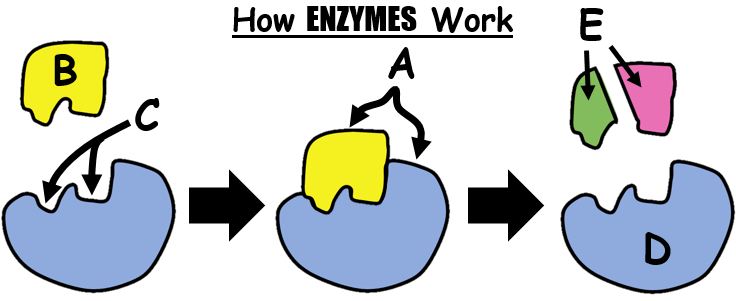
In the diagram, what is letter A?
a)
product
b)
substrate
c)
enzyme-substrate complex
d)
active site
23.
An enzyme speeds up a chemical reaction in the cell but can only be used once. True or False?
a)
true
b)
false
24.
What is the function of an enzyme?
a)
enzymes break themselves into small pieces
b)
enzymes slow down chemical reactions
c)
enzymes speed up chemical reactions
d)
enzymes combine products to form reactants
25.
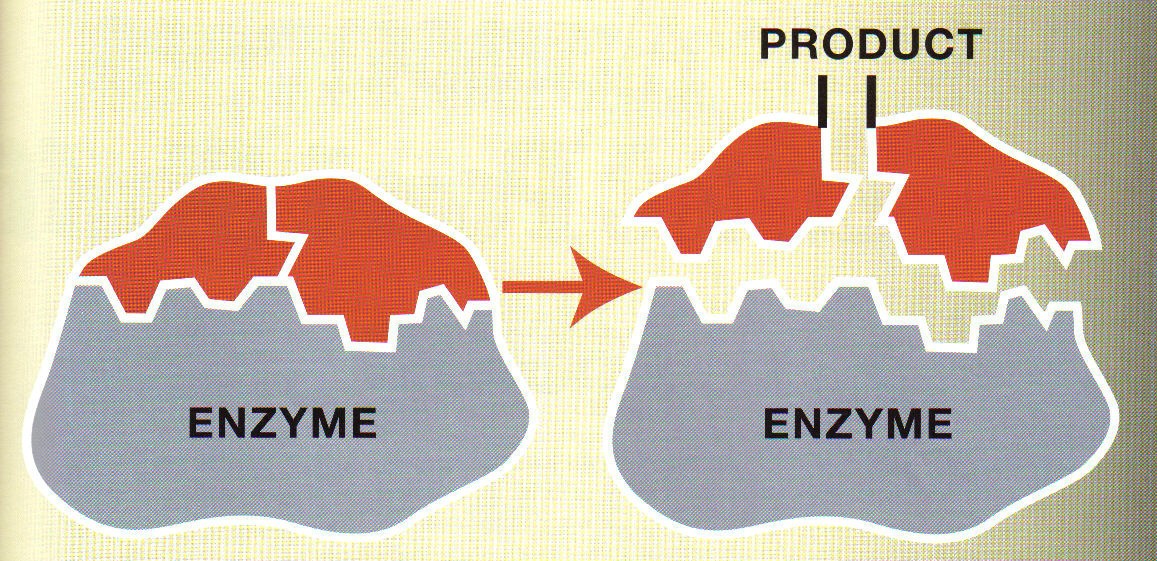
Enzymes speed up reaction rates by changing...
a)
Activation Energy
b)
pH
c)
Hydrogen Bonds
d)
Kinetic Energy
26.
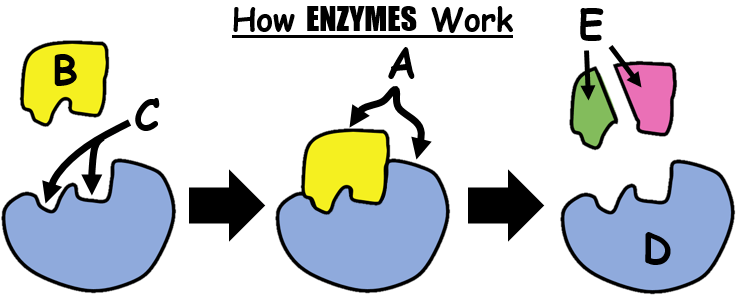
Letter D...
a)
active site
b)
enzyme
c)
substrate
d)
products
27.
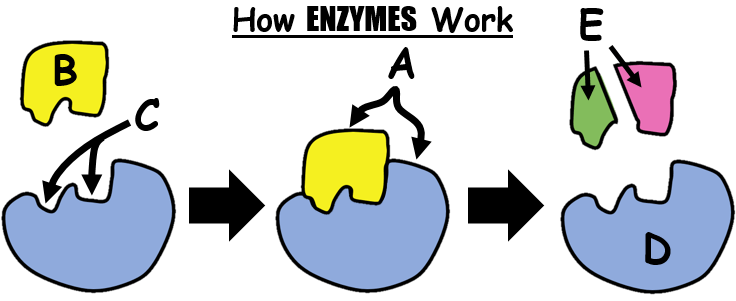
Letter B...
a)
active site
b)
enzyme
c)
substrate
d)
products
28.
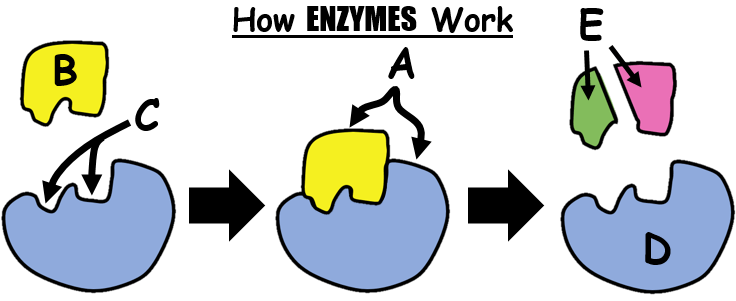
Letter C...
a)
active site
b)
enzymes
c)
substrate
d)
products
29.
Letter C...
a)
active site
b)
enzymes
c)
substrate
d)
products
30.
The __________________ variable is the variable you are observing and that changes in response to the _________________ variable.
a)
independent (experimental), dependent
b)
dependent, independent (experimental)
c)
dependent, control
d)
independent (experimental), control
31.
The __________________ variable is the variable you are observing and that changes in response to the _________________ variable.
a)
independent (experimental), dependent
b)
dependent, independent (experimental)
c)
dependent, control
d)
independent (experimental), control
32.
Maria wants to know if birds prefer to eat in one place over another. She makes three feeders out of 2-liter bottles and paints all of them red. She fills each of the feeders with the same amount of mixed birdseed, and plans to keep the feeders out for 10 days before measuring how much seed is eaten from each feeder. She puts each of the feeders in her back yard: one feeder in a large dead tree, another feeder she sits on the dog house, and the last she sits in a small bushy tree.
What is the dependent variable?
What is the dependent variable?
a)
Length of the birdfeeders
b)
Amount of time feeders are outside
c)
Amount of seed eaten
d)
Location the feeders are put in.
33.

Is this picture accuracy or precision?
a)
Just accuracy
b)
Just precision
c)
Both
d)
Neither
34.
If you were testing how well different dish soap cleaned grease, the independent (experimental) variable would be the:
a)
Dishes
b)
Water
c)
Dish Soap
d)
Types of Grease
35.
Changeable elements of an experiment which can affect the outcome of the experiment if not carefully controlled are called:
a)
placebos
b)
variables
c)
quantitative elements
d)
control groups
36.
Data such as "10 drops" is referred to as ___________.
a)
robust data
b)
qualitative data
c)
control data
d)
quantitative data
37.
The number of variables that should be allowed to change in a well designed, controlled experiment is:
a)
none
b)
1
c)
2 or more
d)
dependent on the type of experiment
38.
The __________________ variable is the variable you are observing and that changes in response to the _________________ variable.
a)
independent (experimental), dependent
b)
dependent, independent (experimental)
c)
dependent, control
d)
independent (experimental), control
39.
Which one of the following is NOT an example of quantitative data?
a)
number of flowers on a plant
b)
size of a flower
c)
height of a flower
d)
color of a flower
40.
Research Question: Does the type of gasoline put in a car effect how fast the car can drive?
What is the independent variable?
What is the independent variable?
a)
Type of gasoline
b)
which car the gas is put into
c)
how fast the car can drive
d)
how much gas is put into the car
41.
A herd of zebras would be considered a
a)
community
b)
species
c)
ecosystem
d)
population
42.
The number of variables that should be allowed to change in a well designed, controlled experiment is:
a)
none
b)
1
c)
2 or more
d)
dependent on the type of experiment
43.
Which of the following terms refers to the variable that is measured or recorded as the results of the experiment?
a)
Experimental Controls
b)
Test Controls
c)
Dependent Variable
d)
Independent Variable
44.
Which of the following terms refers to the group that receives no treatment with the independent variable?
a)
Constant group
b)
Control group
c)
Dependent group
d)
Experimental group
45.
Which of the following terms refers to the variable that is manipulated (changed) by the experimenter?
a)
Experimental Controls
b)
Test Controls
c)
Dependent Variable
d)
Independent Variable
46.
When experimenting with the growth of a plant, a scientist uses three (of the same type of) plants, two different fertilizers, equal light, and equal water. What type of variable is the fertilizer?
a)
Dependent
b)
Independent
c)
Control
d)
Compound
47.
An experiment in which only one variable is manipulated at a time.
a)
controlled experiment
b)
data
c)
scientific law
d)
hypothesis
48.
What you measure, count, or observe as a result of what you changed.
a)
Dependent/Responding variable
b)
Independent/Manipulated variable
c)
Scientific law
d)
scientific method
49.
Changeable elements of an experiment which can affect the outcome of the experiment if not carefully controlled are called:
a)
placebos
b)
variables
c)
quantitative elements
d)
control groups
50.
In an experiment, this is what you COMPARE your experimental data to so that you can see if anything changed (our time WITH thumbs):
a)
control
b)
constants
c)
problem
d)
independent variable
51.
The ONE thing you, as the experimenter, change is called the:
a)
control
b)
constants
c)
independent variable
d)
dependent variable
52.
What is the factor that an experimenter changes on purpose?
a)
Dependent Variable
b)
Independent Variable
c)
Constant
d)
Control
53.
The part of the experiment that does not contain the independent variable. Used for comparison.
a)
Control Group
b)
Experimental Group
c)
Results
d)
Data
55.
What are all the things that are kept the same in an experiment?
a)
controls
b)
data
c)
constants
d)
independent variables
55.
What are all the things that are kept the same in an experiment?
a)
controls
b)
data
c)
constants
d)
independent variables
56.
Food and water ____________is used to grow, move, and reproduce.
a)
bottle
b)
energy
c)
calories
d)
power
57.
Plants, animals, humans and microbes are all composed of...
a)
bones
b)
muscle
c)
cells
d)
water
58.
The reproduction that needs two living beings is
a)
sexual
b)
asexual
c)
impossible
59.
Temperature plays an important role in ...
a)
moving
b)
homeostasis
c)
nonliving things
d)
the air
60.
Homeostasis refers to an organism's ability to
a)
compete for living space.
b)
dissolve chemicals.
c)
maintain stable internal conditions.
d)
obtain energy.
61.
If the offspring are exactly like the progenitor, the reproduction is
a)
sexual
b)
asexual
c)
heterosexual
62.
A worm turns away from light is an example of a worm
a)
reproducing
b)
doing cellular respiration
c)
having cells
d)
responding to its environment
63.
A word to describe a chance over time is:
a)
evolution
b)
reproduce
c)
cell
d)
organism
64.
Which of the following characteristics of living things best explains why your legs and arms get longer and stronger as you get older?
a)
living things respond to their environment
b)
living things maintain internal balance
c)
living things are made of cells
d)
living things grow and develop
65.
Which of the following correctly describes ASEXUAL reproduction?
a)
One parent, genetically identical offspring
b)
One parent, genetically different offspring
c)
Two parents, genetically identical offspring
d)
Two parents, genetically different offspring
66.
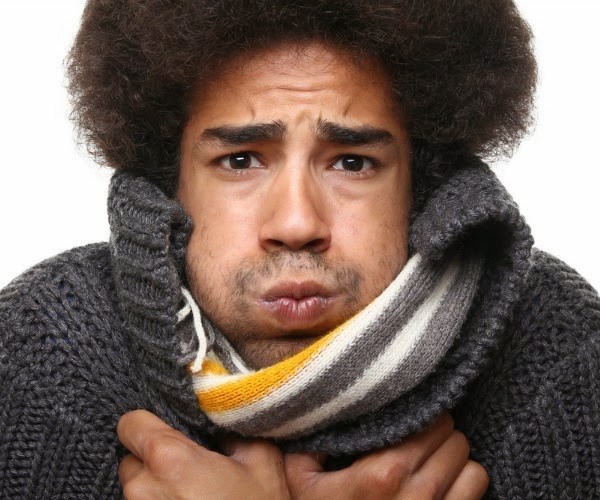
The image seen here is of a person shivering due to cold temperature. This is an example of an organism maintaining ________________!
a)
Homeostasis
b)
Adaptations
c)
Evolution
d)
Development
67.
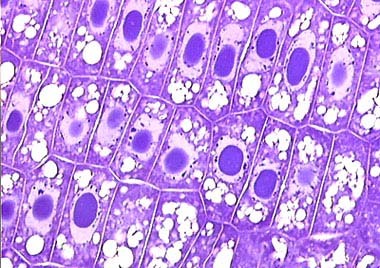
This is a example of ........
a)
cell
b)
tissue
c)
organ
d)
organ system
68.
Which level of organization is more complex than a population and less complex than an ecosystem?
a)
organism
b)
population
c)
community
d)
ecosystem
69.
which is the correct order of the levels of organization from simple to complex?
a)
organism, population, community, ecosystem
b)
ecosystem, community, population, organism
70.
Certain tasks of cells
a)
Organ System
b)
Structure
c)
Specialization
d)
Biotic
71.
A community is ___________ types of species living together.
a)
Same
b)
Alternating
c)
All
d)
Different
72.
Certain tasks of cells
a)
Organ System
b)
Structure
c)
Specialization
d)
Biotic
73.
A ecosystem is both biotic and abiotic parts in an ecosystem.
a)
True
b)
False
74.

What are the abiotic factors in this image?
a)
water, sunlight, dirt, air
b)
birds and plants
c)
water, plants, and birds
75.
What is the correct order of organization
a)
tissues-cells-organs-organ systems-organism
b)
cell-tissue-organs-organ systems-organism
c)
organism-cells-tissues-organ systems-organism
d)
tissues-cells-organs-organ sytems-organism
76.
Which of the following lists the Levels of Organization of an ecosystem correctly from smallest to largest?
a)
community -> population -> ecosystem -> biosphere
b)
population -> ecosystem -> community -> biosphere
c)
organism -> community -> population -> ecosystem
d)
organism -> population -> community -> ecosystem -> biosphere
77.
All the organisms in a given group, along with abiotic factors within which they interact
a)
symbiosis
b)
species
c)
ecology
d)
ecosystem
78.
The chemical reaction that breaks down a molecule by adding water is
a)
Dehydration Synthesis
b)
Hydrophobia
c)
Hydrolysis
d)
Dehydration
79.
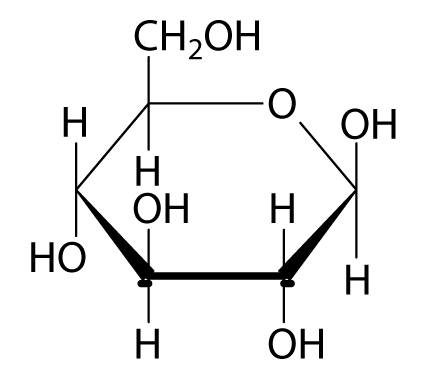
Identify the biomolecule
a)
Carbohydrate
b)
Lipid
c)
Protein
d)
Nucleic Acid
80.
What is the functions of lipids?
a)
Quick source of energy
b)
Builds muscles, skin, enzymes
c)
Stores genetic information
d)
Stores energy, insulation, protection
81.
Which of the following is an example of a nucleic acid?
a)
Glucose
b)
Phospholipid
c)
Enzymes
d)
DNA
82.
What is the function of a nucleic acid?
a)
Stores genetic information
b)
Stores energy
c)
Quick source of energy
d)
Builds structures
83.
What does the word organic mean?
a)
has nitrogen
b)
has sulfur
c)
has carbon
d)
has oxygen
84.
Which examples are a sources of energy?
a)
Starch, cellulose, glycogen
b)
Valine, Histidine, Cysteine
c)
DNA, RNA
d)
Unsaturated and Saturated Fats
85.

The monomer, building block, of carbohydrates; simple sugar
a)
Amino acid
b)
Fatty Acid
c)
Nucleotide
d)
Monosaccharide
86.
What biologist call the large moelcules that make up the "big 4"
a)
Monomer
b)
Macromoleucles
c)
Monosaccharide
d)
Polysaccharide
87.
A large molecule made up of multiple monomers
a)
Polymer
b)
Polysaccharide
c)
Macromolecules
d)
Protein
88.
Which biomolecule includes fats, such as triglycerides, oils, waxes, and steroids (cholesterol); insoluble in water; provides energy storage, insulation, part of cell membrane, and hormones
a)
Nucleic Acid
b)
Lipids
c)
Carbohydrate
d)
Protein
89.
What do monomers do?
a)
Bonds to make a Polymer
b)
Creates Protiens
c)
Stores energy
d)
Splits to make more cells
90.
What are the monomers of proteins?
a)
amino acids
b)
monosaccharides
c)
fatty acids
d)
nucleotides
91.
Which biomolecule includes fats, such as triglycerides, oils, waxes, and steroids (cholesterol); insoluble in water; provides energy storage, insulation, part of cell membrane, and hormones
a)
Nucleic Acid
b)
Lipids
c)
Carbohydrate
d)
Protein
92.
The process that builds molecules by removing water to bind them together is
a)
Hydrolysis
b)
Protein Synthesis
c)
Dehydration Synthesis
d)
Lysis
93.
The four most common elements found in biomolecules are:
a)
Carbon, Nitrogen, Phosphorus, Bromine
b)
Sulfur, Nitrogen, Iron, Carbon
c)
Sulfur, Phosphorus, Carbon, Oxygen
d)
Carbon, Oxygen, Nitrogen, Hydrogen
94.
I contain C, H, O, N.
a)
Protein
b)
Lipid
c)
Nucleic Acid
d)
Carbohydrate
95.
All 4 biomolecules -
a)
Contain C, H, O, N
b)
Contain C, H, O
c)
Are made up of Sulfur
d)
Are made up of Amino Acids
96.
Which of the following elements are present in all 4 biomolecules?
a)
C, H, O
b)
C, H, O, N
c)
C, H, O, N, S
d)
C, H, O, N, P
97.
Both Carbohydrate & Lipids contain C, H, and O. How can we distinguish between these 2 biomolecules?
a)
Carbohydrate have more oxygen
b)
In lipids, the # of carbon equals the number of oxygen
c)
In carbohydrate, the # of carbon equals the number of oxygen
98.
The chemical reaction that breaks down a molecule by adding water is
a)
Dehydration Synthesis
b)
Hydrophobia
c)
Hydrolysis
d)
Dehydration
99.
9.2 Km = ______m
a)
92
b)
920
c)
0.92
d)
9200
100.
convert 93.2 cm to km
a)
0.00932
b)
0.0932
c)
0.932
d)
0.000 932
100 %

