
 Worksheets
LE Regents State Labs Review
Total questions: 78
Worksheet time: 1hrs 10mins
An investigation is carried out to determine the effect of exercise on the rate at which a person can squeeze a clothespin.
In this investigation, the independent variable is the
control
exercise
rate of squeezing
number of participants
An investigation is carried out to determine the effect of exercise on the rate at which a person can squeeze a clothespin.
Muscle fatigue occurs during this activity when
carbon dioxide is used up in the muscle cells
simple sugar is converted to starch in the muscle cells
proteins accumulate in mitochondria in the muscle cells
certain waste products collect in the muscle cells
An investigation is carried out to determine the effect of exercise on the rate at which a person can squeeze a clothespin.
The experimental results could be made more valid by
increasing the number of students
using safety precautions
using a plastic clothespin
making a bar graph of the data
An investigation is carried out to determine the effect of exercise on the rate at which a person can squeeze a clothespin.
The dependent variable for this experiment is the
time the student was squeezing the clothespin
number of times the student was able to squeeze the clothespin
strength of the student
length of the clothespin
A student lifted weights after school and found that his muscles started to burn. He couldn’t continue to lift the weights after prolonged exercising. This muscle fatigue is most likely due to
the heart beating too fast and tiring out
the lungs accumulating oxygen
lack of oxygen and build up of waste in the muscles
lack of carbon dioxide in the muscles
A student hypothesized that watching sports on television would cause viewers’ pulse rates to increase. She designed an experiment to determine the effect of watching sports on pulse rate. A group of 200 volunteers took their pulse rates and then watched their favorite sports on television. After the games, they immediately took their pulse rates again. The data collected showed that the pulse rates of some people increased, but the pulse rates of an equal number of people did not change. Although the hypothesis was not supported by the data, the hypothesis is still valuable because it
may lead to further investigation
can be changed to fit the data
is the opinion of the experimenter
is based on beliefs of the volunteers
If a control group is not included in an experiment, it would be difficult to
formulate a hypothesis for the experiment
make observations about the experimental group
record data in a data table
draw a valid conclusion

An experiment was conducted to determine the effect of activity on pulse rate. Data were collected and recorded in the table shown.
Which activity most likely corresponds to the pulse rate of the person while sleeping?
1
2
3
4

Students were asked to design a lab that investigated the relationship between exercise and heart rate. Heart rate was determined by recording the pulse rate in beats per minute. The students hypothesized that increased exercise results in an increased heart rate. The class results for the experiment are shown in the graph.
Which statement is best supported by the graph?
Before exercising, the average pulse rate was 65; four minutes after exercising, the average pulse rate was 65.
After four minutes of exercising, the average pulse rate was 120; two minutes after exercising, the average pulse rate was 120.
While exercising, the highest average pulse rate was 150; before exercising, the average pulse rate was 65.
Two minutes before exercising, the average pulse rate was 80; after two minutes of exercise, the average pulse rate was 140
Students were asked to design a lab that investigated the relationship between exercise and heart rate. Heart rate was determined by recording the pulse rate in beats per minute. The students hypothesized that increased exercise results in an increased heart rate. The class results for the experiment are shown in the graph.
Students in a different science class carried out the same experiment. The data they obtained did not support the hypothesis that increased exercise results in increased heart rate. The most scientifically sound way to deal with this situation is to
write a new hypothesis
read about pulse rate in a biology textbook
have the students in both classes vote to decide which hypothesis is correct
ask students in a third class to do the experiment and see if their results support the hypothesis

A class is recording pulse rates of the students in a data table like the one shown.
One student checks his pulse and counts 23 beats over a time interval of 20 seconds. In which row in the data table should the pulse rate of this student be recorded?
A
B
C
D
An athlete bought a sport gel food and wanted to test it to see if it contained fats, starches, and glucose. The tests that the student used are shown in the table below.
If a starch-digesting enzyme were added to a sports gel that lists starch as an ingredient, which substance would increase in concentration?
fat
glucose
amino acids
water
During periods of vigorous physical activity, a person's breathing and heart rates increase. This enables the cells of the body to perform more efficiently because it helps the cells to
remove waste products faster
store excess glucose in muscles
reduce the amount of ATP produced
convert more oxygen to glucose
In the lab activity Making Connections, an experiment was designed to test the effect of exercise on the ability to squeeze a clothespin. The number of times the clothespin was squeezed served as the
independent variable
dependent variable
hypothesis
control
A person's pulse rate generally goes down while sleeping. One reason for this decrease is
the body is producing more carbon dioxide when a person is sleeping
a person is not using energy while sleeping
a person requires less oxygen when sleeping
the body is using more nutrients while asleep

The diagram below represents one of many microscopic air sacs in a human lung. The alveolus (air sac) is the place where oxygen (O2) and carbon dioxide (CO2) move into or out of the blood, as represented in the diagram.
Which statement best explains why these gases are able to move in the directions shown in the diagram?
The CO2 moves out of the capillary and into the alveolus to make more room for the blood to carry O2.
The O2 is needed by the cells, so it is actively transported into the blood. The CO2, which is not needed, is actively transported out of the blood.
The blood coming to the lungs is low in CO2 and high in O2, so the gases each diffuse from a lower to a higher concentration in this area.
The blood coming to the lungs is high in CO2 and low in O2, so the gases each diffuse from a higher to a lower concentration in this area.
Identify the cellular structure that diffusion occurs across.
ribosome
mitochondria
cytoplasm
cell membrane
chloroplast
Describe diffusion:
the movement of molecules higher concentration to an area of lower concentration
the synthesis of molecules higher concentration to an area of lower concentration
the movement of molecules lower concentration to an area of higher concentration
the synthesis of molecules lower concentration to an area of higher concentration

Identify the substance/molecule that will not diffuse.
Starch
Glucose
Iodine
Identify the substance(s)/molecule(s) that will diffuse.
Starch
Glucose
Iodine
Select the four organic macromolecules.
nucleic acids
proteins
lipids
amino acids
carbohydrates
Select the four organic building blocks.
amino acids
fatty acids
nucleic acids
nucleotide bases
simple sugars

Identify the substance that was added to the outside of the plant cells that caused the change observed.
salt water
fresh water
distilled water
glucose

Identify the substance that was added to the outside of this cell that caused the change observed.
salt water
fresh water
distilled water
glucose

Identify which molecule is diffusing into the cell.
A
B

Molecule A cannot diffuse. What is a possible reason why?
Molecule A is a macromolecule and it is too large to move.
Molecule A is a building block and it is too large to move.
Molecule A is a building block and it is too small to move.
Molecule A is a macromole and it is too small to move.

The following image shows a plant cell in a normal environment. Which picture shows what a plant cell would like if salt was added to the outside?


Which choice accurately describes what happened in steps A and B?
Step A added saltwater so the water diffused out. Step B added freshwater so water diffused in.
Step A added saltwater so the water diffused in. Step B added freshwater so water diffused out.
Step A added freshwater so the water diffused in. Step B added saltwater so water diffused out.
Step A added freshwater so the water diffused out. Step B added saltwater so water diffused in.

What is the starch indicator?
Iodine
Bromothymol Blue
Benedict's Solution
Glucose
What color does the starch indicator turn when it comes in contact with starch?
blue-black
blue
orange-red
yellow

A model cell setup is represented in the "Initial State" diagram below.
Which diagram indicates the area where each of these substances would be located after 20 minutes?


A starch solution in a test tube was separated from the water in a beaker by a dialysis membrane. One hour later, it was observed that the liquid had risen in the test tube.
If a starch indicator solution was initially added to the water in the beaker, describe one observation that would be made after one hour.
The tube would start to bubble
The starch solution would change color
The temperature of the solution would decrease
The water would change color

Molecules A and B are commonly found in plant cells. When tested, it was discovered that molecule A quickly passed through the artificial plant cell membrane. Molecule B did not pass through.
The locations of molecules A and B at the beginning of the experiment are shown. Which statement best describes what was observed when the setup was examined 20 minutes later?
Molecule A remained inside the artificial cell and molecule B remained outside
Only molecule A was found both inside and outside the artificial cell.
Only molecule B was found both inside and outside the artificial cell.
Both molecules A and B were found inside and outside the artificial cell.

The diagram represents a sugar cube being dropped into an undisturbed beaker of water at room temperature. One sugar molecule is labeled.
Which diagram below represents the distribution of sugar molecules in the water a day later?


The diagram represents red blood cells placed in three test tubes, each containing a different salt solution.
Which solution would be most similar in concentration to the normal internal environment of the human circulatory system?
solution A, only
solution B, only
solutions A and B
solutions A and C


Scientists attempted to determine the evolutionary relationships between three different finch species, A , B , and C . In order to do this, they examined the physical characteristics and DNA of these species. DNA was extracted from all three species and analyzed using gel electrophoresis. The results are shown in the diagram. Which statement best describes the method used above to determine the evolutionary relationships between three species of finches?
Examine the structure of the beaks and compare them.
Observe behavioral and physical characteristics of all the finches and group them by similarities.
Obtain molecular evidence from all three species and identify similarities.
Compare common ancestors of all three of the species to see if they are the same.
Which chemicals are used to cut DNA into fragments for a gel electrophoresis procedure?
molecular bases
enzymes
hormones
ATP molecules
A laboratory setup that can be used to provide information about relationships between four plant species is represented below. This setup is part of the technique known as
electrophoresis
biological staining
dissection
chromatograph

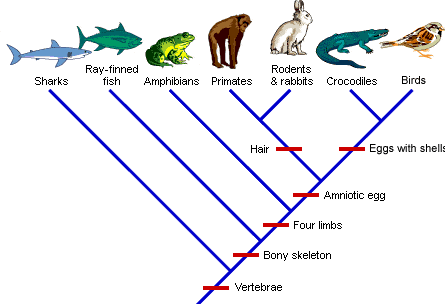
Which evidence should receive the most emphasis when determining the relatedness?
genetic sequence
the presence of an enzyme
plant pigments
structural characteristics of the stems

What human activities could cause Botana curus to become extinct? (Choose all that apply)
destruction of natural habitat
pollution
introduction of foreign species that compete with native species
removal of predators
planting more Botana curus
Why is it important to preserve Botana curus? (Choose all that apply)
We could lose the source of the genetic material if it becomes extinct
The extinction of this species could lead to the extinction of another species
It could be used for other medicinal properties
The local people will have no plants to eat
It will make the environment look like a desert
a student added an enzyme to test a tube containing a sample of DNA. After a period of time, analysis of the DNA sample indicated it was now broken into three segments. The purpose of the enzyme was most likely to
cut the DNA at a specific location
Move the DNA to a different organism
Copy the DNA for protein synthesis
alter the DNA sequence in the segment
Which technique could be used to determine the relative number of bases in fragments taken from a sample of DNA?
electrophoresis
cloning
paper chromatography
light microscophy

gel electrophoresis
gene therapy
chi squared test
electron microscope

they have the correct child child, because her genetic information is identical to that of the father
they have the wrong child, because her genetic information does not match of that either parent
they have the wrong child, because her genetic information matches only that of the mother
they have the correct child, because her genetic information came from both parents
paper chromography is a method used in
seperating mixtures of plant pigments
comparing the shapes of plant levels
comparing habitats of different plants
seperating individual DNA fragment of plants

The base pairs for DNA are
A-T
T-C
G-C
A-U
C-G
G-U
T-A
A-T
T-A
A-T
C-G
G-C
A-U
T-A
C-G
G-C

Which data is not molecular data?
DNA
Enzymes
Amino Acid Sequence
Flower shape

Why would scientists want to find other plants similar to an important medicinal plant?
The important plant is very slow growing
There are very few specimans of the important plant
There is high demand for the important plant
All of these could be true
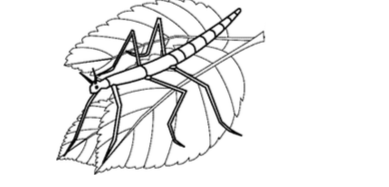
The size, shape, and green color of this insect are adaptations that would most likely help the insect to
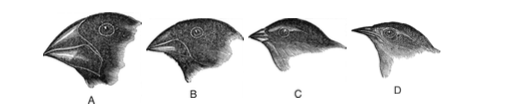
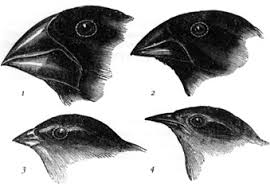
The four different types of beaks shown are most likely the result of
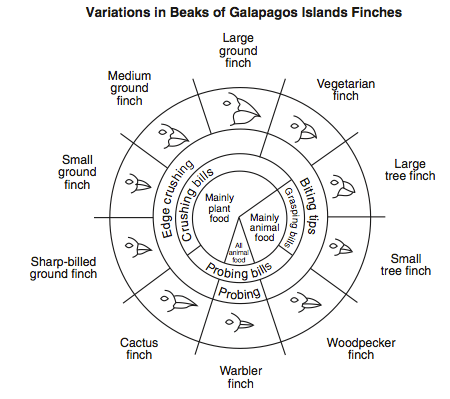
biology.
Several of the Galapagos Islands are inhabited by grasshoppers, beetles, flies, bees, and butterflies. Finches that feed on these consumers would have beaks adapted for
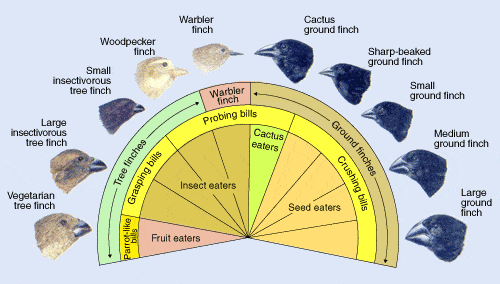
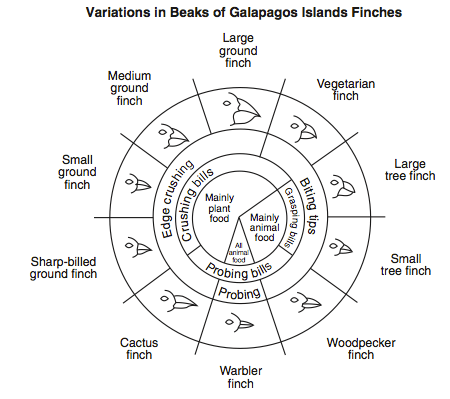
Which two finches would compete the least for food?
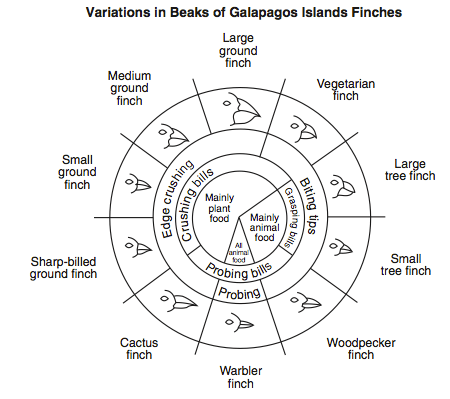
Which factor most directly influenced the evolution of the diverse types of beaks of these finches?

