
 Worksheets
oxidation and reduction
Total questions: 34
Worksheet time: 6mins
What is the oxidation number of chlorine in ClO3-1 ?
-1
+1
+7
+5
+3
What is the oxidation number of chlorine in ClO4-1 ?
-1
+1
+7
+5
+8
What is the oxidation number of chlorine in ClO2 ?
-1
+4
+7
+5
+2
Oxidation is the _________ of electrons.
loss
gain
sharing
transfer
Reduction is the ___________ of electrons.
loss
gain
sharing
transfer
Mg → Mg2+ + 2e–
Which of the following half reactions correctly represents a reduction half reaction? be sure your answer is a correct equation
What is the oxidation number of Nitrogen in HNO3
-7
-5
+5
+7
+2
The below reaction is an example of _________reaction.
F2 → 2 F- + 2 e-
Oxidation
Reduction
Neutralization
decomposition
combustion
Which of the following is the correct, balanced half -reaction for the oxidation of Cu to Cu+2?
Cu ⟶ Cu+2
Cu + 2 e- ⟶ Cu+2
Cu - 2e- ⟶ Cu+2
Cu ⟶ Cu+2 + 2 e-
Fe + 3e- →Fe what charge should be here
+3
-3
0
-1
2Fe + __e- →2Fe +2 how many electrons are needed
1
2
3
4
Cu + →Cu +2 __e- how many electrons are needed
1
2
3
4
Cu+1 + →Cu +2 __e- how many electrons are needed
1
2
3
4
3Cu+1 + →3Cu +2 __e- how many electrons are needed
1
2
3
4
S-1 + →S+2 __e- how many electrons are needed
1
2
3
4
Ca → + 2e- + Ca what charge should be here
+2
-2
+1
-1
Ca-1 → + 2e- + Ca what charge should be here
+2
-2
+1
-1
Based on your knowledge of ioninc bonding what will Aluminum do in order to lower it's energy and become more stable?
Gain 3 electrons and become Al+3
Lose 3 electrons and become Al+3
Gain 5 electrons and become Al+3
Nothing it is stable as Al0
Based on your knowledge of ioninc bonding what will Oxygen do in order to lower it's energy and become more stable?
Gain 2 electrons and become O-2
Lose 2 electrons and become O-2
Lose 6 electrons and become O-2
Nothing it is stable as O0
Based on your knowledge of ioninc bonding what will Nitrogen do in order to lower it's energy and become more stable?
Gain 3 electrons and become N-3
Lose 3 electrons and become N-3
Lose 5 electrons and become N-3
Nothing it is stable as N0
Based on your knowledge of ioninc bonding what will Argon do in order to lower it's energy and become more stable?
Gain 3 electrons and become Ar+3
Lose 2 electrons and become Ar-2
Lose 5 electrons and become Ar-3
Nothing it is stable as Ar0
What causes redox reactions to occur?
Atoms are more stable with more electrons
Atoms have less energy with less electrons
Atoms are more stable and have less energy with 8 valance electrons
Atoms need to be paired up in compounds
The fact that atoms want to have a full set of valence electrons is known as the
Octet Rule
The rule of 8
Hund's Rule
The energy level principle
How many electrons and what charge will make the stable form of nitrogen
N + __e- → N what charge should be her
2 and +2
2 and -2
3 and +3
3 and -3
What process is needed to make the stable for of Mg
Oxidation
Reduction
What process is needed to make the stable for of Li
Oxidation
Reduction
What process is needed to make the stable for of Cl
Oxidation
Reduction
What process is needed to make the stable for of P
Oxidation
Reduction
What process is needed to make the stable for of P
Remove 3 electrons
Add three electrons
Add 5 electrons
Remove 5 electrons
What process is needed to make the stable for of Ga
Remove 3 electrons
Add three electrons
Add 5 electrons
Remove 5 electrons
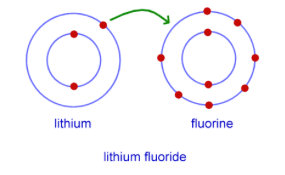

Does this bonding picture shows a redox process...
Yes it is an Ionic Bond
No it is Covalent Bond
No way to tell
Not a bond
In order for both elements to be stable how many atoms of Ca and N must bond
1Ca and 2N
3Ca and 2N
1Ca and 1N
2Ca and 3N

