
Font size
 Worksheets
Physics Revision
Total questions: 106
Worksheet time: 1hrs 12mins
If a bow is stretched just before an arrow is fired, what type of energy has increased?
chemical energy
heat energy
elastic potential energy
nuclear energy
Nuclear energy would be found in which situation
In a power station the uses the burning of coal
In a power station that splits atoms of uranium
In a power station that uses water flowing down a mountain
In a power station that uses radiation from the sun
A person is pedalling on their bike and going down the road. Which of the following statements is true.
Kinetic energy is being transferred from the pedals to the wheels
Potential energy in the pedals is being transformed into kinetic energy
Nuclear energy in the legs of the person is being transferred to the wheels
Kinetic energy is being transferred from the wheels to the pedals
Energy can be stored in a high level water reservoir. The water in the high level reservoir stores
electrical energy
gravitational potential energy
kinetic energy
nuclear energy
Water in a high level reservoir is allowed to flow to the low level reservoir. The flowing water has
electrical energy
sound energy
gravitational potential energy
kinetic energy
Flowing water turns a turbine which is connected to a generator thus creating electricity. The generator also produces some waste energy in the form of
electrical energy
kinetic energy
sound energy
nuclear energy
The total power of a power station is 600 MW. The useful power output is 540 MW. The efficiency of the power station is
100%
90%
50%
10%
The total power of a power station is 600 MW. The useful power output is 540 MW. The amount of power wasted by the power station is
60 MW
540 MW
600 MW
1140 MW
The Law of the Conservation of Energy explains
the importance of not wasting energy
that the total amount of energy stays the same in energy transformations
why the efficiency of a machine is never 100%
why companies are fined if they do not keep to the law about unnecessary wastage of energy
A power lifter lifts a 180 kg bar from the floor to 2 m high. Work out the change in gravitational energy. Take gravity to be 10 N kg−1
36 J
360 J
3600 J
36 000 J
If a car of mass 800kg is travelling at 10 m/s what is the amount of kinetic energy it has?
400 J
800 J
8000 J
40 000 J
Work done is the amount of energy used or transferred. What is the correct units of energy for work?
Joules
Newtons
Watts
Metres per second per second
How much work has been done if a force of 20N is applied to a box to move it 5m?
100 J
25 J
100 N
25 N
Bob can lift a 30kg box up onto the back of a truck in 3 seconds. Samson can lift the same box onto the back of the truck in 1 second. Which of the statements below is true?
Samson did more work that Bob
Samson is more powerful that Bob
Bob and Samson are both as powerful as each other
Bob is a lazy slob
A car is going along the road and then smashes into a tree and comes to a halt. Which of the following statements is true?
The car had potential energy as it was going along the road and this was converted into kinetic energy as it hit the tree.
The tree had potential energy and this was converted into heat energy when the car hit it.
The car had wind energy as it was going along the road but this was converted into elastic energy as the tree bent.
Some of the kinetic energy that the car had was transformed into sound energy when it hit the tree.
A cyclist travels 15 km in 0.6 hours. What is the average speed of the cyclist, in km h−1 , over this period?
9 km h−1
0.04 kmundefined
25 kmundefined
15.6 kmundefined

Which section of the graph shown represents a stationary body?
EF
DE
CD
BC
Which section of the graph shown represents a body moving with constant speed?
EF
DE
CD
BC
Which section of the graph shown represents a body moving with changing speed?
EF
DE
CD
AB
An athlete runs for 1.4 hours at an average speed of 15 km h−1 . What distance do they cover?
21 km h−1
10.7 km
21 km
0.09 km
A car is driven at 100 km h−1 to cover a distance of 25 km. How long did it take to cover this distance?
4 hours
1/3 hour
30 minutes
15 minutes
When a skydiver is falling with parachute deployed, a speed toward Earth will be reached that no longer changes, the "terminal velocity".
What can be inferred about the sizes of the downward force acting on the skydiver, and the upward one, and why?
the forces must be equal because there is no change in speed.
the down force must be greater because weight force is large.
the up force from the parachute must be greater because it is large to slow down the skydiver.
not enough information is given to make a judgement.
What is Newton's First Law
The force is equal to mass times acceleration
Every action has an equal and opposite reaction
An object at rest stays at rest, an object in motion stays in motion unless acted upon by a force
Friction is a force that resists motion
If a stationary object starts moving then a _________________ must have acted on the object.
force
velocity
inertia
acceleration
A stationary body stays at rest because the forces acting on it are
Balanced
Unbalanced
Changing
Unequal

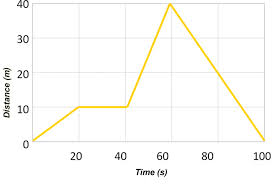
Describe the motion in the graph:
Constant Speed (positive slope)
Stopped (at rest)
Acceleration (increasing speed)
Return Home (negative slope)

Describe the motion in the graph:
Constant Speed (positive slope)
Stopped (at rest)
Acceleration (increasing speed)
Return Home (negative slope)

Describe the motion in the graph:
Constant Speed (positive slope)
Stopped (at rest)
Acceleration (increasing speed)
Return Home (negative slope)


Which runner had a head start?
A
B
C
A and C
In which of the following graphs below are both runners moving at the same speed?


What is the equation to calculate time taken for a distance to be travelled?
time = speed/distance
time = distance/speed
time = speed x distance
time = distance x speed
You do work only when you exert a force on an object and move it
Which of the following is the best example of work being done.
doing homework
lifting a box
pushing a stationary box
holding a box
W=5000 Joules
t=???


What is needed to calculate work?
force
distance
time
mass
Which of the graphs shows that one of runners started 10 yards further ahead of the
other?


In which of the following graphs below are both runners moving at the same speed?
Match the description to the graph:
"The car is stopped."


Match the description to the graph:
"The car is traveling at a constant speed."
Match the description to the graph:
"The speed of the car is decreasing."
Match the description to the graph:
"The car is coming back."

Segment O-A The bus is _________________.
at rest
returning (to original position)
moving forward
Segment A-B The bus is _________________.
at rest
returning (to original position)
moving forward
Segment B-C The bus is _________________.
at rest
returning (to original position)
moving forward
Segment C-D The bus is _________________.
at rest
returning (to original position)
moving forward
Segment D-E The bus is _________________.
at rest
returning (to original position)
moving forward
Segment E-F The bus is _________________.
at rest
returning (to original position)
moving forward

Which runner won the race?
Albert
Bob
Charlie
Which runner stopped for a rest?
Albert
Bob
Charlie
How long did Charlie stop for a rest?
2.5 seconds
2 seconds
3 seconds
5 seconds
How long did Bob take to complete the race?
17 seconds
12 seconds
14 seconds
15 seconds
Calculate Albert's average speed for the 100-meter race.
8.33 m/s
5 m/s
7.14 m/s
5.88 m/s
Which of the graphs shows that one of runners started in the same place?
Which of the graphs shows that one of runners ended the race 10 yards ahead of the other?
In which of the following graphs below did one runner overtake (run past) the other?
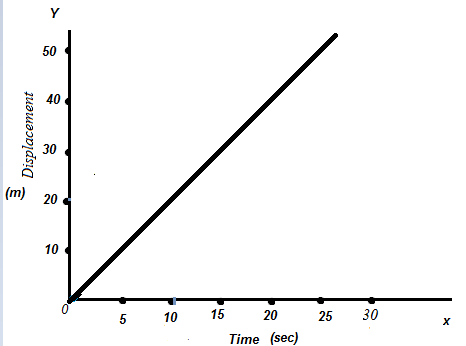
What is shown in this displacement vs time graph?
uniform velocity
uniform speed
no speed (at rest)
acceleration
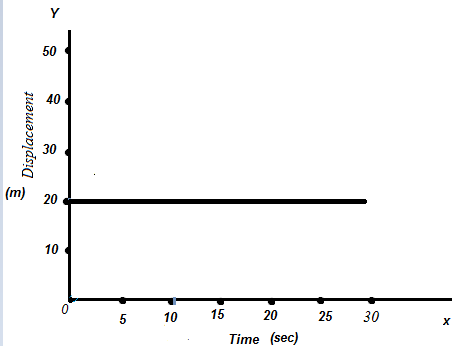
What does this graph mean?
no velocity (at rest)
uniform velocity
uniform speed
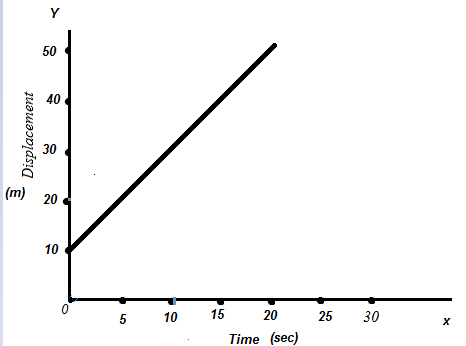
What is shown in this graph?
uniform velocity and initial displacement 10m
uniform velocity and initial velocity 10m
acceleration
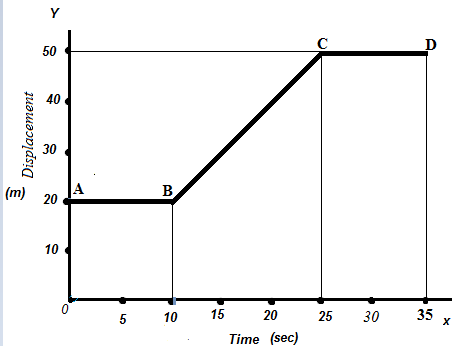
What is happening between B and C in this graph?
constant acceleration
uniform velocity
at rest
What is happening between C and D in this graph?
constant acceleration
uniform velocity
at rest
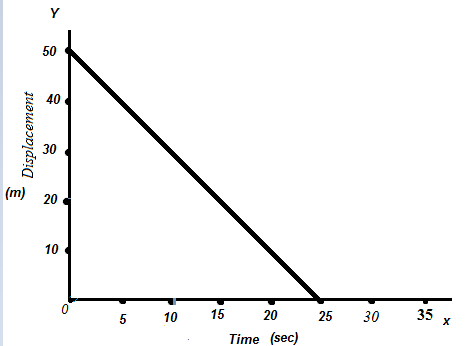
What is happening in this graph?
constant positive velocity
constant negative velocity
negative acceleration
gravity
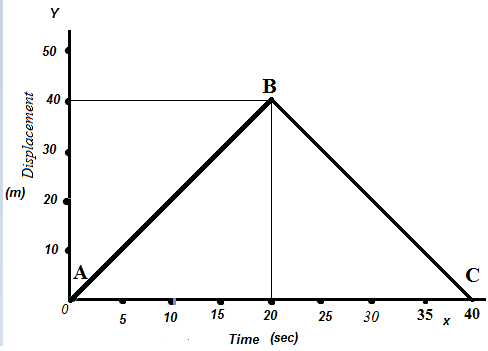
What is happening from A to B?
acceleration
uniform velocity
uniform acceleration
What is happening from B to C?
acceleration
uniform negative velocity
uniform acceleration
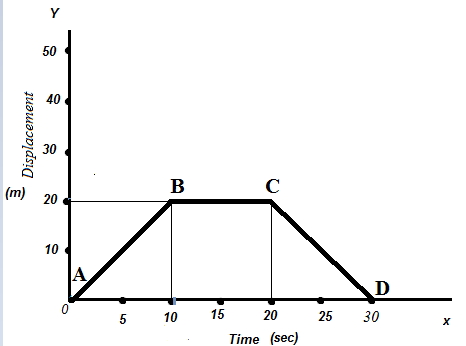
What is happening from A to B, from B to C and from C to D in the given graph?
A to B uniform positive velocity, B to C at rest, C to D uniform negative velocity
A to B positive acceleration, B to C no acceleration and C to D negative acceleration
A to B high speed, B to C low speed, C to D very low speed
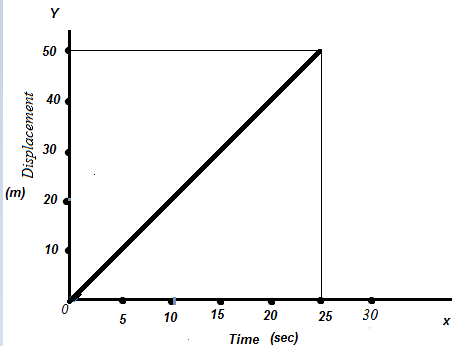
Find the velocity from the given graph.
2 m/s
21 m/s
100 m/s
-2m/s
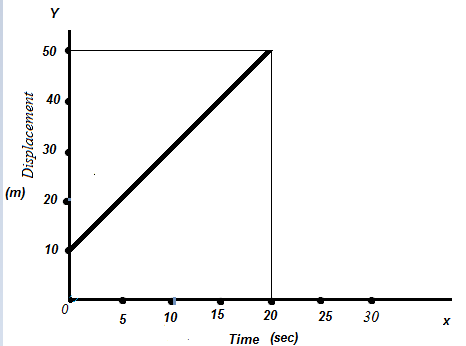
Find the velocity from the given graph.
2 m/s
-2m/s
2.5m/s

Find the velocity from the given graph.
-2m/s
−21 sm
2m/s

what does this graph show?
positive acceleration
negative acceleration (deceleration)
positive uniform velocity
negative uniform velocity
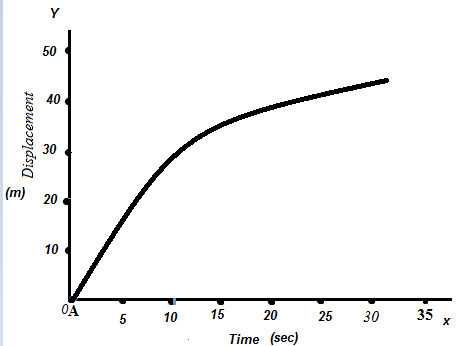
what is shown in this graph?
negative velocity
positive velocity
negative acceleration deceleration
positive acceleration
Initial velocity of a car was 10m/s after 5s the velocity of the car 30m/s. Find the acceleration of the car.
4
s2m4m/s
3m

Find how much time does it take for the car to go from rest to 10m/s at an acceleration of 2m/s^2(use the acceleration triangle)
5s
2s
1m/s

