wayground logo

Free Printable Worksheets

Font size

S
M
L
XL
Worksheets

Module 3 - Understanding Life - Review

Total questions: 100

Worksheet time: 2hrs 40mins

Name
Class
Date
1.

What is the MINIMUM amount of cells an organism must have to be considered living

a)

1

b)

2

c)

3

d)

4

2.

Pick all examples of a living thing

a)

A human

b)

A rock

c)

A dog

d)

Sand

3.
Is fire living, nonliving, or once alive? 
a)
Once Alive
b)
Nonliving
c)
Alive
d)
None of the above
4.
Is a mushroom growing from the ground living, nonliving, or once alive? 
a)
Living
b)
Nonliving
c)
One alive
d)
None of the above
5.
Is lightning living, nonliving, or once alive? 
a)
Living
b)
Nonliving
c)
Once alive
d)
None of the above
6.
Is bacteria living, nonliving, or once alive? 
a)
Living
b)
Nonliving
c)
Once alive
d)
None of the above
7.
How do we know that coral is alive? 
a)
It grows.
b)
It reproduces.
c)
It uses energy. 
d)
All of the above. 
8.
How do we know that a seed is alive? 
a)
It grows and develops. 
b)
It comes from the Earth. 
c)
It has a protective shell. 
d)
They are often carried by the wind. 
9.
Which of the following is true for ALL living things? 
a)
All living things can move independently.
b)
All living things need insulin to survive.
c)
All living things have brain cells.
d)
All living things grow.
10.
Which of the following is true for ALL living things? 
a)
All living things eat other organisms to survive.
b)
All living things have muscle fibers.
c)
All living things need oxygen.
d)
All living things reproduce.
11.
All living things use energy.
a)
True.
b)
False.
12.

_______ are the smallest units of life because they grow, reproduce, respond, and use energy.

a)

atoms

b)

elements

c)

cells

d)

all of the above

13.

Cells come from______.

a)

other preexisting cells

b)

cytoplasm

c)

organelles

d)

prokaryotes

14.

The cell theory states that_________

a)

cells come from cells

b)

all organisms are made of cells

c)

cells are the basic unit of structure and function for life

d)

all of the above

15.

________ is the scientist who saw small chambers when looking at cork, and named them “cells”.

a)

Newton

b)

Hooke

c)

Carson

d)

Manning

16.

The size of an organism is determined -

a)

by the size of the cells that make up the organism.

b)

by the number of cells that the organism has.

17.

The cell theory is a result of the work of one very important scientist name Hooke.

a)

True

b)

False

18.

A multicellular organism is made of

a)

one cell

b)

multiple cells

c)

unicellular cells

d)

there is no such thing as a "multicellular" organism

19.

One common feature of all cells is their ability to -

a)

work with other cells in a "unicellular" organism.

b)

reproduce themselves.

c)

be formed by spontaneous generation.

d)

exist without needing a cell membrane

20.

When a cell is ready to reproduce, it duplicates its contents, then divides into two similar (and sometimes exact duplicate) cells.

a)

True

b)

False

21.

Regardless of type, all cells

a)

have a cell membrane

b)

have cytoplasm

c)

can duplicate themselves by undergoing cell division

d)

all of the above

22.
A ____________ is the basic unit of function in all living things.
a)
organism
b)
cell
c)
tissue
d)
nucleus
23.
An _____________ is any living thing.
a)
cell
b)
tissue
c)
organism
d)
organelle
24.
Some organisms have only one cell.  They are called _________.
a)
single celled
b)
multi-celled
25.
Organisms that have many cells are called __________
a)
single celled
b)
multi-celled
26.
Acts as the "brain" of the cell and controls all of the cell's activities
a)
cell membrane
b)
cell wall
c)
cytoplasm
d)
nucleus
27.
Acts as a "door".  Holds the cell together and controls what goes in and out of the cell
a)
cell membrane
b)
nucleus
c)
cell wall
d)
chloroplast
28.
Found only in plant cells.  It supports and protects the cell
a)
cytoplasm
b)
nucleus
c)
cell wall
d)
cell membrane
29.
A jelly like substance that helps the cell stay healthy
a)
cell wall
b)
cytoplasm
c)
nucleus
d)
chloroplast
30.
Makes food for the plant cell
a)
nucleus
b)
vacuole
c)
cell wall
d)
chloroplast
31.
Acts as a "storage tank".  Stores food, water, and waste
a)
nucleus
b)
cell wall
c)
vacuole
d)
cytoplasm
32.
The "powerhouse".  Releases energy from food.
a)
mitochondrion
b)
nucleus
c)
chloroplast
d)
vacuole
33.
Cells work together to make ____
a)
organs
b)
tissues
c)
organ systems
d)
organisms
34.
Tissues work together to make _____
a)
tissues
b)
organs
c)
organ systems
d)
organisms
35.
Organs work together to make _____
a)
tissues
b)
organs
c)
organ systems
d)
organisms
36.
Organ systems work together to make ____
a)
tissues
b)
organs
c)
organ systems
d)
organisms
37.
1.What cells carry electrical signals?
a)
Red blood cells
b)
Nerve cells
c)
Sperm cells
38.
The nucleus 
a)
contains genetic material
b)
is for respiration
c)
is for photosynthesis
d)
is for movement
39.
What cell carries the father’s genetic information?
a)
Sperm cell
b)
Egg cell
c)
Leaf cell
d)
Red blood cell
40.
Mitochondria are used for...
a)
Collecting sunlight
b)
Containing genetic material
c)
Respiration
d)
Collecting water
41.

Which type of cells are able to make their own food?

a)

Animal cells only

b)

Plant cells only

c)

Both animal and plant cells

d)

Fungi cells

42.

What extra organelles are found in plant cells only

a)

Chloroplasts, Nucleus and Cytoplasm

b)

Nucleus only

c)

Nucleus and Cytoplasm

d)

Chloroplasts, Cell wall and Vacoule

43.

Why do very active cells have lots of mitochondria?

a)

Mitochondria release energy to power cells

b)

Mitochondria help cells to divide in two

c)

Mitochondria help give the cell their shape

d)

Mitochondria make hormones

44.

What type of cell is this?

a)

nerve cell

b)

egg cell

c)

sperm cell

d)

red blood cell

45.

What type of cell is this?

a)

red blood cell

b)

white blood cell

c)

nerve cell

d)

egg cell

46.

What type of cell is this?

a)

white blood cell

b)

sperm cell

c)

egg cell

d)

leaf (palisade) cell

47.

What type of cell is this?

a)

nerve cell

b)

muscle cell

c)

bacterium

d)

sperm cell

48.
 ______________ is the process by which plants make their own food.
a)
photosynthesis
b)
sunlight
c)
seeds
d)
chlorophyll
49.
To make food plants needs...1. 2.3.
a)
carbon dioxide, water, and sunlight
b)
soil, water, sunlight
c)
sunlight, oxygen, and water
d)
air, seeds, and flowers
50.
The process by which a plant grows from a seed.
a)
growing
b)
germination
c)
adult
d)
baby to adult
51.
The ______ of a plant work with the sun to make food for the plant.
a)
leaves
b)
petals
c)
flowers
d)
roots
52.
They make seeds for new plants to grow and they attract  insects or birds that will carry pollen.
a)
flowers
b)
seeds
c)
petals
d)
roots
53.
Brightly colored parts of flowers that attract insects.
a)
petals
b)
pistils
c)
stamen
d)
filaments
54.
After fertilization what does the ovary develop into?
a)
Fruit
b)
Bud
c)
Seed
d)
Flower
55.
C, D , and E are collectively known as the ______.
a)
stamen
b)
anther
c)
sepal
d)
pistil
56.
The male reproductive structure of a flower is the ___.
a)
pistil
b)
ovary
c)
stamen
d)
ovule
57.

Plants are _________________ which means they make their own food.

a)

heterotrophs

b)

chemotrophs

c)

autotrophs

d)

liveotrophs

58.

What substance is made through photosynthesis and is food for the plant?

a)

chlorophyll

b)

chloroplast

c)

glucose

d)

dextrose

59.

The tiny opening on the plant that lets air in and holds water in is called the ___________________.

a)

guard cell

b)

stomata

c)

petal

d)

cuticle

60.

Respiration is a vital function that all living things carry out.

a)

True

b)

False

61.

Respiration takes place in

a)

the cells

b)

the lungs

c)

the heart

d)

the brain

62.

Is respiration the same as breathing?

a)

Yes

b)

No

63.

Respiration is the process by which (a)   is produced.

64.

For respiration to take place glucose needs to react with substance A. Select substance A.

a)

Carbon dioxide

b)

Water

c)

Oxygen

d)

Ozone

65.

When respiration takes place, energy is produced along with another two substances B and C. Select substances B and C.

a)

Carbon dioxide

b)

Water

c)

Oxygen

d)

Ozone

66.

The glucose used during respiration is provided by our

a)

digestive system

b)

respiratory system

c)

circulatory system

67.

The oxygen used during respiration is provided by our

a)

digestive system

b)

respiratory system

c)

circulatory system

68.

During exercise our body needs to produce more energy by respiration thus it needs

a)

less oxygen

b)

more oxygen

69.

Do plant cells carry out respiration

a)

Yes

b)

No

70.

What are the gases found in the air?

a)

Hydrogen, oxygen, carbon dioxide, noble gases and water vapour.

b)

Nitrogen, oxygen, carbon dioxide. noble gases and water.

c)

Hydrogen, oxygen, carbon dioxide and helium.

d)

Nitrogen, oxygen, carbon dioxide, noble gases and water vapor.

71.

What is the percentage of nitrogen gas in the air?

a)

1%

b)

0.03%

c)

20%

d)

79%

72.

What is the percentage of oxygen gas in the air?

a)

1%

b)

0.03%

c)

20%

d)

79%

73.

What is the percentage of noble gases in the air?

a)

1%

b)

0.03%

c)

20%

d)

79%

74.

What is the percentage of carbon dioxide gas in the air?

a)

1%

b)

0.03%

c)

20%

d)

79%

75.

During breathing human take in __________________ gas and breathe out _________________ gas.

a)

hydrogen, oxygen.

b)

hydrogen, carbon dioxide

c)

oxygen, carbon dioxide

d)

carbon dioxide, nitrogen

76.

What gas is not present in the air?

a)

xenon

b)

carbon dioxide

c)

hydrogen

d)

carbon dioxide

77.

What is the correct order of gases, from LARGEST to smallest amount?

a)

Oxygen, Nitrogen, other gases

b)

Nitrogen, Oxygen, Other gases

c)

Other gases, Oxygen, Nitrogen

78.

Air pollution causes all of the following, except

a)

holes in the ozone layer

b)

increased particles in the air

c)

acid rain

d)

healthy air to breath

e)

smog

79.

Natural causes of air pollution include all of the following

a)

forest fires

b)

dust

c)

volcanic ash

d)

wind

e)

pollen

80.

How do humans cause air pollution?

a)

plowing of fields

b)

burning fossil fuels (coal, oil)

c)

using solar power

d)

driving electric cars

81.

What is the main cause of air pollution?

a)

plowing fields and releasing dust

b)

using solar power

c)

burning fossil fuels

d)

using water power

82.

Climate change caused by extra carbon dioxide in the air that causes heat to get trapped in the atmosphere is called

a)

global warming

b)

photosynthesis

c)

smog

83.

A mixture of smoke, fog and chemicals in the air is known as ________.

a)

oxygen

b)

radiation

c)

smog

84.

What are ways that we can decrease air pollution?

a)

carpool

b)

conserving electricity

c)

follow laws made by the EPA

d)

burning extra fossil fuels

85.

Pests are defined as

a)

Any species that interferes with human welfare

b)

Chemicals that can kill

c)

Any species that can be beneficial to humans

86.

An herbicide is a type of pesticide that kills ...

a)

insects

b)

plants

c)

fungi

d)

rodents

87.

In agriculture pests can cause devastation and huge financial losses.

a)

True

b)

False

88.

Pest control is as old as agriculture, it dates back 4,500 years ago.

a)

True

b)

False

89.

Respiratory problems, birth defects and cancer have been connected to the use of chemical pesticides.

a)

True

b)

False

90.

What is the layer of soil just below the topsoil?

a)

soil

b)

subsoil

c)

topsoil

d)

terrace farming

91.
When plants, animals, and other organisms die, they break down and become part of the soil. What is this part of the soil called?
a)
sand
b)
silt
c)
clay
d)
humus
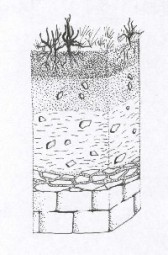
92.
Which layer is the bottom of the soil profile?
a)
C - Partially Weathered Parent Material
b)
D - Separated rock
c)
R - Bedrock
d)
A - Topsoil
93.
Layers of soil are also known as:
a)
Soil Profiles
b)
Soil Horizons
c)
Soil sheets
d)
Soil cores
94.
Soil is made of
a)
weathered rocks and minerals
b)
dead plants and animals
c)
air and water
d)
all of the above
95.
An organism, especially a soil bacterium, fungus, or invertebrate, that breaks down organic material is a...
a)
Decomposer
b)
Burrower
c)
Humus source
96.
The texture of soil depends mainly on
a)
the types of plants that grow in the soil.
b)
the size of the particles in the soil.
c)
the color of the soil.
d)
the number of worms in the soil.
97.
If a soil particle is big, meaning it has a larger pore space, how will the water flow?
a)
Fast
b)
Slow
98.
Which type of soil drains the slowest?
a)
silt
b)
clay
c)
sand
d)
loam
99.

What type of soil has all other soils in it?

a)

Sand

b)

Clay

c)

Loam

d)

Silt

100.

Which soil is best to grow plants in?

a)

silt

b)

loam

c)

sand

d)

clay