
 Worksheets
ENHANCEMENT PHYSICS FINAL EXAM
Total questions: 50
Worksheet time: 54mins
Which of the following is a CORRECT statement?
Sound can travel through the vacuum of space.
Sound can't travel through the vacuum of space.
Sound is produced in the vacuum of space.
Sound can travel between planets .

List the order of mediums through which sound travels from fastest to slowest.
Liquid, Gas, Solid
Gas, Solid, Liquid
Solid, Liquid, Gas
Solid, Gas, Liquid

What is frequency?
the number of vibrations per second
how high or low a sound is
the loudness or softness of a sound
the back and forth movement of matter
Which of the graphs below has the highest maximum frequency?


brick, concrete, glass, tile, wood


Which of the following materials will sound travel the fastest? air, water, milk, or metal
air
milk
water
metal
Why is sound able to travel faster through a solid than a gas?
Gas molecules are packed tightly.
Solid molecules are packed tightly.
Sound does not travel faster through a solid than a gas.
Gas molecules move slowly.

Flash and thunder are produced simultaneously. But thunder is heard a few seconds after the flash is seen. Why?
The speed of sound is faster than the speed of light.
The speed of sound is equal to the speed of light.
The speed of light is faster than the speed of sound.
All of the above
Which of the following would be most likely to transmit sound the best?
steel in cabinet
water in the ocean
air in your classroom
water in a swimming pool
Why sound is better heard at night than at day?
How can sound travel through air?
Through open spaces
Through air particles bumping into each other
Through electronically charged particles
It doesn't travel; it just exists

The water in Mario’s swimming pool absorbs energy as heat during the day. Which of the following would the water in the pool be most likely to do?
condense
evaporate
freeze
melt
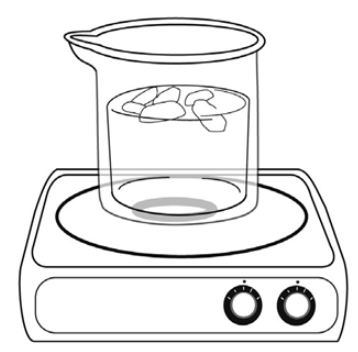
Emerson places a beaker of water on a hotplate and turns the hotplate on. The temperature in the room is 25 ºC. After the water heats to 75 ºC, she adds pieces of ice to the beaker.
Which of the following describes a transfer of heat energy that occurs during this experiment?
from the air to the water
from the ice to the beaker
from the water to the ice
from the water to the hotplate

How does the thermal energy of the liquid in the larger beaker compare to the thermal energy of the liquid in the smaller beaker?
The liquid in the larger beaker has less thermal energy than the liquid in the smaller beaker.
The liquid in the larger beaker has more thermal energy than the liquid in the smaller beaker.
The liquid in the larger beaker has the same amount of thermal energy as the liquid in the smaller beaker.
The exact volume of the liquid in each beaker must be known to compare the thermal energy of the liquids.
Which description defines heat?
total thermal energy of an object or substance
change in the temperature of a substance in degrees Celsius
energy transferred between objects at different temperatures
average kinetic energy of the particles that make up a substance

The pan is made of iron. The handle is NOT too hot to touch. What might the pan's handle be made of?
copper
aluminum
wood
iron

Rahma got an ice cream from her mom. The ice cream melts under the sun because the ice cream ___________.
gains heat from the sun
loses heat to the sun
cannot withstand the heat from the sun
produce too much heat

A device that measures temperature.

the lesser the temperature
the constant the temperature of objects

Mariana is at the beach with her parents so she see on a clock that the temperature is 104 ºF, she asks his father what is the temperature in celsius. He father says:
279,5 ºC
40 ºC
55,5 ºC
104 ºC

Juanita tells to his mother that she wants to go some day to iceland to see beautiful landscape, but his mother says that the temperatures there are around 280 K on may, Juanita convert to Celsius and get:
44.33 ºC
280 ºC
7 ºC
89 ºC
What is heat?
a form of light
a form of energy
a measure of how old or cold something is

Which cup contains more heat?
Cup A
Cup B
If two objects have different temperatures, heat will flow from the warmer object to the cooler one UNTIL ____________
one reaches a temperature of zero
they both have an equal temperature
one runs out of energy
How much heat is required to raise the temperature of a sample of copper from 10.0°C to 55.0°C, if its mass is 10.00 g? specific heat of copper is 0.385 J/(g∙°C).
1881 J
250. J
173 J
359 J

Kito puts his spoon into a helping of fresh, hot, mashed potatoes as shown in the picture. Which process takes place when the objects come together?
The temperature of the spoon increases, but its thermal energy does not change.
Energy in the form of heat is transferred by conduction from the warmer mashed potatoes to the cooler spoon.
The thermal energy of both the mashed potates and the spoon increase as the energy in the form of heat is transferred between them.
The average temperature of the spoon does not change.

Which state of matter does this image represent?
liquid
solid
gas

When thermal energy is added to a substance, the substance's particles move:
More rapidly at an increased distance from each other.
More rapidly with less distance between each other.
More slowly with a greater distance between each other.
More slowly with a reduced distance between each other.

The picture shows two completely identical mason jars. They're both filled with the same gas, only one of them has more in it (more molecules). What can you say about the pressures of both jars?
P1 > P2 (greater pressure in jar 1)
P1< P2 (greater pressure in jar 2)
P1 = P2 (same pressure in both)
There's not enough info to tell
The entropy of the universe tends to be maximum. What of the laws of thermodynamics generalises to the above statement?
Zeroth
First
Second
Third

Explain how the 1st law of thermodynamics is applied to this system.

