Worksheets
Gravitation
Total questions: 47
Worksheet time: 54mins
Newton’s Universal Law of Gravitation state that gravitational force, F is ______ to the product of mass of the objects and ______ to the square of the distance between the objects
Hukum Kegravitian Semesta Newton menyatakan bahawa daya graviti, F adalah ______ terhadap hasil darab jisim-jisim objek dan ______ terhadap kuasa dua jarak antara objek-objek
directly proportional, directly proportional
berkadar terus, berkadar terus
directly proportional, inversely proportional
berkadar terus, berkadar songsang
inversely proportional, inversely proportional
berkadar songsang, berkadar songsang
inversely proportional, directly proportional
berkadar songsang, berkadar terus
F = G r2m1m2
What is represented by r in this formula?
Apakah yang diwakili oleh r dalam formula ini?
Gravitational force
between two objects
Daya graviti antara dua objek
Universal gravitational constant
Pemalar kegravitian semesta
Mass of object
jisim objek
Distance between two objects
jarak antara dua objek
Factors that affect gravitational force are
Faktor-faktor yang mempengaruhi daya graviti adalah
mass of objects
jisim objek-objek
velocity of objects
halaju objek-objek
acceleration of objects
pecutan objek-objek
distance between the objects
jarak antara objek-objek

When the distance between two objects increases, the gravitational force __________
Apabila jarak antara objek-objek bertambah, daya graviti _________
increases
bertambah
decreases
berkurang
unchanged
tidak berubah

When the mass of two objects increases, the gravitational force _______
Apabila jisim antara dua objek meningkat, daya graviti ________
increases
bertambah
decreases
berkurang
unchanged
tidak berubah

This formula is used to find the value of g. What is g?
Formula ini digunakan untuk mendapatkan nilai g. Apakah itu g?
Mass of Earth
Jisim Bumi
Gravitational acceleration of Earth
Pecutan graviti Bumi
Universal gravitation constant
Pemalar kegravitian semesta
Distance between Earth and the object
Jarak antara Bumi dengan objek

When the distance between object and Earth increases, Earth's gravitational acceleration _______
Apabila jarak antara objek dan Bumi bertambah, pecutan graviti Bumi ________
increases
bertambah
decreases
berkurang
unchanged
tidak berubah

Calculate the gravitational acceleration when the object is at 3R.
Kirakan pecutan graviti apabila objek berada pada 3R.
2.5 m s−2
3.3 m s−2
4.9 m s−2
9.8 m s−2

Calculate the gravitational acceleration of Jupiter.
Kirakan pecutan graviti bagi Jupiter.
3.7 m s−2
10.42 m s−2
25.94 m s−2
274 m s−2

What happen to the centripetal force if the linear speed of the object is higher?
Apakah yang berlaku terhadap daya memusat apabila laju linear objek lebih tinggi?
Centripetal force will be higher
Daya memusat akan lebih tinggi
Centripetal force will be lower
Daya memusat akan lebih rendah
Centripetal force will stay the same
Daya memusat akan tetap sama
Which of the following shows the applications of centripetal force in our daily life?
Manakah antara berikut menunjukkan aplikasi-aplikasi daya memusat dalam kehidupan seharian kita?


F = G r2Mm
12.4 N
19.5 N
26.6 N
31.3 N

M=GT24π2r3
Figure shows Mercury orbiting the Sun with a radius of 5.79 × 10^10 m and a period of revolution of 7.57 × 10^6 s. Calculate the mass of the Sun.
1.5×1030 kg
1.8×1030 kg
2.0×1030 kg
2.5×1030 kg

Which of these law applies to that statement?
Manakah antara hukum-hukum berikut mengikuti penyataan tersebut?
Kepler's First Law
Hukum Kepler Pertama
Kepler's Second Law
Hukum Kepler Kedua
Kepler's Third Law
Hukum Kepler Ketiga

Choose the correct statement from Kepler's First Law.
Pilih penyataan yang betul daripada Hukum Kepler Pertama.
The major axis is shorter than the minor axis.
Paksi major lebih pendek daripada paksi minor.
The Sun always stays on a focus of the ellipse.
Matahari sentiasa menjadi fokus bagi elips.
Planets can be assumed to make circular motion around the Sun.
Planet-planet dianggap membuat gerakan membulat mengelilingi Matahari.
The radius of orbit = the average value of the distance between the planet and the Sun.
Jejari orbit = nilai purata jarak antara planet dan Matahari.

Which of these law applies to that statement?
Manakah antara hukum-hukum berikut mengikuti penyataan tersebut?
Kepler's First Law
Hukum Kepler Pertama
Kepler's Second Law
Hukum Kepler Kedua
Kepler's Third Law
Hukum Kepler Ketiga

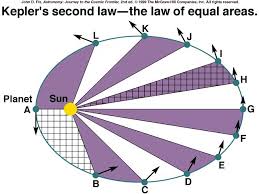
Which statements are true based on Kepler's Second Law?
Manakah penyataan yang betul berdasarkan Hukum Kepler Kedua?
Time/Masa : AB = CD
Area/Luas : AFB = CFD
Distance/Jarak : AB < CD
Linear speed/Laju linear : AB > CD

Which of these law applies to that statement?
Manakah antara hukum-hukum berikut mengikuti penyataan tersebut?
Kepler's First Law
Hukum Kepler Pertama
Kepler's Second Law
Hukum Kepler Kedua
Kepler's Third Law
Hukum Kepler Ketiga

A planet which has larger radius, r will have a ________ orbital period, T.
Sebuah planet yang mempunyai jejari , r yang lebih besar akan mempunyai tempoh orbital, T yang ________
T2α r3
longer
lebih lama
shorter
lebih singkat
constant
malar

At what height should a satellite be if the satellite is required to orbit the Earth in a period of 24 hours?
[Orbital period of the Moon = 27.3 days, radius of orbit of the Moon = 3.83 × 10^8 m]
2.8×10⁷ m
2.9×10⁷ m
3.5×10⁷ m
3.6×10⁷ m

The escape velocity, v of an object depends on
Halaju lepas, v bagi sesuatu objek bergantung kepada
mass of Earth
jisim Bumi
mass of object
jisim objek
distance of the object from the center of the Earth
jarak objek dari pusat Bumi
The Earth has large mass, the escape velocity of an object from the Earth must be at ________ 11 200 ms-1 or 40 300 km h-1.
Bumi mempunyai jisim yang besar, maka halaju lepas sesuatu objek dari Bumi perlulah mempunyai ________ 11 200 m s-1 atau 40 300 km j-1.
higher value than
nilai yang lebih tinggi daripada
lower value than
nilai yang lebih rendah daripada
same value as
nilai yang sama seperti
Escape velocity is the ________ requirement for an object on the Earth's surface to overcome the gravitational force and escape to outer space.
Halaju lepas adalah keperluan _________ bagi sesuatu objek di Bumi untuk mengatasi daya graviti dan melepaskan diri ke ruang angkasa.
minimum
minimum
maximum
maksimum
Compare the escape velocity from the Earth for spacecraft X of mass 1500 kg and spacecraft Y of mass 2000 kg.
Bandingkan halaju lepas daripada Bumi untuk kapal angkasa X yang berjisim 1500 kg dan kapal angkasa Y yang berjisim 2000 kg.
X > Y
X < Y
X = Y

Proba-1 satellite orbits the Earth at a height of 700 km. What is the linear speed of this satellite?
[G = 6.67 × 10⁻¹¹ N m2 kg–2, mass of the Earth = 5.97 × 1024 kg, radius of the Earth = 6.37 × 10⁶ m]
4.52 x 10³ m s-1
7.49 x 10³ m s-1
9.37 x 10³ m s-1
12.26 x 10³ m s-1
Astronauts live in the ____________________ and conduct experiments.
International Space Room
International Space Station
International Space Rocket
International Space House
The velocity a rocket must achieve to establish an orbit around another object in space
Orbit Velocity
Velocity
Space shuttle
probe
The velocity a rocket must reach to escape from a planet or moons gravitational pull
Vacuum
Satellite
Escape velocity
Geosynchronous orbit
Calculate the escape velocity of a satellite in an orbit 300 km above Earth’s surface. Given G = 6.67 x 10^-11 N m^2 kg^-2, radius of earth is 6370 km and mass of the earth is 5.97 x 10^24 kg.
7.73 km s^-1
10.9 km s^-1
36.4 km s^-1
244 km s^-1
Which of the following is true about non-geostationary satellites?
Its orbital period around the earth is one day.
It is at a height of (35000-36000) km above the equator of surface of the earth.
Example of the satellites are GPS.
It can be in an orbit of which is very close to the surface of the earther or very further away from the surface of the earth.
Example of the satellites are communication satellites.
Acceleration of a satellite is ______
A) rGM
B) r2GM
C) r2GM1M2
A
B
C
none of the above

Two satellites orbit a moon. Satellite A and Satellite B. Satellite B is twice as far away from the moon. Its speed should be ____
half as much as the speed of A
less than the speed of A but not exactly half as much
twice as great as the speed of A
greater, but not twice as great as A

A satellite orbits a moon at radius r, if the moon were to gain a significant amount of mass from asteroid collisions, the speed of the satellite will ___
increase
decrease
remain unaffected
depends on the mass of the satellite

A space donut orbits a planet in an elliptical orbit... The donut is moving the SLOWEST at ____ (see image)
r1
r2
it is the same speed at every part of its orbit
none of the above