
 Worksheets
LC5 - Y9 Ecosystems & Tropical Rainforests 2.0
Total questions: 60
Worksheet time: 30mins
The variety of life in the world or a particular ecosystem
Environmental Diversity
Biodiversity
Flora and Fauna
Biomass
Direct connections between different organisms (plants and animals) that rely upon one another as their source of food
Food Chain
Food Web
Habitat
Biome
The term biotic refers to what?
The non-living parts of an ecosystem.
The living parts of an ecosystem.
Decomposers
An organism that is able to create energy (glucose) from the sun through photosynthesis
Primary Consumer
Secondary Consumer
Tertiary Consumer
Producer
An organism that eats other flora or fauna
Consumer
Producer
Decomposer
Devourer
A complex hierarchy of plants and animals relying on each other as different food sources
Nutrient Cycling
Food Chain
Food Cycle
Food Web
Organisms such as bacteria or fungi that break down dead organic matter
Producer
Decomposer
Ants & Beetles
Microscopic Animals
Which ecosystem is located closest to the equator?
Hot deserts
Tropical grasslands
Hot deserts
Tropical rainforests
Which map best shows the location of tropical rainforests?
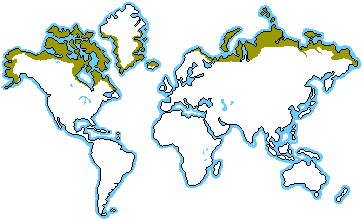
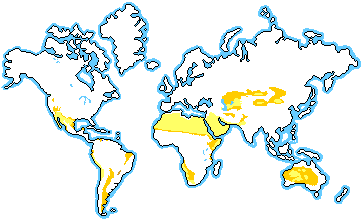
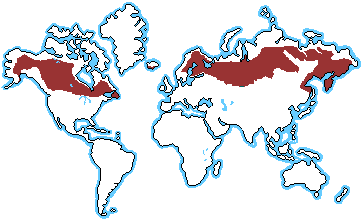
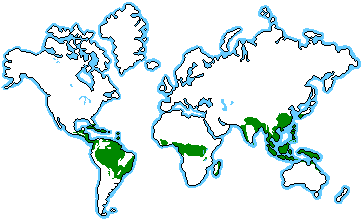
The climate in a Tropical Rainforest can be described as...
Cold, Wet and Humid
Humid, dry and Hot
Humid, wet and Hot
Cold, Wet and unstable
Rainforests typically have more than, how much rainfall?
250 mm
1500 mm
2500 mm
500 mm
How would you describe the soils of the tropical rainforest?
Deep and rich in nutrients.
Thin and poor in nutrients.
What is the largest store in the nutrient cycle for tropical rainforests?
Biomass
Litter
Soil

Using the climate-graph which month had the highest monthly rainfall?
August
December
March
June
What is the name of the top layer of tropical rainforests?
(a)
Which rainforest layer receives the most sunlight?
Under canopy
Forest floor
Canopy
Emergent layer
The process of an organism or species changing over time to become better suited to its environment
Darwinism
Evolution
Changes
Adaptation

The leaves on the Emergent trees are smaller than the leaves on the trees that grow in the Shrub layer. This is because ...
At the shrub layer there is limited light for seeing
At the shrub layer there is limited light for photosynthesis
At the shrub layer there are many animals that eat leaves
At the shrub layer there is a lot of rain so the leaves are big for animals to hide under
The canopy contains most of the _____ in the rainforest.
Fungi
Air
Animals
Soil
The Emergent trees have __________ roots to help stop them _________________.
Buttress, Falling down
Big, Growing taller
Butted, Hurting other trees
Buttress, Growing too close together
Which of the following are adaptations of plants in the tropical rainforest?
Drip tip leaves
Buttress roots
Succulents
Large leaves
This is a disease that affects ash trees causing bark damage...?
(a)
The rate of deforestation has (a) over time.
Which of one of the below is a cause of deforestation?
Urbanisation
Buying a chirstmas tree during the holidays
Overbreeding birds in the wild
Cutting down the tree in your backyard
If the rainforests were to disappear, the amount of carbon dioxide in the atmosphere would ____.
Increase
Decrease
Increase briefly, then decrease
Stay the same
Select the correct positive to palm oil being used below...
Covers a low surface area for higher yield than other vegetable oils
Decreases forest fires in tropical rainforest regions
Changes habitats and alters the biodiversity of the area
There are no positives to palm oil
Which of the below is a reason NOT to deforest the Tropical Rainforest (select all that apply)
They contain 60% of the worlds biodiversity
They are a carbon sink and store large amounts of carbon
They are not needed for anything other than a food source
They are not important unless used for cattle ranching
Which of the following needs to be higher for a population to naturally increase?
Death rate
Life expectancy
Birth rate
Which two continents are projected to experience the greatest urban growth in the future?
Europe
Africa
Asia
North America
Which of the following is the correct definition for urbanisation?
The increase in the number of people living in urban areas.
The increase in the proportion of people living in urban areas.
The increase in the proportion of people living in rural areas.
The increase in the number of people living in rural areas.
Areas of sea, fresh or groundwater depleted of dissolved oxygen are known as (a) ?
A naturally occurring event that has the potential to affect people is which of the below?
Natural Disaster
Convection Currents
Natural Hazard
Tectonic Hazards
I don't know
A naturally occurring event that causes significant social, environmental and economic damage is which of the below?
Natural Disaster
Convection Currents
Natural Hazard
Tectonic Hazards
I don't know

Using the diagram name layer 'A' of the Earth
(a)
Using the diagram name layer 'B' of the Earth
(a)
The upper mantle and crust make up the...
Athenosphere
Mesosphere
Geosphere
Lithosphere
I don't know

From the image, what theory is this showing?
Convection Currents
Continental Drift
Slab Pull
Subduction
I don't know

From the image, what theory is this showing?
Convection Currents
Continental Drift
Slab Pull
Subduction
I don't know
Which type of crust is denser, younger and colder?
Oceanic Crust
Continental Crust
Constructive Crust
I don't know
Which type of crust is less dense, older and warmer?
Oceanic Crust
Continental Crust
Constructive Crust
I don't know

Which plate boundary is shown in the image?
Conservative
Collision
Destructive
Constructive
I don't know

Which plate boundary is shown in the image?
Conservative
Collision
Destructive
Constructive
I don't know
The thickness of a fluid or semi-fluid is the definition for which word? Write it in the box below
(a)
Name the country of our earthquake HIC case study...
(a)
Name the country of our earthquake LIC case study...
(a)
The indirect impact that occur after a natural event e.g. homelessness, is which of the below?
Primary Effects
Secondary Effects
Immediate Responses
Long-Term Responses
I don't know
The reactions of people as a disaster happens and the aftermath e.g. digging out survivors, is which of the below?
Primary Effects
Secondary Effects
Immediate Responses
Long Term Responses
I don't know
The reactions that occur in the weeks, months and years after an event e.g. rebuilding homes, is which of the below?
Primary Effects
Secondary Effects
Immediate Responses
Long Term Responses
I don't know
The initial impact of a natural event on people and property e.g. buildings collapsed, is which of the below?
Primary Effects
Secondary Effects
Immediate Responses
Long Term Responses
I don't know
An 'Increase in the area covered by cities' is known as which of the below?
Squatter Settlements
Urbanisation
Urban Growth
I don't know
Which TWO reasons below are why cities populations are increasing?
Migration
Natural Decrease
Urban to Rural Migration
Natural Increase
Attractions
Cities with a population of over 10 million are called...
(a)
What country is Rio de Janeiro in?
(a)
Which neighbourhood in Rio is the richest?
West
North
South
East/ Downtown
I don't know
Which neighbourhood in Rio is where the Olympic Stadium is built?
West
North
South
East/ Downtown
I don't know
'Jobs with regular wages, contracts and who pay taxes' are called which of the below?
Informal Economy
Industrial Economy
Formal Economy
I don't know
Which of the below are socioeconomic challenges in Rio?
Tapping into electricity power lines
Shortage of schools in the favelas
Most jobs are in the informal economy
Introduction of pacifying units to favelas
All of the above

Name which Megacity does not follow the trend...
(a)
Which of the following two are challenges favelas face?
Creative Hubs
Landslides
High Death Toll
High Crime Rates
I don't know
Which of the following two are opportunities within favelas?
No legislation to begin projects
Most jobs are informal
Lack of infrastructure
Cable cars between favelas allows for travel
I don't know

