wayground logo

Free Printable Worksheets

Font size

S
M
L
XL
Worksheets

Biology Final Review!

Total questions: 82

Worksheet time: 2hrs 47mins

Name
Class
Date
1.

Fox

a)

Abiotic

b)

Biotic

2.

water

a)

biotic

b)

Abiotic

3.

Mushroom

a)

biotic

b)

Abiotic

4.

A rock

a)

Biotic

b)

Abiotic

5.

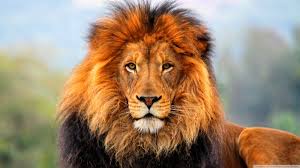
What is this?

a)

herbivore

b)

carnivore

c)

omnivore

d)

decomposer

6.

worms and fungi break down dead organisms so that the matter can be reused because they are

a)

herbivores

b)

carnivores

c)

omnivores

d)

decomposers

7.
Lions only eat buffalo, antelopes, zebras and crocodiles. They are called __________.
a)
Omnivore
b)
Herbivore
c)
Carnivore
d)
Delivore
8.
Bears eat fish, insects, plants, seeds, nuts and young elk. They are called __________.
a)
Franivore
b)
Carnivore
c)
Herbivore
d)
Omnivore
9.
Elephants only eat leaves, fruit, nuts and grass. They are called __________.
a)
Omnivore
b)
Fortivore
c)
Herbivore
d)
Carnivore
10.

Organisms that can produce their own source of food are called...

a)

heterotrophs

b)

omnivores

c)

autotrophs

d)

herbivores

11.

Organisms that are unable to make their own food are called...

a)

autotrophs

b)

heterotrophs

c)

homeotrophs

d)

heterovores

12.

Anything that has mass and takes up space

a)

Matter

b)

Energy

c)

Both

d)

None of the above

13.

The ability to do work, such a make something move or warm something up.

a)

Matter

b)

Energy

c)

Both

d)

None of the above

14.

As we digest food, what happens to the bonds in the food molecules?

a)

they are formed releasing energy

b)

they are formed absorbing energy

c)

they are broken releasing energy

d)

they are broken absorbing energy

15.

In photosynthesis sunlight provides the...

a)

Matter

b)

Energy

c)

Both

d)

None of the above

16.

Heat

a)

Matter

b)

Energy

c)

Both

d)

None of the above

17.

It is made of atoms

a)

Matter

b)

Energy

c)

Both

d)

None of the above

18.

This can leave the ecosystem

a)

matter

b)

energy

c)

both matter and energy

d)

neither matter or energy

19.

This cannot leave the ecosystem, but is recycled

a)

matter

b)

energy

c)

both matter and energy

d)

neither matter or energy

20.

can be created or destroyed

a)

matter

b)

energy

c)

both matter and energy

d)

neither matter or energy

21.
About how much percent of energy is passed on from one organism to to the next on a food web pyramid. 
a)
100 percent of all energy gets passed
b)
45 percent of all energy gets passed
c)
10 percent of all energy gets passed
d)
0 percent of all energy gets passed
22.

Decomposers get energy from...

a)

the sun

b)

eating plants

c)

eating animals

d)

dead things and waste

23.

The original source of energy for a food web is...

a)

plants

b)

sun

c)

producers

d)

decomposers

24.

Producers are ...

a)

plants

b)

able to do photosynthesis

c)

also called autotrophs

d)

all of these are true

25.

Photosynthesis is important because...

a)

it creates energy

b)

it transforms solar energy into chemical energy

c)

it makes water

d)

it's not important

26.

A person who eats a chicken that ate grain is a ...

a)

primary producer

b)

primary consumer

c)

secondary consumer

d)

quaternary consumer

27.

Which of the organisms in the food chain would you expect to have the smallest population

a)

grasses

b)

crickets

c)

field mice

d)

hawks

28.

which does not go with the "K" strategy of reproduction

a)

many offspring

b)

high offspring survival

c)

high parental care

d)

small amount of offspring

29.
Largest number of individuals of a population that the environment can support...  
a)
carrying capacity
b)
population crash
c)
lag phase
d)
mutualism
30.
Which type of growth is best illustrated by this rabbit population?
a)
exponential
b)
logistic
c)
S-shaped
d)
predator-prey
31.

What is the carrying capacity of the graph?

a)

1000

b)

8000

c)

800

d)

600

32.

AB -->A + B

a)

Anabolic

b)

Catabolic

33.

A + B --> AB

a)

Anabolic

b)

Catabolic

34.
Main cellular energy molecule
a)
ATP
b)
ADP
c)
cAMP
35.

Reactions that build up molecules

a)

catabolic reaction

b)

anabolic reaction

c)

thermal expansion

d)

reactants and products

36.

Reactions that break down molecules

a)

anabolic

b)

burning

c)

catabolic

d)

thermal

37.

energy is released feels warm

a)

catabolic

b)

anabolic

38.

Energy is absorbed (feels cold)

a)

catabolic

b)

anabolic

39.

Which statement is true according to the image?

a)

A: anabolic; B: catabolic

b)

A: catabolic; B: anabolic

40.

Which type of reaction does the graph represent?

a)

anabolic

b)

catabolic

c)

endergonic

d)

ATP phosphorylation

41.

A larger molecule broken into smaller molecules and releasing energy is an example of a

a)

problematic reaction

b)

anabolic reaction

c)

catabolic reaction

d)

no reaction takes place

42.

What happens to energy as stability increases

a)

it decreases

b)

it increases

c)

it stays the same

43.
Each enzyme only has 1 substrate that will fit its active site.  What is this called?
a)
reusablility
b)
denaturation
c)
specificity
d)
fragility
44.
With what 3 letters do enzymes typically end?
a)
-ose
b)
-ase
c)
-ese
d)
-tic
45.
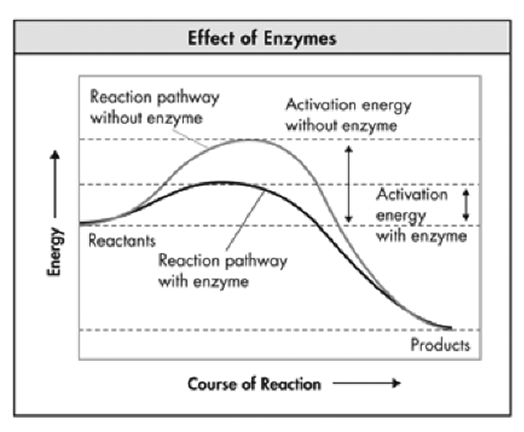
The graph shows how enzymes affect reactions in cells. Which statement best summarizes the information shown in the graph?
a)
Enzymes increase the energy of the reactants.
b)
Enzymes decrease the energy level of the products.
c)
Enzyme decrease the activation energy of the reaction.
d)
Enzymes reverse the direction of the reaction.
46.
Any substance that is acted upon by an enzyme is called a(n)?
a)
Coenzyme
b)
Substrate
c)
Vitamin
d)
Polypeptide
47.
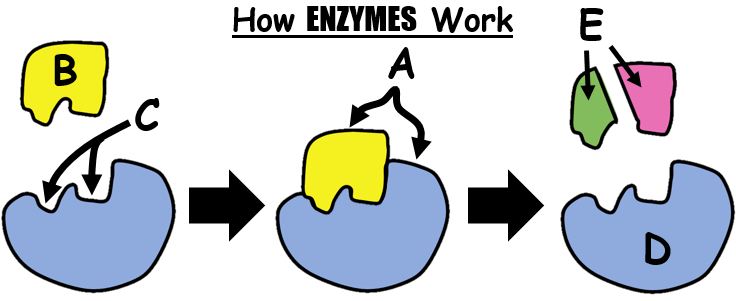
In the diagram, what is letter A? 
a)
product
b)
substrate
c)
enzyme-substrate complex
d)
active site
48.
Enzymes are...
a)
nucleic acids
b)
proteins
c)
lipids
d)
carbohydrates
49.
An enzyme speeds up a chemical reaction in the cell but can only be used once.  True or False? 
a)
true
b)
false
50.
What happens when enzymes are heated to a high temperature?
a)
The enzymes die.
b)
The shapes of the enzyme are altered denature
c)
The enzymes' amino acid sequence changes.
d)
The enzymes remain the same
51.
What is the function of an enzyme?
a)
enzymes break themselves into small pieces
b)
enzymes slow down chemical reactions
c)
enzymes speed up chemical reactions
d)
enzymes combine products to form reactants 
52.
Proteins are made of monomers called ___________
a)
Nucleotides
b)
Monosaccharides
c)
Amino Acids
d)
Glycerol and fatty acids
53.
DNA and RNA are examples of 
a)
Carbohydrates
b)
Lipids
c)
Proteins
d)
Nucleic Acids
54.
Nucleotides are monomers of
a)
Carbohydrates
b)
Lipids
c)
Proteins
d)
Nucleic Acids
55.
Monosaccharides are monomers of
a)
Carbohydrates
b)
Lipids
c)
Proteins
d)
Nucleic Acids
56.
Waxes, oils and fats are examples of
a)
Carbohydrates
b)
Lipids
c)
Proteins
d)
Nucleic Acids
57.
What is the function of nucleic acids?
a)
store genetic information
b)
store energy (long-term)
c)
store energy (short-term)
d)
build skin, hair, nails, muscles
58.
Which macromolecule stores energy, insulates us, and makes up the cell membrane?
a)
lipids
b)
proteins
c)
carbohydrates
d)
nucleic acids
59.
Which group of biomolecules provide quick energy to organisms?
a)
proteins
b)
carbohydrates
c)
lipids
d)
nucleic acids
60.
Lipids can be digested into what smaller subunits?
a)
nucleic acids
b)
amino acids
c)
fatty acids
d)
glucose
61.
Genetic information is stored in which class of organic compounds?
a)
proteins
b)
lipids
c)
nucleic acids
d)
carbohydrates
62.
All organic compounds contain the element
a)
carbon
b)
nitrogen
c)
phosphorus
d)
sulfur
63.
This is one job proteins do NOT have in the body
a)
storing genetic information
b)
structure
c)
speed up chemical reactions
d)
transport things through cell membrane
64.
This process releases chemical energy from sugars and other carbon-based molecules to make ATP when oxygen is present.
a)
photosynthesis
b)
light-independent reaction
c)
cellular respiration
d)
light-dependent reaction
65.
Glucose is broken down during which process
a)
Krebs cycle
b)
Calvin cycle
c)
Glycolysis
d)
Photosynthesis
66.

What are the reactants (taken into) of cellular respiration? (Mark all of them!)

a)

oxygen

b)

glucose

c)

carbon dioxide

d)

water

e)

energy

67.

What is the correct equation for cellular respiration?

a)

6O2 + C6H12O6 -> 6CO2 + 6H2O + Energy

b)

6O2 + C6H12O6 + Energy -> 6CO2 + 6H2O

c)

6CO2 + 6H2O -> 6O2 + C6H12O6 + Energy

d)

6CO2 + 6H2O + Energy -> 6O2 + C6H12O6

68.

Cellular Respiration's goal is to

a)

make water

b)

make ATP

c)

make glucose

d)

make oxygen

69.
Where does the Krebs Cycle take place?
a)
mitochondria
b)
chloroplast
c)
cytoplasm
d)
nucleus
70.

What are the products (what is released) of cellular respiration? (Mark all of them!)

a)

oxygen

b)

glucose

c)

carbon dioxide

d)

water

e)

ATP (energy)

71.

Which stage of the cellular respiration process produces the most ATP?

a)

Glycolysis

b)

Acetyl CoA

c)

Kreb's Cycle

d)

Electron Transport Chain

72.
What are the products of photosynthesis?
a)
water and carbon dioxide
b)
oxygen and glucose
c)
oxygen and carbon dioxide
d)
oxygen and water
73.
Which gas is removed from the atmosphere during photosynthesis?
a)
hydrogen
b)
oxygen
c)
nitrogen
d)
carbon dioxide
74.
Which sentence correctly describes photosynthesis. (assume there is enough sunlight)
a)
CO2 and water combine and make O2 and glucose
b)
O2 and water combine to make glucose and CO2
c)
O2 and CO2 combine to make water and glucose
d)
CO2 and glucose combine to make O2 and water
75.
Green plants reflect ________ light.
a)
Red
b)
Green
c)
All
d)
Red and Violet
76.
What is the organelle that contains the chlorophyll used in photosynthesis ?
a)
mitochondria
b)
ribosome
c)
chloroplast
d)
nucleus
77.
What is the end product of photosynthesis ?
a)
carbon dioxide
b)
water
c)
glucose
d)
methane
78.
The raw ingredients (reactants) of photosynthesis are sunlight along with ?
a)
CO2 and H20
b)
CO2 AND C6H12O6
c)
oxygen and water
d)
oxygen and CO2
79.
Which of the following is the correct equation for PHOTOSYNTHESIS?
a)
CO+ light + H2O --> O+ glucose
b)
CO+ glucose + H2O --> O+ light
c)
O2 + light + H2O --> CO+ glucose
d)
CO+ O2 + H2O --> Light+ glucose
80.
After photosynthesis, plants store their energy as _________ .
a)
chlorophyll
b)
pigment
c)
glucose (sugar)
d)
Oxygen
81.

Where does the carbon atoms come from for photosynthesis?

a)

CO2 in the atmosphere

b)

water and sunlight

c)

carbon is created by the plants

d)

carbon is not necessary to produce glucose

82.

Which is the correct order from smallest to largest

a)

carbon atom--> nucleotide--> enzyme--> bacterial cell

b)

bacterial cell--> enzyme--> Carbon atom --> nucleotide

c)

carbon atom --> enzyme --> nucleotide--> bacterial cell

d)

enzyme --> carbon atom --> nucleotide--> bacterial cell