wayground logo

Free Printable Worksheets

NEW

Font size

S
M
L
XL
Worksheets

Atomic Theory and Structure Chem I H

Total questions: 63

Worksheet time: 1hrs 15mins

Name
Class
Date
1.

Subatomic particles with a negative charge

a)

Electrons

b)

Neutrons

c)

Protons

d)

Quarks

2.
Subatomic particles with a positive charge
a)
neutrons
b)
atomic mass
c)
protons
d)
isotopes
3.
Measure mainly of the nuclear particles: protons + neutrons
a)
Subatomic Particles
b)
Atomic Number
c)
Atomic Mass
d)
Gluons
4.
Value representing the number of protons in an element
a)
Atomic Mass
b)
Mass Number
c)
Valence Electrons
d)
Atomic Number
5.
Subatomic particles that are neutral in charge
a)
Neutrons
b)
Protons
c)
Nucleus 
d)
Electrons
6.
A tiny but very dense, positively charged portion of the atom that holds most of the atomic mass
a)
Electron Shells
b)
Orbitals
c)
Electron Cloud
d)
Nucleus
7.

What is the atomic number?

a)

35

b)

18

c)

17

d)

52

8.

How many protons and electrons does this element have?

a)

35

b)

18

c)

17

d)

52

9.
What number indicates the nucleus?
a)
1
b)
2
c)
3
d)
4
10.
What number indicates an electron?
a)
1
b)
2
c)
3
d)
4
11.
Referring to the table, what is the relative mass of a proton?
a)
10
b)
1
c)
0.1
d)
0.01
12.

Which part of an atom is used to identify it?

a)

number of protons

b)

number of neutrons

c)

number of electrons

13.

The atomic mass of an atom is equal to

a)

number of protons plus number of neutrons

b)

number of protons plus number of electrons

c)

number of electrons plus the number of neutrons

14.
The nucleus of an atom is made of
a)
electrons and protons
b)
electrons and neutrons
c)
protons and neutrons
d)
empty space
15.
Outside the nucleus of an atom are these
a)
protons
b)
neutrons
c)
quarks
d)
electrons
16.
The mass of this particle is so small that it is not counted.
a)
proton
b)
electron
c)
neutron
d)
quark
17.
All atoms of a particular element have the same number of these
a)
electrons
b)
neutrons
c)
protons
18.
Which of these phrases best describes an atom?
a)
a positive nucleus surrounded by a hard negative shell
b)
a positive nucleus surrounded by a cloud of negative charges
c)
a hard sphere with postive and negative charges on the outside
d)
a negative nucleus surrounded by protons and neutrons
19.
What is true about an atom?
a)
Most of the space in an atom is taken up by the nucleus
b)
Atoms are mostly empty space
c)
Atoms have no mass
d)
Electrons have much more mass that protons or neutrons.
20.
The term "neutral" means
a)
having only a little bit of charge
b)
having a positive charge
c)
having a negative charge
d)
having no charge at all
21.

What is the atomic number?

a)

the number of protons in the nucleus

b)

the number of protons and neutrons in the nucleus

c)

the number of neutrons in the nucleus

d)

the number of protons in the energy levels

22.

What is the mass number?

a)

the number of protons in the nucleus

b)

the number of protons and neutrons in the nucleus

c)

the number of neutrons in the nucleus

d)

the number of protons and electrons in the atom
23.

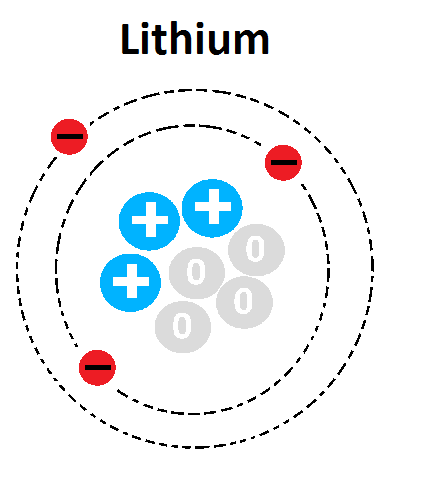
What is the atomic number of this atom?

a)

1

b)

3

c)

4

d)

7

24.

What is the mass number of this atom?

a)

1

b)

3

c)

4

d)

7

25.
In order for an atom to be neutral what has to be true?
a)
The atom has more protons than neutrons
b)
The atom has more neutrons than protons
c)
The atom has the same number of protons and neutrons
d)
The atom has the same number of protons and electrons
26.
How is the number of neutrons in the nucleus of an atom calculated?
a)
Add the number of e- and p+ together
b)
Subtract the number of e- from p+
c)
Subtract the number of p+ from the mass number
d)
Add the mass number to the number of e-
27.

An atom has 10 protons, 15 neutrons and 10 electrons what is its mass number.

a)

20

b)

10

c)

35

d)

25

28.

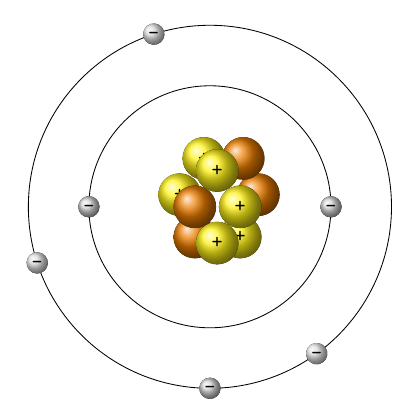
How many electrons does this atom have?

a)

2

b)

4

c)

6

d)

10

29.
The atomic number of an element that has 9 protons, 9 electrons, and 10 neutrons is _____.
a)
9
b)
10
c)
19
d)
28
30.
An element with a mass number of 11 and an atomic number of 5 has how many neutrons?
a)
11
b)
5
c)
6
d)
16
31.
An atom has an atomic number of 15 and a mass number of 31. How many protons are there in the atom?
a)
15
b)
31
c)
16
d)
47
32.
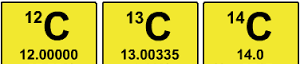
What do these isotopes of carbon all have in common?
a)
neutrons & mass number
b)
atomic number and neutrons
c)
atomic number and electrons
d)
protons, atomic number, and mass number
33.
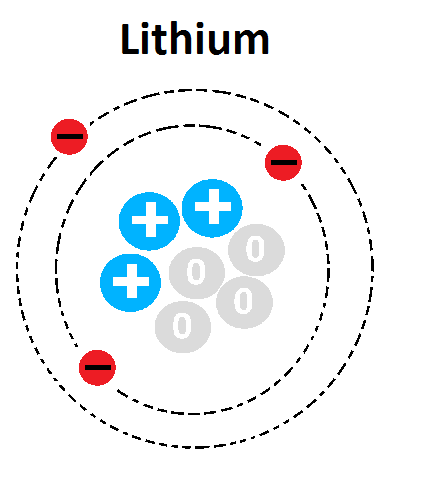
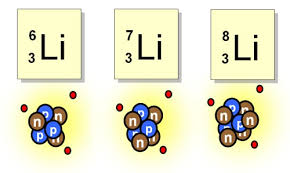
How many neutrons does the isotope of lithium have?
a)
8
b)
3
c)
4
d)
5
34.
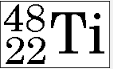
How many protons does this isotope of titanium have?
a)
48
b)
22
c)
26
d)
70
35.
In a correctly written symbol what would be located in the "A" position?
a)
number of neutrons
b)
atomic number
c)
number of electrons 
d)
mass number
36.
What quantities vary between isotopes of an element?
a)
protons, electrons, and atomic mass
b)
protons, electrons, and atomic number
c)
neutrons and electrons
d)
neutrons and atomic mass
37.
which atom has  4 neutrons?
a)
Li-6
b)
Li-7
c)
Li-8
d)
they have the same # of neutrons
38.
How many neutrons in C-14?
a)
6
b)
7
c)
14
d)
8
39.
Isotopes are atoms of the same element with different #’s of __________ & therefore different __________.
a)
n0 ;  atomic #’s
b)
p+ ; atomic #’s
c)
e- ; atomic masses
d)
n0 ; atomic masses
40.
If X is the symbol for an element, which of the following two symbols represent    isotopes of the same element?     I. 7735X  II. 7733X  III. 8137X  IV. 8135 X
a)
I and II
b)
III and IV
c)
I and IV
d)
I and III
41.
Four isotopes of lead include lead-204, lead-206, lead-207, and lead-208.  The average atomic mass of lead is 207.2.  Which isotope of lead is likely to be the most abundant.
a)
204
b)
206
c)
207
d)
208
42.

76 protons and 114 neutrons

a)

Osmium-114

b)

Osmium-76

c)

Osmium-190

d)

Osmium-190.23

43.

Rubidium has two common isotopes, 85Rb and 87Rb. If the abundance of 85Rb is 72.2% and the abundance of 87Rb is 27.8%, what is the average atomic mass of rubidium?

a)

85.468 amu

b)

37 amu

c)

85.6 amu

d)

86.4 amu

44.

There are two primary isotopes found in any sample of copper: copper-63 and copper-65. The isotope 65Cu composes 69.2% of the sample and 63Cu comprises the other 30.8%. Based on this data, what is the atomic mass of copper?

a)

29 amu

b)

63.546 amu

c)

64.4 amu

d)

63.6 amu

45.

How do you calculate mass number?

a)

Mass x percent

b)

Protons + Electrons

c)

Protons + Neutrons

d)

Neutrons + Protons + Electrons

46.

Bromine-80 has how many neutrons?

a)

41

b)

42

c)

44

d)

45

47.
Which scientist developed the atomic theory?
a)
JJ Thomson
b)
Ernest Rutherford
c)
John Dalton
d)
James Chadwick
48.
He developed the planetary model of the atom.
a)
Rutherford
b)
Bohr
c)
Chadwick
d)
Dalton
49.
James Chadwick discovered the ________.
a)
proton
b)
neutron
c)
electron
d)
nucleus
50.
What did Thomson discover?
a)
electron
b)
proton
c)
neutron
d)
electron cloud
51.

He claimed that matter was made of small, hard particles that he called “atomos.”

a)

Democritis

b)

Dalton

c)

Moseley

d)

Einstein

52.
The scientist responsible for "discovering" the nucleus is:
a)
Bohr
b)
Rutherford
c)
Schroedinger
d)
Einstein
53.

What experiment did JJ Thomson use?

a)

gold foil experiment

b)

cathode ray tube experiment

54.

John Dalton wrote postulates to make the idea of the atom useful. Which postulate below was proven wrong?

a)

All elements are made up of tiny indivisible particles called atoms.

b)

The atoms of one element are different from the atoms of another element.

c)

Atoms of different elements chemically combine to form chemical compounds.

d)

During chemical reactions, atoms are rearranged.

55.

JJ Thomson came up with which model for the atom?

a)

planetary model

b)

electron cloud model

c)

plum pudding model

d)

nuclear model

56.

What determines chemical reactivity?

a)

protons

b)

neutrons

c)

electrons

d)

isotopes

57.

What determines the identity of the atom?

a)

protons

b)

neutrons

c)

electrons

d)

isotopes

58.

After Rutherford discovered the nucleus, which model is believed to be true?

a)

protons, neutrons, and electrons are evenly distributed

b)

the nucleus is made of protons, neutrons, and electrons

c)

the nucleus is made of protons and electrons

d)

the model is mostly empty space with a central nucleus

59.
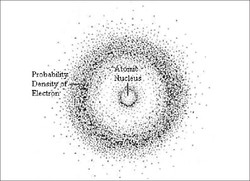
Who came up with this model of an atom?
a)
J.J. Thompson
b)
Ernest Rutherford
c)
Neils Bohr
d)
James Chadwick
60.
Which of the following scientist discovered the current model of the atom?
a)
Dalton
b)
Schrodinger.
c)
Thomson
d)
Dalton
61.
Which is the correct sequence of the scientists who made major changes in the model of the atom?
1-JJ Thomson
2-Erwin Schrodinger
3-John Dalton
4-Niels Bohr
5-Ernest Rutherford
a)
2, 1, 4, 3, 5
b)
3, 1, 5, 4, 2
c)
5, 3, 2, 1, 4
d)
4, 3, 2, 1, 5
62.
Which scientist saw the atom as a solid sphere?
a)
Dalton
b)
Thomson
c)
Rutherford
d)
Bohr
63.
What is the difference between the Electron Cloud Model and the Bohr Model
a)
placement of the electrons
b)
placement of the neutrons
c)
placement of protons
d)
Bohr model did not include a nucleus