Wayground logo

Free Printable Worksheets

Font size

S
M
L
XL
Worksheets

parts of the cell

Total questions: 52

Worksheet time: 34mins

Name
Class
Date
1.
a rigid supporting layer that surrounds the cells of plants and some other organisms
a)
cell membrane
b)
cell wall
c)
 nucleus
d)
cytoplasm
2.
In cells a large oval organelle that contains the cells genetic material in the form of DNA and controls many of the cells activities
a)
organelle
b)
ribosome
c)
cell wall
d)
nucleus
3.
the thick fluid region of a cell located inside the cell membrane or between the cell membrane and nucleus
a)
cytoplasm
b)
cell wall
c)
organelle
d)
golgi apparatus
4.
What is found in both plant and animal cells but is much larger in plant cells?
a)
Nucleus
b)
Mitochondrion
c)
Chloroplast
d)
Vacuole
5.
Which is not a part of cell theory?
a)
All organisms are made of cells
b)
All existing cells come from preexisting cells
c)
All matter is composed of living cells
d)
The cell is the most basic unit of life
6.
This is the outside wall of an animal cell
a)
Smooth ER
b)
Cell Wall
c)
Cell Membrane
d)
Cytoplasm
7.
This is the organelle that gives plants the structure they need to stand up tall
a)
Cell Membrane
b)
Smooth ER
c)
Cell Wall
d)
Vacuole
8.
The smallest unit of an organism that carries on the functions of life
a)
cell
b)
tissue
c)
organ
d)
organ system
9.
Gelatin-like substance that contains organelles
a)
nucleus
b)
cell membrane
c)
cytoplasm
d)
cell membrane
10.
This is where photosynthesis happens in plant cells
a)
mitochondria
b)
vacuole
c)
chloroplast
d)
nucleus
11.
Which of the following are NOT found in animal cells
a)
chloroplasts and cytoplasm
b)
chloroplasts and cell wall
c)
cell wall and cell membrane
d)
mitochondria and nucleus
12.

The jelly-like fluid inside of the cell. It holds the organelles in place.

a)

cytoplasm

b)

chloroplasts

c)

cell membrane

d)

mitochondria

13.

Responsible for packaging, modifying, and moving substances from the cell.

a)

mitochondria

b)

Golgi apparatus

c)

nucleolus

d)

rough E.R.

14.

Jelly bean shaped structures that break down food molecules and release energy.

a)

cytoplasm

b)

lysosomes

c)

ribosomes

d)

mitochondria

15.

This is an organelle that loops back and forth and detoxifies the cell.

a)

rough E.R.

b)

smooth E.R.

c)

lysosomes

d)

ribosomes

16.

These are liquid filled spaces that are ONLY found in animal cells.

a)

lysosomes

b)

vacuoles

c)

central vacuoles

d)

chloroplasts

17.

These are round organelles that digest waste, old cell parts and food.

a)

ribosomes

b)

lysosomes

c)

chloroplasts

d)

vacuoles

18.

This is a rigid structure that provides support to plant cells.

a)

cell membrane

b)

cell wall

c)

cytoplasm

d)

central vacuole

19.

These organelles contain green chlorophyll. They make food for plants.

a)

lysosmes

b)

chloroplasts

c)

ribosomes

d)

vacuoles

20.

This stores water in plant cells.

a)

chloroplasts

b)

cell wall

c)

vacuoles

d)

central vacuole

21.

These are protein builders. They are located on the rough E.R.

a)

vacuoles

b)

lysosomes

c)

mitochondria

d)

ribosomes

22.

Which structure inside a cell makes proteins?

a)

Ribosomes

b)

Golgi Body

c)

Nucleus

d)

Endoplasmic Reticulum

23.

This is found in prokaryotic cells and plant cells, it surrounds the plasma membrane.

a)

Cytoskeleton

b)

Plasma Membrane

c)

Cell Wall

d)

Golgi Body

24.

This part of a prokaryotic cell is a slime layer that helps the cell stick to things.

a)

Cell Wall

b)

Capsule

c)

Plasma Membrane

d)

Nucleus

25.

An internal network of tubes that help the cell keep its shape and helps with cell division.

a)

Plasma Membrane

b)

Cell Wall

c)

Capsule

d)

Cytoskeleton

26.

This part of a Eukaryotic cell holds the DNA and acts like the "brain" of the cell.

a)

Nucleus

b)

Ribosomes

c)

Endoplasmic Reticulum

d)

Golgi Body

27.

This is the membrane that protects the nucleus and has pores so things can move in and out.

a)

Nucleolus

b)

Nuclear Membrane

c)

Nuclear Envelope

d)

Plasma Membrane

28.

This is the part of the nucleus where ribosomes are made...

a)

Nucleolus

b)

Chromatin

c)

Smooth ER

d)

Rough ER

29.

Which organelle in a Eukaryotic cells digests food and worn-out organelles?

a)

Rough ER

b)

Smooth ER

c)

Lysosomes

d)

Golgi Body

30.

Which organelle's job is to package and ship out proteins and lipids?

a)

Rough ER

b)

Golgi Body

c)

Smooth ER

d)

Nucleus

31.

This organelle is the "powerhouse" of the cell...

a)

Golgi Body

b)

Rough ER

c)

Ribosomes

d)

Mitochondria

32.

This organelle helps to make proteins by moving them to the Golgi, ribosomes are found here.

a)

Rough ER

b)

Smooth ER

c)

Golgi Body

d)

Mitochondria

33.

This organelle is responsible for making lipids.

a)

Mitochondria

b)

Golgi Body

c)

Rough ER

d)

Smooth ER

34.

This organelle is found in plant cells and performs photosynthesis.

a)

Cell Wall

b)

Chloroplasts

c)

Central Vacuole

d)

Nucleus

35.

This organelle is found in plant cells, its job is to store extra water, sugar and toxins for the plant.

a)

Cell Wall

b)

Chloroplasts

c)

Chlorophyll

d)

Central Vacuole

36.

This part of a plant cell gives plants their green color and helps gather sunlight for photosynthesis.

a)

Capsule

b)

Chlorophyll

c)

Chlroplasts

d)

Chromosomes

37.
Who are the three scientists credited with creating the Cell Theory?
a)
Schlieden, Schwann, Virchow
b)
Schindler, Schmeil, Vanderhoot
c)
Schwimmer, Shanazzek, Van Halen
38.
The second part of Cell Theory states: "All living organisms are made up of cells."
a)
True
b)
False
c)
I don't know
d)
If you say so
39.
The third part of cell theory states: "All cells come from prehistoric cells."
a)
False
b)
True
c)
Yep
d)
Not even close
40.
All cells come from___________ cells.
a)
pregnant
b)
pre-existing
c)
paternal
d)
pin size
41.
Rocks are not living because
a)
they never move
b)
they aren't needed for humans
c)
they are not made of cells
d)
they don't break down
42.
There are three parts to the cell theory. Which is NOT one of those parts?
a)
All organisms are composed of one or more cells.
b)
The cell is the basic unit of structure and organization in organisms.
c)
Cells spontaneously arise from carbon and nutrients carried in the bloodstream.
d)
All cells come from pre-existing cells.
43.
Anton van Leeuwenhoek made his own version of the microscope and discovered something very odd when he looked a the gunk on his teeth. What did he discover?
a)
Cells
b)
Bacteria
c)
Cavities
d)
Influenza
44.
This scientist was the first to identify cells and name them:
a)
Hooke
b)
Leeunwenhoek
c)
Schleiden
d)
Virchow
45.
Which is true of prokaryotic and eukaryotic cells?
a)
Prokaryotic cells are larger than eukaryotic cells.
b)
Eukaryotic cells do not have nuclei, and prokaryotic cells do have nuclei.
c)
Prokaryotic cells lack membrane-bound organelles, and eukaryotic cells contain membrane-bound organelles.
d)
Eukaryotic cells are simpler than prokaryotic cells.
46.

Which do BOTH prokaryotes and eukaryotes contain?

a)

nucleus

b)

mitochondria

c)

ribosomes

d)

cell wall

47.

Which does only eukaryotic cells contain?

a)

nucleus

b)

DNA

c)

cell membrane

d)

ribosomes

48.
Which of the following is not a characteristic of a Prokaryotic cell?
a)
unicellular
b)
floating DNA
c)
very small
d)
complex
49.
A fossilized cell is discovered, and evidence suggests it reproduced on its own and had DNA, but a membrane did not enclose its DNA. Which type of organism would this most likely be?
a)
prokaryote
b)
eukaryote
c)
plant cell
d)
animal cell
50.

Bacteria is an example of a(n)

a)

prokaryotic cell.

b)

eukaryotic cell.

51.
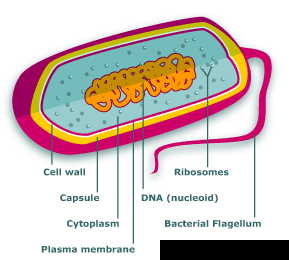
Which type of cell?
a)
Prokaryote
b)
Eukaryote
52.
Which type of cell?
a)
Prokaryote
b)
Eukaryote