wayground logo

Free Printable Worksheets

Font size

S
M
L
XL
Worksheets

Chemistry Unit 1 GSE

Total questions: 124

Worksheet time: 3hrs 48mins

Name
Class
Date
1.
What atom matches this electron configuration?
1s22s22p63s23p64s23d10
a)
Zinc
b)
Copper
c)
Nickel
d)
Germanium
2.
What electron configuration matches an oxygen atom?
a)
1s22s22p63s2, 3p64s23d104p5
b)
1s22s22p4
c)
1s22s22p6
d)
1s22s22p63s23p64s23d1
3.
How many electrons can the first energy level hold?
a)
1
b)
2
c)
8
d)
0
4.
The electron configuration of an atom is 1s22s22p6.  The number of electrons in the atom is 
a)
3
b)
6
c)
8
d)
10
5.
Which electron configuration belongs to Chlorine (Cl)?
a)
1s2s2p3s3p5
b)
1s2s2p3s3p6
c)
1s2s2p3s3p7
6.
Which is associated with more energy? 
a)
2p
b)
2s
c)
3p
d)
1s
7.
How many electrons can the d sublevel hold?
a)
14
b)
10
c)
2
d)
6
8.
How many electrons can the s sublevel hold?
a)
14
b)
10
c)
2
d)
6
9.
How many electrons can the p sublevel hold?
a)
14
b)
10
c)
2
d)
6
10.
As you move down a group, atomic radius increases because - 
a)
you add more and more neutrons
b)
you add more and more protons
c)
you add more and more shells (energy levels)
d)
you add more atomic mass
11.
The atom with the largest atomic radius in Group 18 is - 
a)
Ar
b)
He
c)
Kr
d)
Rn
12.
As you move across the periodic table from left to right, the atomic radius decreases.  This is because - 
a)
the number of protons increases, so attraction to electrons increases
b)
the number of energy levels increases
c)
the number of electrons increases
d)
the atomic mass increases
13.
The atom with the largest atomic radius in Period 4 (row 4) is - 
a)
K
b)
Kr
c)
Fe
d)
Fe
14.
Francium (Fr) has the lowest ionization energy in Group 1 because - 
a)
it has the smallest number of valence electrons
b)
it has the greatest atomic mass
c)
it has the greatest number of protons, so it attracts its electrons the strongest
d)
its 1 valence electron is very far from the nucleus, so little energy is needed to remove it
15.
The element with the smallest ionization energy in Period 6 is - 
a)
Rn
b)
Cs
c)
Os
d)
Tm
16.
As you move across the periodic table atoms tend to get smaller because, ______________.
a)
the atoms have more mass.
b)
the atoms have less mass
c)
the atoms have more protons.
d)
the atoms have less electrons.
17.
The energy required to remove electrons is the definition of: 
a)
Electronegativity
b)
Atomic Number
c)
Atomic Radius
d)
Ionization
18.

What is the name of Group 1

a)

Alkaline Earth Metals

b)

Boron Family

c)

Alkali Metals

d)

Halogen Family

19.

Groups 3-12 are known as the:

a)

Inner Metals

b)

Transition Metals

c)

Weirdos

d)

Changelings

20.
Families all have similar 
a)
Names
b)
atomic numbers
c)
atomic masses
d)
properties
21.
Electronegativity is...
a)
the ability of an atom to attract/ accept electrons
b)
the ability of an atom to lose electrons
c)
the energy required to remove an electron from a specific atom
d)
how easy it is to make friends. 
22.
Which has the greater Electronegativity: 
N or C?
a)
C
b)
N
23.
Electronegativity __________ from left to right within a period and __________ from top to bottom within a group.
a)
decreases, increases 
b)
increases, increases
c)
increases, decreases 
d)
stays the same, increases
24.

What were John Dalton three contributions to atomic history?

a)

Created the atomic theory

b)

Discovered that the atom is mostly empty space

c)

Believed that atoms of a given element are identical

d)

Hypothesized that the atom is a tiny, hard sphere

e)

Believed that the universe was made of tiny "uncuttable" particles

25.

Who was the first contributor to the atomic theory?

a)

John Dalton

b)

Ernest Rutherford

c)

JJ Thompson

d)

Democritus

e)

Neils Bohr

26.

Which scientist was the the most recent contributor to the atomic theory?

a)

John Dalton

b)

Ernest Rutherford

c)

JJ Thomson

d)

Democritus

e)

Neils Bohr

27.

What is the correct order of scientists in order of their work related to the atomic theory from earliest to most recent?

a)

Neils Bohr, Ernest Rutherford, JJ Thomson, John Dalton, & Democritus

b)

JJ Thomson, John Dalton, Neils Bohr, Ernest Rutherford, & Democritus

c)

Democritus, John Dalton, JJ Thomson, Ernest Rutherford, and Neils Bohr

d)

John Dalton, Neils Bohr, JJ Thomson, Democritus, & Ernest Rutherford

28.

What were J. J. Thomson's three contributions to the atomic theory?

a)

Discovered the electron

b)

Discovered the nucleus -did the gold foil experiment

c)

Used the cathode ray tube in his discovery

d)

Created a model of the atom with electrons moving around the nucleus in fixed orbits

e)

Created the "plum pudding" model of the atom

29.

What are two facts about Democritus's?

a)

Greek philosopher

b)

Created the atomic theory

c)

Used the cathode ray tube in his discovery

d)

Believed that the universe was made of tiny "uncuttable" particles

e)

Discovered that the atom is mostly empty space

30.

What is Neils Bohr's contribution to the atomic theory?

a)

Created the atomic theory

b)

Created a model of the atom with electrons moving around the nucleus in a fixed orbits

c)

Discovered that the proton had a positive charge
d)

Believed that atoms of a given element are identical

e)

Discovered the electron

31.

What were Ernest Rutherford's three contributions to atomic theory?

a)

Discovered that the atom is mostly empty space

b)

Discovered the nucleus- did the gold foil experiment

c)

Used the cathode ray tube in his discovery

d)

Discovered the electron

e)

Discovered that the proton had a positive charge

32.
4.35% of all X atoms have a mass of 39.946 amu. 83.79% have a mass of 41.941 amu, 9.50% have a mass of 42.941 amu, and 2.36% have a mass of 43.939 amu. What is the average atomic mass of atom X?
a)
41.97 amu
b)
42.19 amu
c)
10.43 amu
d)
40.04 amu
33.
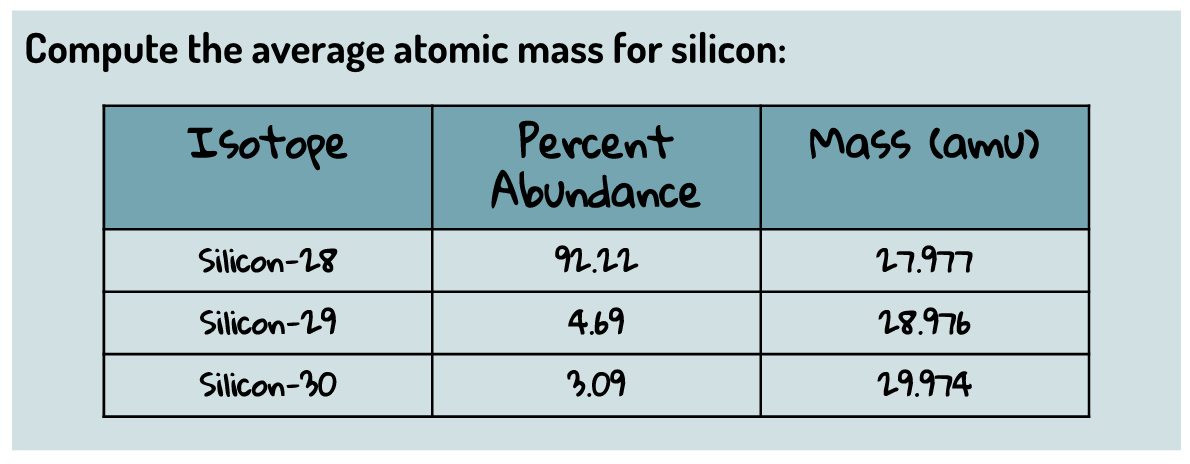
Compute the average atomic mass for silicon:
a)
27.977
b)
28.09
c)
28.976
d)
The average mass cannot be determined from provided information.
34.
24.1% of all the isotopes of a an element have a mass of 75.23 amu, 48.7% have a mass of 74.61 amu, and 27.2% have a mass of 75.20 amu.
How many protons does this element have?

a)
32
b)
33
c)
34
d)
no way to know
35.
An element has three different isotopes. One has a mass of 35.00 amu; another has a mass of 36.00  amu; and another has a mass of 38.00  amu. What is the average atomic mass of this element?
a)
36.33 amu
b)
37.00 amu
c)
12.11 amu
d)
impossible to tell
36.
An element with 4.35% have a mass of 49.9461 amu, 83.79% have amass of 51.9405 amu, 9.50% have a mass of 52.9407 amu, and 2.36% have a mass of 53.9389amu.
a)
51.99 amu
b)
52.19 amu
c)
53.45 amu
d)
17.33 amu
37.
An isotope has three forms.  30% have a mass of 4 amu, 20% have a mass of 5 amu and 50% have a mass of 3 amu.  Average atomic mass will be closest to
a)
2 amu
b)
3 amu
c)
4 amu
d)
5 amu
38.
Calculate the average atomic mass of silver.
a)
106.38649amu
b)
111.91896amu
c)
107.8677amu
d)
121
39.
An element has two naturally occurring isotopes. One is 10.013 amu and is 19.9% abundant. The other is 11.01 amu and is 80.1% abundant. What is the average atomic mass? What element is it?
a)
9.012, Beryllium
b)
12.011, Carbon
c)
6.941, Lithium
d)
10.812, Boron
40.
What is the name of the atom pictured here?
a)
Nitrogen
b)
Nitrogen-15
c)
Nitrogen-7
d)
Nitrogen-8
41.
Which of the following could have 82 neutrons?
a)
W-182
b)
Ta-181
c)
Cs-132
d)
Ba-138
42.
How many Protons does the element Titanium have?
a)
47
b)
22
c)
4
d)
48
43.
How many Protons does Chlorine have?
a)
17
b)
35
c)
18
d)
39
44.
How many electrons does the Chloride Ion have?
a)
17
b)
35
c)
18
d)
39
45.
What is the Atomic Mass of Gold?
a)
197g
b)
11g
c)
196g
d)
47g
46.
What is the Atomic Number of Silicon? 
a)
3
b)
28
c)
14
d)
16
47.
How many Neutrons does Uranium-238 have?
a)
92
b)
146
c)
238
d)
149
48.
How many Electrons does the
Potassium cation have?
a)
19
b)
20
c)
18
d)
39
49.
How many Electrons does 
Potassium have?
a)
19
b)
20
c)
18
d)
39
50.
What is the Atomic mass of Manganese?
a)
54
b)
24
c)
25
d)
55
51.
How many Electrons does Mercury have?
a)
80
b)
200
c)
201
d)
81
52.
What is the Atomic Mass of Barium?
a)
56
b)
137
c)
54
d)
131
53.
How many neutrons does Cobalt have?
a)
32
b)
27
c)
31
d)
59
54.
How many Protons does Neon have?
a)
18
b)
20
c)
2
d)
10
55.
Which has more Electrons the Rubidium cation or Iodide anion?
a)
Rubidium
b)
Iodine
56.
How many neutrons does Oxygen have?
a)
8
b)
10
c)
16
d)
11
57.
Radon has how many Electrons?
a)
86
b)
222
c)
18
d)
6
58.
How many Electron shells does Nickel have?
a)
10
b)
4
c)
2
d)
28
59.
How many neutrons are in the Calcium-42 isotope?
a)
20
b)
40
c)
22
d)
42
60.
Which of the following is an isotope?
a)
Hydrogen-1
b)
Helium-4
c)
Lithium-6
d)
Beryllium-9
61.
 The diagram above represents two electrons with 
a)
a. opposite spins.
b)
 b. the same spin.
c)
c. different energies.
d)
d. different energy levels.
62.
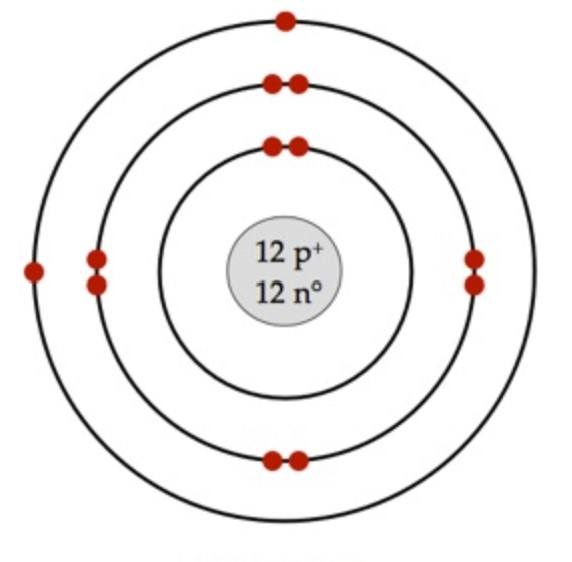
Which element is pictured?
a)
neon
b)
fluorine
c)
magnesium
d)
argon
63.
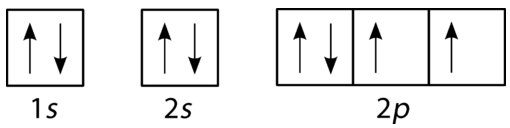
This orbital diagram represents:  
a)
C
b)
B
c)
N
d)
O
64.
What is incorrect about this orbital diagram?
a)
Both arrows in the 2p box should be pointing up
b)
There is nothing incorrect with this diagram
c)
In the there should only be 1 orbital in the first 2p box and one in the 2nd 2p box
d)
All the arrows should be pointing up.
65.
Electrons occupy orbitals of lowest energy first is part of what electron configuration rule?
a)
Hund’s Rule
b)
Aufbau Principle
c)
Pauli Exclusion Principle
66.

Which rule is being violated in the following orbital diagram?

a)

Hund's

b)

Aufbau's

c)

Pauli's Exclusive

67.

Which shows the correct orbital diagram for Cobalt?

a)
b)
c)
d)
68.
An atom becomes _______ when it loses electrons.
a)
Positive
b)
Negative
c)
Neutral
d)
Invinsible
69.
An atom becomes _________ when it gains electrons.
a)
Positive
b)
Negative
c)
Neutral
d)
Invinsible
70.
Which particles change the charge in atoms when ions are formed?
a)
Protons
b)
Electrons
c)
Neutrons
d)
Kittens
71.
What is the charge of an atom that has lost one electron?
a)
-1
b)
-2
c)
+1
d)
+2
72.

Na ionizes to a charge of _______

a)

+1

b)

+2

c)

-1

d)

-2

73.

Li ionizes to a charge of _________

a)

+2

b)

+1

c)

-1

d)

-2

74.

Mg ionizes to a charge of ______.

a)

+1

b)

+2

c)

-1

d)

-2

75.

N ionizes to a charge of _______.

a)

+3

b)

-3

c)

+2

d)

-2

76.

S ionizes to a charge of _______.

a)

-2

b)

-1

c)

+1

d)

+2

77.

Br ionizes to a charge of ________

a)

-1

b)

-2

c)

+1

d)

+2

78.
How many neutrons does the isotope below have?     89 36Kr
a)
53
b)
36
c)
89
d)
125
79.
If X is the symbol for an element, which of the following two symbols represent    isotopes of the same element?     I. 7735X  II. 7733X  III. 8137X  IV. 8135 X
a)
I and II
b)
III and IV
c)
I and IV
d)
I and III
80.
Four isotopes of lead include lead-204, lead-206, lead-207, and lead-208.  The average atomic mass of lead is 207.2.  Which isotope of lead is likely to be the most abundant.
a)
204
b)
206
c)
207
d)
208
81.
What is the name of the pictured isotope?
a)
Copper-29
b)
Copper-63
c)
Copper-34
d)
CopperWopperHopperBopper
82.
Emission of light from an atom occurs when an electron
a)
drops from a higher to a lower energy level.
b)
   jumps from a lower to a higher energy level.   
c)
   moves within its atomic orbital.
d)
falls into the nucleus.
83.

A fellow student of yours thought that flame color was based on the element written at the beginning of the compound. Which statement would give evidence to support their claim?

a)

The flames of LiCl and and NaCl are the same color

b)

The flames of LiCl and NaCl are different colors

c)

The flames of Na2SO4 and NaCl are different colors

d)

The flames of Na2SO4 and CuCl2 are different colors

84.

Consider the following data:

Cu - blue, green, teal

Na - yellow-orange

K - yellow, orange, pink/lavender

Li - red, light red

Sr - deep red

If the unknown color was yellow-orange, which element is most likely the unknown?

a)

Cu

b)

Na

c)

K

d)

Li

85.

An atomic emission spectrum is...

a)

unique to the element

b)

a complete rainbow

c)

both of these are correct

d)

neither of these are correct

86.
What is the name of this element?
a)
Helium
b)
Hydrogen
c)
Argon
d)
Silver
87.

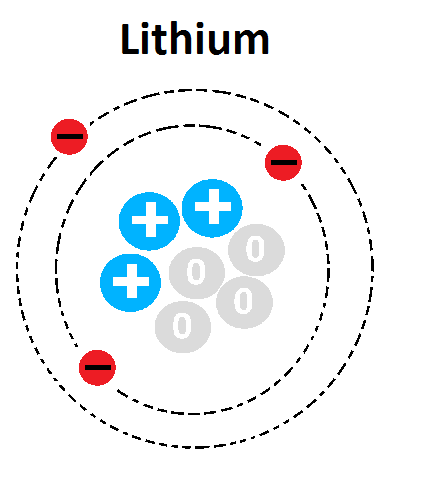
What element is represented in this Bohr Model?

a)

Carbon

b)

Hydrogen

c)

Aluminum

d)

Lithium

88.
What is the name of this element?
a)
Lithium
b)
Boron
c)
Carbon
d)
Neon
89.
What is the mass number of this atom?
a)
1
b)
3
c)
4
d)
7
90.
What is the atomic number of this atom?
a)
2
b)
4
c)
6
d)
none of the above
91.
Isotopes are elements with a different amount of
a)
protons
b)
neutrons
c)
electrons
d)
atoms
92.
an element will always have the same number of 
a)
neutrons
b)
protons
c)
isotopes
d)
atoms
93.
How are electrons arranged in an atom?
a)
In groups of five
b)
In energy levels
c)
By color
d)
By shape
94.

What is the atomic number of this element?

a)

17

b)

18

c)

35

d)

35.453

95.

How many electrons can fit on the 1st energy level (orbital) for any Bohr Model?

a)

2

b)

6

c)

8

d)

10

96.

What is the mass number of this atom of Chlorine?

a)

17

b)

18

c)

35

d)

35.453

97.
What does the nucleus of an atom contain?
a)
Electrons and neutrons
b)
Protons and neutrons
c)
Neutrinos and positrons
d)
Electrons and megatrons
98.

What is a Bohr Model?

a)

a simplified representation of an atom

b)

vertical column in periodic table

c)

horizontal row in periodic table

d)

Only shows the element symbol and it's outer most electron shell

99.

Which element does this Bohr model represent?

a)

Aluminum

b)

Silicon

c)

Magnesium

d)

Cobalt

100.

What is the mass of this atom?

a)

9

b)

10

c)

19

d)

28

101.

What element does this Bohr model represent?

a)

Chromium

b)

Magnesium

c)

Carbon

d)

Krypton

102.

Why do carbon, silicon, and tin all react similarly?

a)

They are located in the same period

b)

They have an even atomic number

c)

They have the same number of energy levels

d)

They are located in the same group

103.

What do Rb, Re, and I have in common?

a)

family

b)

number of energy levels

c)

location of discovery

d)

valence electrons

104.

What is the valence electron count of the alkaline earth metal family?

a)

-2

b)

-1

c)

2

d)

1

105.

The diagram below is the bohr model of an atom. Which best describes this atom?

a)

it has a full outermost shell

b)

it has 6 valence electrons

c)

it has a positive charge

d)

it has 6 electrons

106.

How many valence electrons are in a neutral atom of nitrogen?

a)

5

b)

3

c)

2

d)

15

107.

which two elements have the same number of valence electrons?

a)

C and O

b)

Cl and F

c)

Ga and Ge

d)

Na and Mg

108.

What is the correct lewis dot diagram for Boron?

a)
b)
c)
d)
109.

The alkali metals elements are in the same family in the periodic table because they all have

a)

eight valence electrons

b)

seven valence electrons

c)

two valence electrons

d)

one valence electron

110.

The elements F, Cl, and I are all in the same column on the periodic table. Which is the best explanation for this arrangement.

a)

They have the same number of energy levels

b)

They were all discovered at ancient times

c)

They were all gases at room temperature

d)

they have the same number of valence electrons

111.

Which of the following is a property shared by the elements in the carbon family? (Column IV)

a)

The same electron configuration

b)

The number of valence eletrons

c)

An atomic mass of 12

d)

An atomic number of 6

112.

Elements with the same valence electron configuration can be expected to have similar

a)

chemical reactivity

b)

number of protons

c)

number of electrons

d)

atomic mass

113.

Which element is most similar to potassium (K)

a)

argon

b)

chlorine

c)

phosphorus

d)

sodium

114.

Both calcium and magnesium have the same number of valence electrons. How else can these two elements be the same?

a)

Both elements have the same atomic number

b)

Both elements have the same atomic mass

c)

Both elements are in the same group in the periodic table

d)

Both elements are in the same period on the periodic table

115.

Bob and Tanya study two electron configurations of a neutral atom. What do the two atoms have in common?

a)

Family

b)

Period

c)

Mass number

d)

Atomic number

116.

The diagram represents an element. Which best describes this element?

a)

10 protons and 9 neutrons in the nucleus

b)

9 protons and 9 neutrons in the nucleus

c)

2 electrons in the first energy level; 8 electrons in the second energy level

d)

2 electrons in the first energy level; 7 electrons in the second energy level

117.
J.J. Thomson provided evidence that an atom...
a)
is the smallest particle of matter
b)
contains negatively charged particles
c)
has an overall negative charge
d)
has an overall positive charge
118.
Who performed the Gold Foil Experiment?
a)
J. J. Thomson
b)
Ernest Rutherford
c)
Neils Bohr
d)
John Dalton
119.
Which model is this?
a)

Plum Pudding Model

b)

Quantum Mechanical Model

c)

Planetary Model

d)

Atomos Model

120.

Rutherford and his students did experiments that showed

a)

quark

b)

nucleus

c)

proton

d)

electron

121.

Which scientist discovered the electrons?

a)

Dalton

b)

Thomson

c)

Atristotle

d)

Bohr

122.

Which one of the following discoveries came first?

a)

electrons

b)

neutrons

c)

quarks

d)

atoms

123.

Which scientist discovered that the nucleus contained neutrons?

a)

bohr

b)

Rutherford

c)

Dalton

d)

Chadwick

124.

Which one of the following is the correct order of scientific contribution of the atom?

a)

Chadwick, Dalton, Bohr, Rutherford, Democritus,Thomson

b)

Thomson, Democritus,Rutherford, Bohr, Dalton ,Chadwick

c)

Dalton, Chadwick ,Bohr, Rutherford, Democritus,Thomson

d)

Democritus, Dalton, Thomson, Rutherford, Bohr, Chadwick