wayground logo

Free Printable Worksheets

NEW

Font size

S
M
L
XL
Worksheets

Waves

Total questions: 50

Worksheet time: 1hrs 12mins

Name
Class
Date
1.

The distance between 2 high points (or low points) in a wave.

a)

frequency

b)

wavelength

c)

crest

d)

trough

2.

Mechanical waves that travel through a medium moving back and forth in the same direction the wave travels

a)

Longitudinal wave

b)

Transverse wave

c)

Surface wave

3.

A substance (like solid, liquid or gas) that the energy of a wave can travel through

a)

amplitude

b)

compression

c)

medium

d)

frequency

4.

The top of something; sometimes called a "peak"

a)

trough

b)

amplitude

c)

compression

d)

crest

5.

Disturbance caused by the vibration of movement of objects.

a)

Amplitude

b)

Mechanical wave

c)

Frequency

d)

Wavelength

6.

The measurement of highest point (or lowest point) in a wave when compared to resting position.

a)

medium

b)

transverse wave

c)

crest

d)

amplitude

7.

The state of being squeezed or pressed together.

a)

compression

b)

trough

c)

amplitude

d)

wavelength

8.

The rate at which something repeats over time.

a)

wavelength

b)

amplitude

c)

frequency

d)

mechanical wave

9.

Mechanical waves that travel through a medium moving perpendicular to the motion of the wave.

a)

Transverse wave

b)

Surface wave

c)

Longitudinal wave

d)

medium

10.

The area around the lowest point of a wave.

a)

medium

b)

crest

c)

amplitude

d)

trough

11.

The size of the displacement off of resting position

a)

frequency

b)

wavelength

c)

compression

d)

amplitude

12.

These waves can travel through a solid, liquid or gas.

a)

wavelength

b)

mechanical

c)

amplitude

d)

frequency

13.

The area of a longitudinal wave where the particles are crowded together.

a)

compression

b)

crest

c)

transverse

d)

medium

14.

The highest point on a wave.

a)

frequency

b)

compression

c)

trough

d)

crest

15.

The point on a transverse wave with the greatest negative value.

a)

crest

b)

trough

c)

wavelength

d)

amplitude

16.
a)
Longitdinal Wave
b)
Transverse Wave
17.
The material through which a wave travel 
a)
trough
b)
medium
c)
crest
d)
vibration
18.
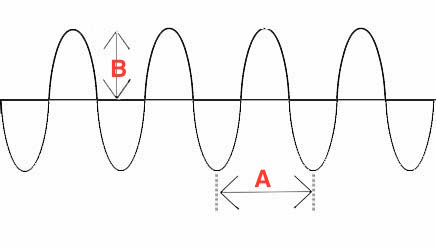
What property of this wave is represented by the letter "A"
a)
amplitude
b)
crest
c)
trough
d)
wavelength
19.
What type of wave is this?
a)
Longitudinal
b)
Transverse
20.

What type of waves have compressions?

a)
longitudinal
b)
transverse
21.

What is being transferred with a wave?

a)

medium

b)

energy

c)

matter

d)

Chicken

22.

What is the crest of a transverse wave?

a)

the lowest point of the wave

b)

the middle of a wave

c)

the highest point of a wave

d)

nothing

23.

Waves that need a medium are called?

a)

Electromagnetic Waves

b)

P-Waves

c)

Mechanical Waves

d)

Taco Bell

24.

Waves that can travel through a vacuum and do no require a medium are called?

a)

Transverse Waves

b)

S-Waves

c)

Mechanical Waves

d)

Electromagnetic Waves

25.

What is the unit for frequency?

a)

Meters

b)

Hertz

c)

Decibels

d)

Meters/Second

26.
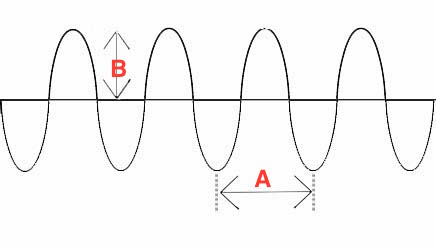
What property of this wave is represented by the letter "A"
a)
amplitude
b)
crest
c)
trough
d)
wavelength
27.
What property of the wave is represented by the letter "B"?
a)
amplitude
b)
crest
c)
trough
d)
wavelength
28.
The number of wavelengths that pass a point each per second is:
a)
frequency
b)
period
c)
longitudinal 
d)
transverse wave 
29.
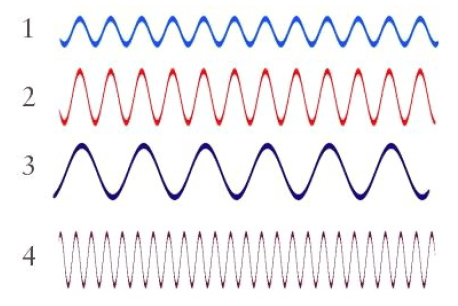
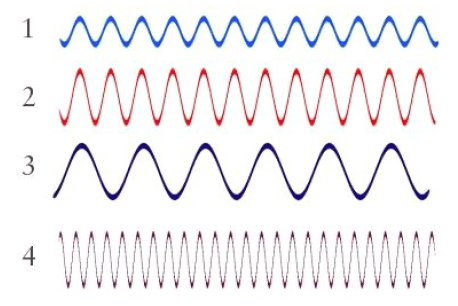
Which wave in the diagram has the greatest frequency?
a)
1
b)
2
c)
3
d)
4
30.
Which wave in the diagram has the greatest wavelength?
a)
1
b)
2
c)
3
d)
4
31.
Which of the following can sound travel through?
a)
solid
b)
liquid
c)
gas
d)
all of the above
32.
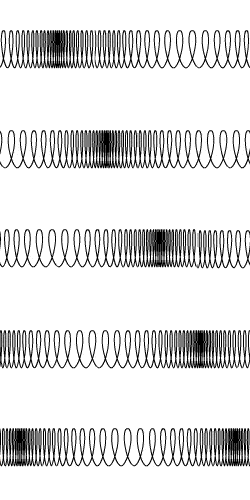
What kind of wave is pictured below?
a)
compressional wave
b)
transverse wave
c)
sound wave
d)
mechanical wave
33.
Which type of wave is pictured here?
a)
Longitudinal
b)
Transverse
c)
Light 
d)
Electromagnetic
34.

It is the high pressure part of the wave where the particles are close together. It is part A on this picture.

a)

Compression

b)

Amplituide

c)

Rarefaction

d)

Wavelength

35.

High pitched waves would have wavelengths that are...

a)

at a rarefaction

b)

far apart

c)

close together

d)

at the trough

36.
What is represented by the  letter 'y'?
a)
Compression
b)
Rarefaction
c)
Wavelength
d)
Amplitude
37.
Distance from an 'x' to an 'x' is a________
a)
wavelength
b)
amplitude
c)
rarefaction
d)
compression
38.
Which answer best explains what causes a wave?
a)
Shaking
b)
Potential energy
c)
Light
d)
Vibrations
39.
What two factors effect the amount of energy a wave has?
a)
Frequency and wavelength
b)
Frequency and amplitude
c)
Amplitude and rest
d)
Wavelength and crest
40.
Waves are a transfer of what?
a)
Heat
b)
Light
c)
Energy
d)
Food
41.

What is frequency measured in?

a)

Milliseconds

b)

Miles

c)

Hertz

d)

Kilograms

42.

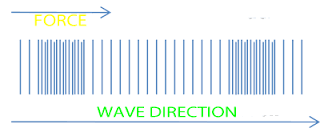
What kind of wave is pictured below?

a)

compressional wave

b)

transverse wave

c)

sound wave

d)

mechanical wave

43.
Which wave is pictured?
a)
Transverse
b)
Longitudinal
c)
Both
d)
Neither
44.
The highest point on a wave is:
a)
the crest
b)
the trough
c)
the top
d)
the coast 
45.
The most dense part of a longitudinal wave.
a)
Density
b)
Compression
c)
Rarefaction
d)
Amplitude
46.
Sound is an example of which type of wave?
a)
Transverse
b)
Longitudinal
c)
Both
d)
Neither
47.
Material (matter) through which a wave travels
a)
medium
b)
Doppler Effect
c)
sound
d)
pitch
48.
A part in a longitudinal wave where the particles are spread apart
a)
compression
b)
rarefaction
c)
crest
d)
trough
49.
As the fire truck approached Mary, the pitch of the siren got higher. Once the fire truck passed and moved away, the siren's pitch got lower. This change in pitch is because of a change in the sound wave's
a)
concussion. 
b)
amplitude. 
c)
reflection.
d)
frequency. 
50.
Which of the following can sound travel through?
a)
solid
b)
liquid
c)
gas
d)
all of the above