
 Worksheets
Force and Motion
Total questions: 45
Worksheet time: 27mins

What is the resultant force?
17 N, Left
6N, Right
11N, Left
23N
Which of the following produces the largest acceleration when forces are applied on a block?
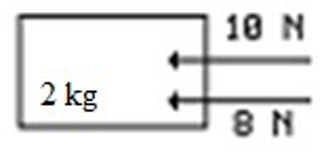
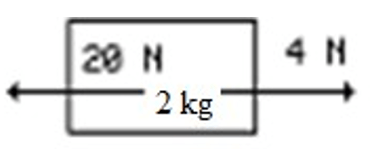
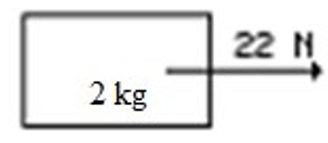
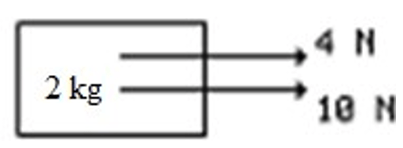

What is the resultant force?
400 N, Up
400 N, Down
800 N, Up
800 N, Down


What is the tool for measuring the force?
spring scale
weight balance
Slope of distance time graph represents-
speed
acceleration
displacement
none of these
SI unit of acceleration is-
ms-1
ms-2
ms2
none of these
Which of the following is a scalar quantity?
acceleration
velocity
distance
displacement
Rate of change of velocity is called-
average speed
average velocity
acceleration
none of these
When an object travels equal distance in equal intervals of time, it is said to be in-
uniform acceleration
non uniform accelration
uniform motion
non uniform motion
Displacement is represented by-
slope of s-t graph
slope of v-t graph
area under s-t graph
area under v-t graph
Speed of an object is equal to the magnitude of velocity if-
the object is travelling in uniform circular motion
the object is travelling along a straight path
the initial and final positions are same
none of these
An object moving in a circular path with uniform speed experiences a continuous change in its
direction
velocity
speed
both a and b
The nature of s-t graph for rest -
straight line passing through origin
straight line parallel to time axis
straight line perpendicular to time axis
straight line overlapping time axis
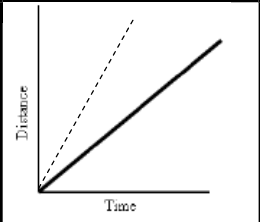
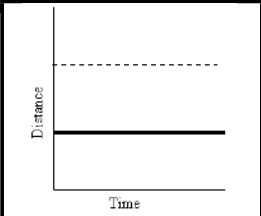

In which of the following graphs below are both runners moving at the same speed?


18. Which is TRUE about Galileo’s cannon ball experiment?
When objects are dropped simultaneously at the same height, they will reach the ground at the same time.
When an object has twice mass as much as another, they will reach the ground at the same time.
When an object with a different mass is dropped simultaneously at the same height, they will not reach the ground at the same time.
When an object is dropped simultaneously with different height, they will not reach the ground.
A particle is moving in a circular path of radius r. The displacement after half a circle would be:
Zero
π r
2 r
2π r
Displacement
Motion of object in circular path with uniform speed
Body in uniform motion
Rate of change of velocity with respect to time
Shortest distance between initial and final position
A worker covers a distance of 40 km from his house to his place of work, and 10 km towards his house back. Then the displacement covered by the worker in the whole trip is?
zero km
10 km
30 km
50 km
Acceleration is a vector quantity, which indicates that its value
Is always negative
Is always positive
Is zero
Can be positive, negative or zero
Mass is the amount of _______ an object has
Matter
weight

What is this tool called....
Ruler
Thermometer
Beaker
Graduated Cylinder
The unit for volume is
grams
milliliters (mL)
Newton
Centimeters Cubed
What two types of measurements make up DENSITY?
Volume and Weight
Temperature and Mass
Mass and Volume
What is the density of water?
34 g/mL
1 g/mL
29 g/mL
6 g/mL
What is the unit for density ?
g/ mL
g
cm3g
cm4

.14 g/cm3
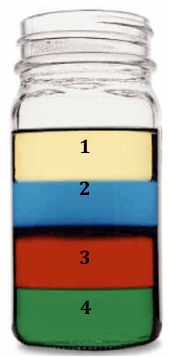
Just after she jumps out of the plane (before the parachute opens). The relative forces will be
Balanced
Unbalanced
Just after she jumps out of the plane (before the parachute opens). The relative forces will be
Weight force is equal to the friction force
Friction force is constant
Weight force is greater that the friction force
Friction force is greater than the weight force
Just after she jumps out of the plane (before the parachute opens). The net force will be
zero
upward
downward
Just after she jumps out of the plane (before the parachute opens). The sky diver will have
a constant speed
a constant acceleration
a constant velocity
After the 60 seconds, the parachutist pulls the cord and opens her parachute.
Explain how the parachute reduces the speed of the parachutist when it is just opened.
The friction force decreases
The weight force decreases
The weight force increases
The friction force increases

Identify true statements:
Drag is increasing
Velocity is increasing
There is no drag
Weight is increasing
Deceleration
An object in equilibrium can still have forces acting on it.
True
False
An object travelling at terminal velocity moves at a steady speed.
True
False
An object travelling at terminal velocity moves in a constant direction.
True
False

Which diagram shows the forces acting on Peter when he is falling at Terminal Velocity?
1
2
3

