
 Worksheets
Motion Review
Total questions: 57
Worksheet time: 50mins

How would you walk to create the graph shown?
stand still
walk at a constant speed
walk away from reference point fast
walk toward the reference point slow

How would you walk to produce this graph?
walk away slow for 4 minutes, stand still for 4 minutes, walk away fast for 2 minutes
walk away slow for 2 minutes, stand still for 2 minutes, walk away fast for 6 minutes
walk toward slow for 4 minutes, stand still for 4 minutes, walk toward fast for 2 minutes
walk away at increasing speed for 4 minutes, stand still for 4 minutes, walk away with increasing speed for for 2 minutes

What is your velocity in segment B of the graph?
0 m/s
10 m/s
2 m/s
6 m/s

Which line segment shows increasing speed?
A
B
C
D

Which line segment show your speed is zero?
A
B
C
D
In science, __________________________ is defined as a change in position.
motion
potential energy
evaporation
sublimation
The SI unit for distance is the ______________________________.
millimeter
foot
meter
gram
The measure of both speed and direction is called _________________________
distance
velocity
acceleration
gravity

How would you walk to create the graph shown?
stand still
walk away from the reference point at constant speed
walk toward the reference point at constant speed
walk away with increasing speed
_____________________________________is a measure of the change in velocity of a moving object
acceleration
speed
distance
displacement
The formula for calculating velocity is
velocity=timedistance plus direction
velocity =distancetime plus direction
velocity = timeacceleration
velocity =accelerationtime

How would you walk to create the graph shown?
stand still
walk away from the reference point at constant speed
walk toward the reference point at constant speed
walk toward the reference point with decreasing speed
Billy runs 400 meters to Andy's house, turns around, and runs 400 meters back home. What is Billy's displacement?
0 meters
400 meters
800 meters
1600 meters
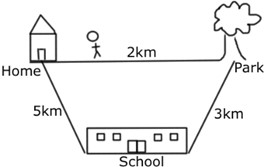
Jerry walked from home to school, then from the school to the park. What is his total displacement?
2 km
5 km
8 km
10 km
Jerry walked from home to school, then from the school to the park. What is his total distance?
2 km
5 km
8 km
10 km
The change in an objects position from the final position to initial position.
displacement
distance
motion
reference point

Two people walk across a parking lot. Their paths are shown in the image. Who traveled with a larger displacement?
Person A
Person B
They both had the same displacement.

How would you walk to create the graph shown?
stand still
walk at constant speed
walk at an increasing speed
your speed is zero
David walks 3 km north, and then turns east and walks 4 km. What is the displacement?
1 km
3 km
4 km
5 km

A runner races in the 100 meter dash. It takes her 10 seconds to finish. What is her average speed?
10 m/s
1000 m/s
100 seconds
10 seconds
Jose wandered 4 km at 2 km/hr. How long did Jose wander?
2 hours
8 hours
0.5 hours
2 km

At 60 seconds, how far had this object traveled?
0 m
10 m
20 m
40 m

_______ is the process of changing position.
Speed
Velocity
Motion
Reference Point

______ is the difference between the initial (first) position and the final position of an object.
Distance
Speed
Displacement
Motion

Joe rides his bike from point A to point B and then on to point C. What is the total distance traveled?
12 m
43 m
7 m
12 m

Joe rides from point A to B to C. What is the displacement?
7 m
12 m
5 m
2 m
In a Velocity vs Time graphs the slope equals to:
Acceleration
Speed
Displacement
Time


What is the rate of acceleration during the first line segment? (slope between 0 - 10 sec)
0 m/s2
2.7 m/s2
6 m/s2
- 4 m/s2
What is the rate of acceleration during the 2nd line segment? (slope between 10 - 15 sec)
0 m/s2
2.7 m/s2
6 m/s2
- 4 m/s2
What is the rate of acceleration during the 3rd line segment? (slope between 15 - 40 sec)
-4 m/s
2.7 m/s2
6 m/s2
- 4 m/s2
The slope of the velocity-time graph tells us the
acceleration
displacement
velocity
direction of travel
Acceleration: is the rate of change in
velocity
speed
displacement
direction
A bus starts from rest and accelerates to 14 m/s in 4 s. What is the average acceleration of the bus?
3.5 m/s2
5.9 m/s2
10.5 m/s2
24 m/s2
When are you undergoing an acceleration in a car? (Choose all that are correct)
speed up
slow down
make turns
constant speed

A box sliding down an inclined plane attains a speed of 27 m/s in 3 seconds from rest. Find the acceleration.
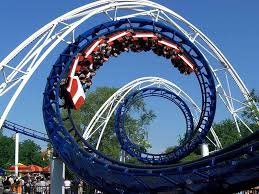
A roller coasters accelerates from an initial speed of of 6.0 m/s to a final speed of 70 m/s over 4 seconds. What's the acceleration?
speed of an object in a particular direction
motion
velocity
speed
acceleration
when an object changes its position compared to a reference point.
acceleration
speed
motion
reference point
total distance traveled divided by total time taken to travel that distance
velocity
motion
acceleration
average speed
At what speed would a car have to move in order to travel 20 kilometers in 2 hours.
5 km/hr
10 km/hr
20 km/hr
40 km/hr

What would this be an example of? The plane is traveling at 500 mph West"
Speed
Velocity
Acceleration
What is the formula for calculating acceleration?
t=(vf-vi)/a
a=(vi-vf)/t
a=(vf-vi)/t
a=d/t

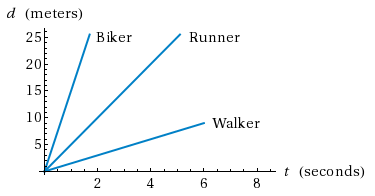
Which person moved the fastest in 3 seconds?
biker
runner
walker
they are all moving equally
Slope of distance time graph represents-
speed
acceleration
displacement
none of these
The speed of an object at one instant of time (like on a speedometer) is called:
Average Speed
Instantaneous Speed
Velocity
Acceleration
Which of the following objects is accelerating?
A car driving in a northwest at a constant speed of 35 mph.
A car driving southwest at a constant speed of 35 mph.
A car driving in a circle at a constant speed of 35 mph.
Back
A car driving south at a constant speed of 45 mph.

