Wayground logo

Free Printable Worksheets

Font size

S
M
L
XL
Worksheets

Honors Chemistry Unit 3 Electrons Review

Total questions: 41

Worksheet time: 3hrs 33mins

Name
Class
Date
1.

What electron configuration matches an oxygen atom?

a)

1s22s22p63s2, 3p64s23d104p5

b)

1s22s22p4

c)

1s22s22p6

d)

1s22s22p63s23p64s23d1

2.

Identify the Electron Configuration for Aluminum (Al)

a)

1s2 2s2 2p6 3s2 3p1

b)

1s2 2s2 2p6 3s2 3p3

c)

1s2 2s2 2p6 3s2 4p1

3.

What atom matches this electron configuration?

1s22s22p63s23p64s23d10

a)

Zinc

b)

Copper

c)

Nickel

d)

Germanium

4.
a)

10

b)

2

c)

8

d)

18

5.
a)

14

b)

4

c)

3

d)

28

6.
How many electrons can the first energy level hold?
a)
1
b)
2
c)
8
d)
0
7.
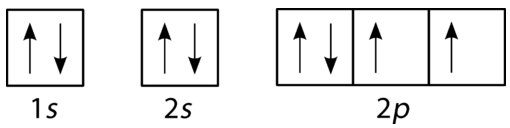
Which element is pictured?
a)
neon
b)
fluorine
c)
magnesium
d)
argon
8.
Electrons occupy orbitals of lowest energy first is part of what electron configuration rule?
a)
Hund’s Rule
b)
Aufbau Principle
c)
Pauli Exclusion Principle
9.
What does Pauli exclusion principle state ?
a)
states that each electron occupies the lowest energy orbital available
b)
states that a maximum of two electrons can occupy a single atomic orbital, but if only if the electros have opposite spins
c)
states that single electrons electrons with the same spin must occupy each-energy orbital before additional electrons with opposite spins can occupy the same orbitals
10.
What does Hund's rule states ?
a)
states that single electrons electrons with the same spin must occupy each-energy orbital before additional electrons with opposite spins can occupy the same orbitals
b)
states that each electron occupies the lowest energy orbital available
c)
states that a maximum of two electrons can occupy a single atomic orbital, but if only if the electros have opposite spins
11.

When a transition metal "naturally" ends in d4 or d9 what will it do?

a)

It will borrow an electron from the previous p sublevel.

b)

It will borrow an electron from the previous s sublevel.

c)

It will move an electron around within its d sublevel.

d)

It will not change.

12.

What is the maximum number of electrons that an s orbital can have?

a)

1 electron

b)

2 electrons

c)

3 electrons

d)

4 electrons

13.

How many electrons can the p sublevel hold?

a)
8
b)

6

c)
2
d)
4
14.
What is the charge of an atom that has gained one electron?
a)
-1
b)
-2
c)
+1
d)
+2
15.

Which electron configuration belongs to a Chloride (Cl-) ion?

a)

1s2 2s2 2p6 3s2 3p5

b)

1s2 2s2 2p6 3s2 3p6

c)

1s2 2s2 2p6 3s2 3p7

d)

1s2 2s2 2p6 3p7

16.
What electron configuration matches an oxygen ion?
a)
1s22s22p63s2, 3p64s23d104p5
b)
1s22s22p4
c)
1s22s22p6
d)
1s22s22p63s23p64s23d1
17.
What is the noble gas shorthand electron for Sulfur atom?
a)
[Ar] 3p4
b)
[He] 3s23p4
c)
[Ne] 3s23p4
d)
[Na] 3s23p4
18.
This orbital diagram represents:  
a)
C
b)
B
c)
N
d)
O
19.

Which orbital is displayed correctly?

a)

A

b)

B

c)

C

d)

D

20.
Which family would have electrons filling orbitals in the d-block
a)
Transition metals
b)
Halogens
c)
Noble Gases
d)
Inner-Transitions
21.
How many electrons can the d sublevel hold?
a)
8
b)
10
c)
2
d)
4
22.
What is incorrect about this orbital diagram?
a)
Both arrows in the 2p box should be pointing up
b)
There is nothing incorrect with this diagram
c)
In the there should only be 1 orbital in the first 2p box and one in the 2nd 2p box
d)
All the arrows should be pointing up.
23.
Rows on the period table are called _____ while columns are called _____.
a)
groups, families
b)
groups, periods
c)
periods, groups
d)
families, groups
24.

The atom with the largest atomic radius in Group 8A is - 

a)
Ar
b)
He
c)
Kr
d)
Rn
25.
As you move down a group, atomic radius increases because - 
a)
you add more and more neutrons
b)
you add more and more protons
c)
you add more and more shells (energy levels)
d)
you add more atomic mass
26.
Francium (Fr) has the lowest ionization energy in Group 1 because - 
a)
it has the smallest number of valence electrons
b)
it has the greatest atomic mass
c)
it has the greatest number of protons, so it attracts its electrons the strongest
d)
its 1 valence electron is very far from the nucleus, so little energy is needed to remove it
27.
The element with the smallest ionization energy in Period 6 is - 
a)
Rn
b)
Cs
c)
Os
d)
Tm
28.

Of the halogens, which has the smallest radius?

a)

F

b)

Br

c)

He

d)

At

29.

Which of the following will have a higher electronegativity than arsenic (As)?

a)

Carbon (C)

b)

Neon (Ne)

c)

Antimony (Sb)

d)

Germanium (Ge)

30.

Which of the following halogens has the greatest electronegativity?

a)

Chlorine (Cl)

b)

Bromine (Br)

c)

Iodine (I)

d)

Astatine (At)

31.

The frequency of violet light is 7.5x10¹⁴ Hz. What is its wavelength?

a)

4.0x10⁻⁷ m

b)

4.0x10⁷ m

c)

2.25x10²³m

d)

2.25x10²³ Hz

32.

If short wavelength has more ENERGY than long wavelength, which color Lightsaber is the most dangerous, or powerful?

a)

Red

b)

Orange

c)

Blue

d)

Green

33.
The distance from one point to the next corresponding point on a wave is called the ________________.
a)
waveform
b)
peak
c)
amplitude
d)
wavelength
34.

The number of waves that pass a fixed point in a given amount of time is...

a)

frequency

b)

wave speed

c)

amplitude

d)

wavelength

35.
Violet light has a wavelength of
4.10 x 10⁻¹²  m. What is the frequency?
a)
1.23 x 10^ -3 Hz
b)
7.31 x 10^ 19 Hz
c)
1.37 x 10^12 Hz
d)
3.0 x 10^ 8 Hz
36.
Select the correct order of waves on the EMS from the longest wavelength to the shortest wavelength
a)
Radio, Micro, Infra, Visible, Ultra, X-ray, Gamma
b)
Gamma, X-ray, Ultra, Vis, Infra, Micro, Radio
c)
Vis, Micro, Infra, Ultra, X-ray, Gamma, Radio
d)
Micro, Radio, Vis, Infra, Ultra, X-ray, Gamma
37.
What is the energy of light whose wavelength is 4.06 x 10⁻¹¹ m? 
a)
2.69 x 10-44 J
b)
1.63 x 10⁻²³ J
c)
4.90 x 10⁻¹⁵ J
d)
8.97 x 10-53 J
38.

Calculate the wavelength of the yellow light emitted by the street light, if the frequency of the radiation is 5.10x10¹⁴Hz.

a)

5.12 x 10⁻⁷m

b)

5.88 x 10⁻⁷ m

c)

4.20 x 10¹⁴m

d)

3.0 x 10⁸m

39.

Energy is measured in........

a)

Wavelength

b)

Meters

c)

Joules

d)

Frequency

40.

What is the frequency of light with a wavelength of

4.8 x 10⁻⁷ meters?

a)

5.34 x 10⁻⁹ Hz

b)

3.0 x 10⁸ Hz

c)

3.21 x 10¹⁷ Hz

d)

6.25 x 10¹⁴ Hz

41.

What does energy have to do with wavelength and frequency?

a)

The higher the frequency the less energy the wave has.

b)

The lower the frequency the more energy the wave has.

c)

The shorter the wavelength the more energy the wave has.

d)

The longer the wavelength the more energy the wave has.