wayground logo

Free Printable Worksheets

NEW

Font size

S
M
L
XL
Worksheets

Psychology: Brain and Nervous System

Total questions: 63

Worksheet time: 1hrs 7mins

Name
Class
Date
1.
The part of the neuron that receives messages from other neurons
a)
axon
b)
dendrite
c)
cell body
d)
Schwann cell
2.
The part of the neuron that sends messages to other neurons
a)
axon
b)
dendrite
c)
cell body
d)
Schwann cell
3.
Label the Neuron-What does the letter "A" represent?
a)
Axon
b)
Dendrite
c)
Axon Terminal
d)
Cell Body
4.
Label the Neuron-What does the letter "D" represent?
a)
Dendrite
b)
Axon
c)
Myelin Sheath
d)
Node of Ranvier
5.
What is the insulating membrane that surrounds parts of the axon that helps the impulses travel faster called?
a)
Axon
b)
Dendrites
c)
Node of Ranvier
d)
Myelin Sheath
6.
What is the chemical used by a neuron to transmit an impulse across a synapse to another nerve cell?
a)
Neurotransmitters
b)
Synapse
c)
Threshold
d)
Impulse
7.
What is being identified with the tiny arrows?
a)
calcium channels
b)
neurotransmitters
c)
receptors
d)
vesicles
8.

Frank has an elevated heart rate, respiration rate and increased blood flow to his arm and leg muscles. Which branch(s) of the nervous system most likely has the most neurons firing action potentials?

a)

Parasympathetic nervous system

b)

Sympathetic nervous systen

c)

Somatic nervous system

d)

Sympathetic and somatic nervous systems

e)

Parasympathetic and somatic nervous systems

9.
This is the gap or space between two neurons
a)
Dendrites
b)
Cell Body
c)
Synapse
d)
Axon
10.
This is composed of Sensory and Motor Neurons everywhere in the body EXCEPT brain and spinal cord
a)
Peripheral Nervous System
b)
Central Nervous System
11.
CNS
a)
Central Neck System
b)
Central Nervous System
c)
Central Nerve System
d)
Cranial Nervous System
12.
what is also known as a nerve cell?
a)
neuron
b)
sensory nerves
c)
dendrites
d)
toes
13.
The central nervous consists of what?
a)
Brain and Spinal cord
b)
Spinal and Cranial Nerves
c)
Afferent and Efferent pathways
d)
Somatic and Autonomic nervous systems
14.

The body's way of responding to threats is:

a)

Stress

b)

Fight or Flight

c)

Resilience

d)

Distress

15.

The Adrenal glands are located

a)

next to the stomach

b)

in the throat

c)

on top of the kidneys

d)

near the lungs

16.

When we experience fight or flight stress, our blood sugar

a)

Decreases

b)

Increases

17.

When we experience fight or flight stress, our heart rate

a)

Decreases

b)

Increases

18.

When we experience fight or flight stress, our blood pressure

a)

Decreases

b)

Increases

19.

When we experience fight or flight stress, our digestion

a)

Decreases

b)

Increases

20.

Regulates breathing, heart rate, digestion, ect.

a)

Central Nervous System

b)

Peripheral nervous system

c)

Somatic nervous system

d)

Automatic nervous system

21.

How would a damaged cerebellum affect the body?

a)

slow down the right side of the body

b)

slow down the right side of the body

c)

affect certain voluntary movements like walking or talking

22.

The Thalamus is involved in

a)

sensory perception and sleep

b)

sports abilities

c)

sense of smell

23.

The optic nerve

a)

only works when our eyes are open

b)

only works when we are 2 months old or more

c)

transfers optic information from the retina to the brain

24.

The Medulla Oblongata

a)

maintains involuntary body functions

b)

regulates vision

c)

regulates athletic abilities

25.

This works to conserve energy and to enhance the body’s ability to recover from strenuous activity such as at the end of a competition you were in.

a)

Peripheral NS

b)

Parasympathetic NS

c)

Sympathetic NS

d)

Somatic NS

26.

This controls our emotions, movements, thinking, and behavior.

a)

Neurotransmitters

b)

The Nervous System

c)

Somatic NS

d)

Neurons

27.

There are two main divisions of the peripheral nervous system.

a)

True

b)

False

28.

When you smell something, the message from your nose to your brain travel over afferent neurons.

a)

True

b)

False

29.

The Peripheral NS is made up of the brain and spinal cord.

a)

True

b)

False

30.

The Sympathetic NS prepares your body for emergencies, it expends energy.

a)

True

b)

False

31.

How might a student's parasympathetic NS respond at the end of gym class?

a)

increasing the supply of oxygen to body tissues

b)

increasing blood flow to the muscles

c)

reducing the heart rate

d)

suspending digestion

32.

One's heartbeat, breathing, and digestive system is controlled by the

a)

Autonomic NS

b)

Peripheral NS

c)

Somatic NS

d)

neurotransmitters

33.

Involuntary movements are controlled by the

a)

Autonomic NS

b)

Somatic NS

c)

brain

d)

Peripheral NS

34.

Voluntary movements, such as raising your hand, are controlled by the

a)

Autonomic NS

b)

Somatic NS

c)

brain

d)

Sympathetic NS

35.

The nerves that branch out from the side of the spinal cord are the

a)

myelin sheath

b)

Peripheral NS

c)

terminal buttons

d)

Parasympathetic NS

36.

The space between neurons is known as the

a)

axon

b)

dendrites

c)

soma

d)

synapse

37.

Messages move to and from the brain along thin cells called

a)

neurotransmitters

b)

synapses

c)

neurons

d)

axons

38.

The brain and spinal cord comprise the

a)

Central NS

b)

Peripheral NS

c)

Autonomic NS

d)

Sympathetic NS

39.

Identify letter "c" from the picture.

a)

Soma

b)

Nucleus

c)

Dendrites

d)

Myelin sheath

40.

Identify letter "g" from the picture.

a)

Soma

b)

Nucleus

c)

Axon

d)

Myelin sheath

41.

Identify letter "b" in the image.

a)

Nucleus

b)

Axon

c)

Cell body

d)

Synapse

42.

What is letter "e" in the image.

a)

Dendrites

b)

Myelin sheath

c)

Axon

d)

Axon terminals

43.
chemical messager, released into the bloodstream, slow but long lasting
a)
neurotransmitter
b)
hormones
44.
Which type of cell communicates within the nervous system and processes information between incoming and outgoing messages?
a)
Glial cells
b)
Motor neurons
c)
Interneurons
d)
Sensory neurons
45.
Which neurotransmitter affects mood, hunger, sleep, and arousal?
a)
Acetylcholine (ACh)
b)
Serotonin
c)
GABA
d)
Dopamine
46.
Which neurotransmitter affects mood, hunger, sleep, and arousal?
a)
Acetylcholine (ACh)
b)
Serotonin
c)
GABA
d)
Dopamine
47.

Anna recently hit her head while rock climbing. Since the accident, her memory of the past has been limited and she has had trouble forming new memories. Based on this information she most likely damaged which brain component?

a)

amygdala

b)

hippocampus

c)

hypothalamus

d)

thalamus

48.

Which part of the brain controls balance and coordination?

a)

cerebellum

b)

cerebrum

c)

reticular formation

d)

pons

49.
Located in the hindbrain, this structure is responsible for coordinated movement and balance
a)
cerebellum
b)
medulla
c)
pons
d)
brain stem
50.
This structure helps pass information between the two hemispheres of the brain.
a)
corpus callosum
b)
hypothalamus
c)
pons
d)
amygdala
51.
When this area of the brain is damaged, patients loose the ability to speak fluently.
a)
Broca's area
b)
Hypothalamus
c)
Amygdala
d)
Occipital lobe
52.
You actually do 'have eyes in the back of your head' because this region of the brain responsible for visual processing is right above the cerebellum!
a)
temporal lobe
b)
sensory cortex
c)
occipital lobe
d)
gyri
53.
The _______ lobe is used to process auditory information and contains the Broca's area and the Wernicke's area.
a)
parietal
b)
prefrontal
c)
occipital
d)
temporal
54.
Which structure is NOT in the hindbrain?
a)
amygdala
b)
cerebellum
c)
pons
d)
medulla
55.
This layer of the brain is  also known as the 'ancient brain'
a)
hindbrain
b)
midbrain
c)
forebrain
d)
spinal cord
56.
Records the waves of electrical activity (studies seizures)
a)
EEG
b)
MRI
c)
CT Scan
d)
fMRI
57.
Shows brain function by using a radioactive glucose solution (active neurons love glucose)
a)
MRI
b)
CT Scan
c)
PET Scan
d)
fMRI
58.
Which letter on the illustration represents the frontal lobe
a)
A
b)
B
c)
C
d)
D
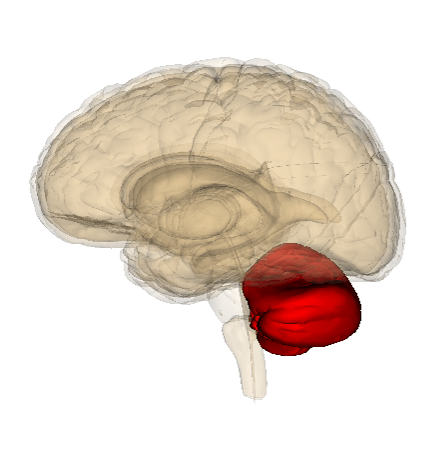
59.
The red portion is the ________
a)
Cerebrum
b)
Cerebellum
c)
Brain Stem
d)
Diencephalon
60.

Tim is having difficulty processing anything hot when he touches something, which lobe is not functioning properly?

a)

Occipital Lobe

b)

Temporal Lobe

c)

Parietal Lobe

d)

Frontal Lobe

61.

This part of the brain makes us unique and is our control information processing center?

a)

Cerebellum

b)

Corpus Collosum

c)

Cerebrum

d)

Hypothalamus

62.
attention
a)
brain stem
b)
frontal
c)
occipital
d)
temporal
63.
goal setting
a)
frontal 
b)
cerebellum
c)
parietal
d)
temporal