wayground logo

Free Printable Worksheets

Font size

S
M
L
XL
Worksheets

Unit 1 Measurement Matter Density

Total questions: 73

Worksheet time: 2hrs 37mins

Name
Class
Date
1.
In physical changes, substances might change in __________ but not in __________.
a)
appearance, composition
b)
volume, state of matter
c)
texture, color
d)
weight, mass
2.

Choose the best description below for the image

a)

physical change

b)

chemical change

3.

Choose the best description below for the image

a)

physical change

b)

chemical change

4.

Choose the best description below for the image

a)

physical change

b)

chemical change

5.

Choose the best description below for the image

a)

physical change

b)

chemical change

6.

Choose the best description below for the image

a)

physical change

b)

chemical change

7.

Choose the best description below for the image

a)

physical change

b)

chemical change

8.

The image is best described as

a)

Chemical Change

b)

Physical Change

9.
Matter can not be created nor destroyed: it can only be
a)
Destroyed a little bit
b)
Invisible
c)
Transformed, changed
d)
None of the above
10.

The Law of Conservation of Mass States

a)

Energy cannot be created nor destroyed, it can only change form.

b)

Mass cannot be created nor destroyed, it can only change form.

c)

Mass can be created or destroyed, it cannot change form.

11.

Which of the models of a chemical reaction best represents the Law of Conservation of Mass?

a)

A

b)

B

c)

C

d)

D

12.

Which of the models of a chemical reaction best represents the Law of Conservation of Mass?

a)

A

b)

B

c)

C

d)

D

13.

Which of the models of a chemical reaction best represents the Law of Conservation of Mass?

a)

A

b)

B

c)

C

d)

D

14.

A student heated a 10 gram sample of a chemical in an open container. A chemical reaction occurred, and the mass of the sample was measured again. The mass of the sample was found to be less than before the reaction. Which of the following best explains the decrease in mass of the sample?

a)

The heat caused the chemical to become less dense.

b)

The reaction gave off more heat than was added.

c)

Some of the lighter particles were destroyed.

d)

Some of the particles escaped as a gas formed.

15.

A student dissolved 25 grams of salt into 1,000 grams of water. What should the mass of the saltwater mixture be?

a)

975 grams

b)

1,000 grams

c)

1,025 grams

d)

2,500 grams

16.

A student measures the mass of an iron nail to be 25 grams. The student heats the nail over a bunsen burner and measures the mass of the nail afterwards. The mass of the nail is found to be greater after burning. Which of the following best explains the increase in mass of the nail?

a)

The heat caused the compound to become more dense.

b)

The reaction gave off less heat than was added.

c)

Some of the heavier particles multiplied inside the nail.

d)

Extra particles from the air were added to the nail during burning.

17.

What is the length?

a)

7

b)

7.7

c)

7.70

d)

7.700

18.

What is the volume?

a)

50

b)

45

c)

45.0

d)

40.5

19.

WHAT IS THE VOLUME?

a)

36

b)

36.5

c)

37.0

d)

36.0

20.

WHAT IS THE LENGTH?

a)

11.45

b)

11.4

c)

11

d)

11.450

21.

WHAT IS THE VOLUME?

a)

20.15

b)

20.1

c)

21.5

d)

21.50

22.

WHAT IS THE LENGTH?

a)

29

b)

29.2

c)

29.20

d)

30

23.
You can measure ______ with grams.
a)
mass
b)
volume
c)
conductivity
d)
melting point
24.
What is the definition of "weight"?
a)
measure of the force of gravity on your body
b)
the time it takes to get on a ride 
c)
the amount of matter in an object
d)
the size of an object
25.
The weight of an object _________ as it moves away from the center of Earth.
a)
increases
b)
stays the same
c)
triples
d)
decreases
26.
The mass of an object ___________ as it moves away from the center of Earth
a)
stays the same
b)
decreases
c)
increases
d)
doubles
27.

We use the BASE UNIT of ______________ to measure length or distance.

a)

Gram

b)

Meter

c)

Liter

28.

We use the BASE UNIT of ______________ to measure liquid volume.

a)

Liter

b)

Meter

c)

Gram

29.

Which is the more precise measurement?

a)

4 mL

b)

4.3 mL

c)

4.30 mL

d)

4.300 mL

30.
How many significant figures does the following number have: 0.002040
a)
6
b)
4
c)
3
d)
2
31.
Round 0.010229 to four sig figs
a)
1022
b)
1023
c)
0.01023
d)
0.01022
32.
How many significant figures does the following number have: 100.00210
a)
7
b)
5
c)
10
d)
8
33.

Why does ice float

a)

Liquid water is less dense than solid water.

b)

Solid water is less dense than liquid water.

c)

Gaseous water is less dense than solid water.

d)

Liquid water is less dense than gaseous water.

34.

Formula for density

a)

density = mass x volume

b)

density = mass + volume

c)

density = mass/ volume

d)

density = mass - volume

35.
Look at this image.  Which object has the LOWEST density in water? How
a)
The Ping Pong Ball because it floats to the top 
b)
The bolt because it has sunk to the bottom
c)
The soda cap because it is not just full of air like the Ping Pong ball
36.
Frank has an eraser. It has a mass of 4g, and a volume of 2cm3. What is its density?
a)
8 g/cm3
b)
2 g/cm3
c)
1/2 g/cm3
d)
24 g/cm3
37.
Archimedes used density to discover if the crown of gold was real because
a)
Substances have their own unique densities
b)
Substances can change densities depending on their size
c)
Substances can change densities depending on their mass
d)
Substances can change densities depending on their volume
38.

Which of the following is NOT correct regarding significant figure rules?

a)

All non-zero digits are significant.

b)

Trailing zeros in a whole number with the decimal shown are not significant.

c)

Zero digits before non-zero digits are not significant.

d)

Zero digits between non-zero digits are significant.

39.
How many significant figures does the following number have: 0.002040
a)
6
b)
4
c)
3
d)
2
40.

Which of the following is the answer for the problem with the correct number of significant digits? 24.32 + 1.2 =

a)
25.6
b)
25.52
c)
25.5
d)
25
41.
For addition or subtraction, the number of sig figs in the answer is determined by _____
a)
the number with the most figures after the decimal point
b)
the number with the fewest figures after the decimal point
c)
the total number of figures after the decimal point
d)
the number of trailing zeros
42.
240 cm = ___________ m
a)
2400
b)
24
c)
2.4
d)
0.24
43.
15.6 L = ___________ mL
a)
15,600
b)
156,000
c)
1,560,000
d)
15,600,000
44.
You know that 12 inches = 1 foot.  Convert 60 inches to feet.
a)
720 feet
b)
5 feet
c)
5 inches
d)
72 feet
45.

Convert 3.5 gallons into cups. (1gal = 16cups)

a)

56 cups

b)

0.21875 cups

c)

19.5 cups

d)

48 cups

46.
The length of a desk is 3.5 feet. How many centimeters is the length? 
(there are 2.54 cm in an inch)
a)
60
b)
120.23
c)
106.68
d)
117.12
47.
How many minutes are in a year?
a)
I can't count that high.
b)
525,600min
c)
52,560min
d)
31,536,000min
48.

How many kilograms of calcium are there in 173 pounds of calcium? (1 pound = 454 grams; 1 kg = 1000 g)

a)

1.10 kg

b)

78.5 kg

c)

110 kg

d)

78500 kg

49.

Measuring the volume of a block uses which equation

a)

Length ×Width×HeightLength\ \times Width\times Height  

b)

(radius)2×Length×π\left(radius\right)^2\times Length\times\pi  

50.

What is the unit for density ?

a)

g/ mL

b)

g

c)

gcm3\frac{g}{cm^3}  

d)

cm4cm^4  

51.

Calculate the density of the cube.

a)

2 g/cm3

b)

4 g/cm3

c)

6 g/cm3

d)

8 g/cm3

52.

what is the volume of the cube?

a)

123

b)

144

c)

244

d)

150

53.
If a block of wood has a density of 0.6 g/cm3 and a mass of 120 g, what is its volume?
a)
200 cm3
b)
0.005 cm3
c)
200.0 ml
d)
72 ml
54.
Find the density of a 2 cm x 2 cm x 2 cm cube with a mass of 64 g.
a)
6 cm3
b)
12 g/cm3
c)
128 g/cm3
d)
8  g/cm3
55.
What is the volume of Object X?
a)
10.0 cm3
b)
15.0 cm3
c)
20.0 cm3
d)
25.0 cm3
56.
The amount of space something takes up
a)
density
b)
volume
c)
mass
d)
matter
57.

Density is ____

a)

is the ratio between mass and volume

b)

the amount of matter in an object

c)

the amount of space an object takes up

d)

the weight of an object

58.

An irregularly shaped rock was lowered into a graduated cylinder holding a volume of water equal to 50 ml. The height of the water rose to 75 ml. If the mass of the stone was 250 g, what was its density?

a)

15 g/mL

b)

3.3 g/mL

c)

10 g/mL

d)

20 g/mL

59.
If you are given the density and volume of an item, how would you calculate its mass?
a)
D = M/V  SO..
M = D/V
b)
D = M/V  SO...
M = V/D
c)
D = M/V SO...
M = D x V
60.
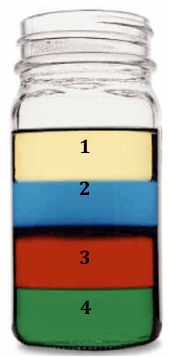
Put the liquids in order from most dense to least dense?
a)
4, 3, 2, 1
b)
1, 2, 3, 4
c)
3, 4, 2, 1, 
d)
4, 3, 1, 2
61.

Which box has a higher density?

a)

A

b)

B

c)

They are the same

62.

In this image, the DENSITY of A is _____ the density of B

a)

equal to

b)

greater than

c)

less than

63.
If an object has a density of 21.45 g/cm3, what will be the density of the object if you cut it in half? (All calculations should have the correct sig figs)
a)
21.45 g/cm3
b)
10.725 g/cm3
c)
2 g/cm3
d)
42.9 g/cm3
64.
Calculate the mass of a substance which has a volume of 35.0 cm3 and a density of 0.50 g/cm3.(All calculations should have the correct sig figs)
a)
17.5 g
b)
0.014 g
c)
18 g 
d)
70. g
65.

What is the volume of 8 grams of the substance pictured in the graph?

a)

8 g

b)

4 mL

c)

8 mL

d)

6 mL

66.

What is the density of this substance?

a)

1 g/mL

b)

1 g

c)

1 mL

d)

10 g/mL

67.
What would the volume be if you had 200 grams of this substance? 
a)
40 grams
b)
40 ml
c)
5 g/ml
d)
200 ml
68.
Which substance is the MOST dense?  ** Use the key
a)
A
b)
B
c)
C
69.
Which substance is the least dense? **Use the key 
a)
A
b)
B
c)
C
70.
Which graph correctly represents the relationship between mass and volume?
a)
A
b)
B
c)
C
d)
D
71.

What is the mass of 700 cm3 of petroleum?

a)

200 g

b)

400 g

c)

600 g

d)

800 g

72.

Find the density of the substance from the mass and volume graph.

a)

10 g/mL

b)

5 g/mL

c)

10 g

d)

5 mL

73.

What would the mass be of an 800 cm3 of gold according to the graph?

a)

11,000 g

b)

14,000 g

c)

12,000 g

d)

15,000 g