
 Worksheets
CLASS_Test01
Total questions: 53
Worksheet time: 2hrs 40mins

What is A in the given diagram?
During DNA replication, which strand is copied faster?

Structure C is
helicase
primase
DNA polymerase III
gyrase


The enzyme that joins together small segments of newly replicated DNA is:
DNA Polymerase III
DNA Polymerase I
DNA Polymerase II
DNA Ligase
Which of the following is false about Klenow Fragment
3′→5′ exonuclease activity
5′→3′ exonuclease activity
324-928 residue of polymerase 1
polymerization activity

1. Recoil
2. Straightens the double helix
3. Breaks Hydrogen bonds
4. Adds Free nucleotides
Enzyme that connects the DNA to the backbone (glues)
Ligase
Polymerase
Helicase
Primase
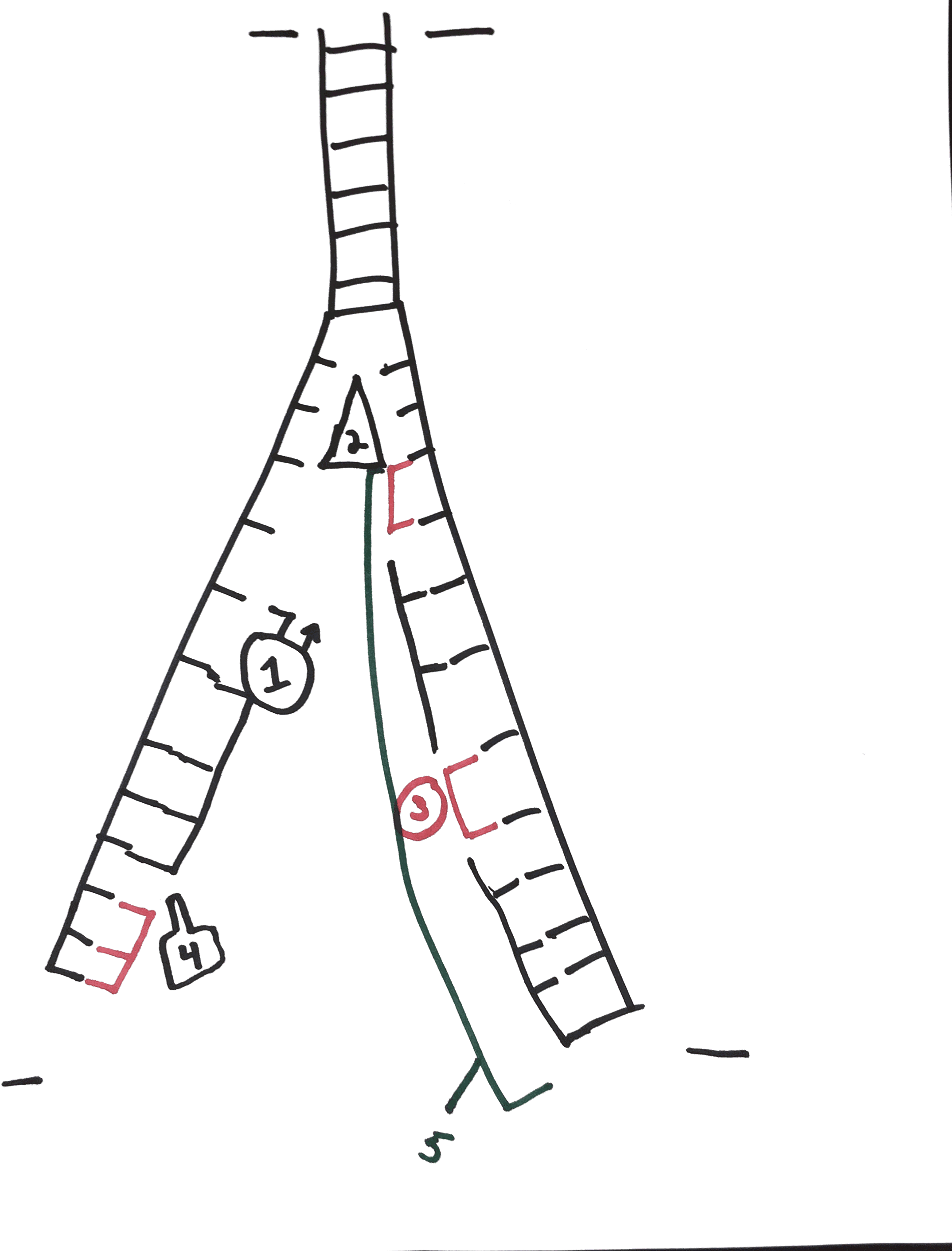
#4 in the picture
Polymerase
Primase
Helicase
Ligase
If a person suffered from a disorder where their DNA fragments were unable to fill in the missing slots in between the fragments of the lagging strand, they would most likely have a disorder that affected which enzyme?
DNA Helicase
DNA Ligase
DNA polyermase
RNA Polymerase
Structure C is
helicase
primase
DNA polymerase III
gyrase
Which of the following is not a feature of Ori
AT rich sequences
GC rich sequences
Multiple short repeats
none of the above
A replicator Ori C is bound which of the following initiator to form replicator - initiator complex?
DNA B
DNA A box
DNA A
DNA C
Rate of replication in EK is ................than E.coli. select a word from the given options to make correct meaning.
slower
fast
same
Archaebacteria has a MONOREPLICONIC DNA.
TRUE
FALSE
NOT KNOWN
none of the above
Select the TRUE statements from the following. (MORE THAN ONE OPTION MAY BE TRUE)
role of AT rich sequences is to facilitate the melting of DNA
13 mer region is known as DNA A box in E.Coli.
Initiation of replication is regulated by methylation in bacteria
A hemi methylated DNA in bacteria can also initiate replication
For methylation the target sites are GCCT/CTAA
Select the false statements from the following. (MORE THAN ONE OPTION MAY BE FALSE).
In E.coli, the target sequences for methylation are GATC/CTAG
A replicon (ARS) in yeast is larger than E.coli.
A replicon (ARS) in yeast is smaller than E.coli
B domains in ARS are more conserved than A domain in ARS of yeast.
Choose the correct definition of replisome.
Replisome are DNA complexes that carries out replication
replisome is a large protein complexe that carries out DNA replication
replisome is a DNA RNA complex that is formed during replication
replisome is a nucleoprotein
Choose the correct word to fill up the blanks in the following sentence:
REPAIR SYNTHESIS OF DNA REPLACES A ........... STRETCH OF ............. OF DNA WITH A DAMAGED BASE
LONG, ONE STRAND
SHORT, ONE STRAND
LONG, BOTH STRANDS
SHORT, BOTH STRANDS
Which of the following statements are TRUE for DNA polymerase? (More than one options may be true)
DNA synthesizing subunit is the only function of holoenzyme.
DNA synthesizing subunit is one of the several functions of holoenzymes.
DNA polymerase III is a product of gene pol C
DNA polymerase alpha shows priming in EK.
DNA polymerase III is a product of gene pol B
Which of the following statement is true?
Bacterial polymerase enzymes possess the 3'-5' exonuclease activity that proceeds in same direction of DNA synthesis.
Bacterial enzymes possess the 3'-5' exonuclease activity that proceeds in reverse direction of DNA synthesis.
Both of the above
None of the above
Choose the correct sequence of WORDS to answer the following question:
FINGERS, PALM and THUMB of human right hand correspond to which of the following functions?
catalytic site, binds DNA and template positioning.
binds DNA, catalytic site and template positioning
template positioning, binds DNA and catalytic site
template positioning, catalytic site and binds DNA
CORE CATALYTIC ENZYME of DNA Polymerase III in E.coli contains which of the following subunits:
α, e, θ
α, β, θ
α, γ, θ
α, and θ
Which enzyme proofreads and removes RNA Primer during DNA replication.
Ligase
Polymerase 1
Polymerase 3
Helicase
Choose the statement that correctly describe the conditions associated with Masselson and Stahl experiment. (more than one option may be correct)
Source of DNA was T4 phage
Source of DNA was E.coli
model organism studied was E.coli
All of the above
In messelson and Stahl's experiment, Nitrogen 'N' was used to incorporate into the newly synthesized DNA. For this, 'N' was supplied in which form?
NH3
NH4Cl
NaNO3
N2
In repeating the Masselson and Stahl Experiment, Three generations are obtained in the laboratory labelled as G0, G1 and G3. Choose the statement that correctly describe G0,/ G1 /G3 in terms of production of band on CsCl Gradient centrifugation.
G0 is the generation from which DNA produces a single N15 band.
G1 refers to DNA obtained after one generation that gives an Intermediate hybrid band.
G2 refers to the generation that produces two types of bands of DNA on CsCl gradient centrifugation.
All of the above
A mode of replication in which two copies of DNA are produced and both contain distinct regions of DNA composed of both original and new strand , is termed as
Conservative mode
Semi-conservative
Dispersive
Non-Dispersive
Which is the last step of DNA replication?
RNA Helicase unwinds original DNA strand
DNA Primase lays down RNA primer for new nucleotide bases.
RNA polymerase builds new strands by bring in new nucleotide bases.
Ligase knits together fragments on lagging strand
Termination of replication is triggered by-----
Helicase
Topisomerase
SSB
Tus
DNA polymerase III holoenzyme possesses the_____
polymerase activity only
3’→ 5’ endonuclease activity
3’→ 5’ exonuclease activity and polymerase activities
5’→ 3’ exonuclease activity
Which of the following statements are correct about DNA synthesis at the replication fork?
I. Only occurs in 3' to 5' direction
II. Catalyse the elongation of new strand
III. Involve both strands of DNA
I only
I and II only
II and III only
I, II and III
Select the statements that hold TRUE for DNA replication for chromosomes of a rat cell.
replicons located in the same vicinity are to be active at the same time
A pre-replicative complex is formed during S phase prior to replication
At any point of time only some of the replicons are active while others are activated at a specific point of time in S phase
Single strand binding protein is a tetramer
Select the correct options to complete the following statement
ARS in yeast contain consensus sequences,..................................,and ...........................................
B Domain
and
additional elements
A domain
and
additional elements
B1 domain
and
additional elements
None of the above
Select the correct statement that describes DNA polymerase holoenzyme of E.coli.
DNA pol III holoenzyme has at least two catalytic cores, two clamps, and a clamp loader complex
DNA pol III holoenzyme has at least two catalytic cores, a clamp, and a clamp loader complex
DNA pol III holoenzyme has at least three catalytic cores, two clamps, and a clamp loader complex
DNA pol III holoenzyme has only one catalytic core, two clamps, and a clamp loader complex
Choose the correct term to complete the following definition
origin of replication are specific ...........on DNA at which replication begins
sequences
sites
signals
all are correct
Choose the FALSE statements from the following. More than one option may be chosen.
E.coli has single ori.
E.coli has multiple ori
In E.coli, unwinding intiates at 13 mer
13 mer is also known as DNA A box
In Ek, the following protein shows helicase activity
Helicase
MCM protein
geminin
None of the above
Which of the following event is required for transition from G1-S phase in EK.
Methylation of CDC6 and MCM
Phosphorylation of CDC6 and MCM
Dephosphorylation of CDC6 and MCM
Phosphorylation of CDC6 only
In eukaryotic DNA replication, the job of Primer removal is done by which of the following?
RNaseH1
DNA polymerase
Flap endonuclease
RNaseH1+ Flap endonuclease (both)

