
Font size
 Worksheets
Nuclear Chemistry Review
Total questions: 41
Worksheet time: 28mins
changes a neutron to a proton and emits an electron.
Negatively charged particles (electrons) emitted from a nucleus at a high speed are ____.
When the isotope 5024X releases an alpha particle we get another element Y that looks like
5022Y
4622Y
4820Y
5426Y
When the isotope 5024X releases a beta particle we get another element, Y, that looks like
5023Y
4622Y
5025Y
5024Y
What is meant by the statement that 3215P has a half life of 14 days
It takes 7 days to go down to 50% radioactivity each time
It takes 14 days to go down to 50% radioactivity each time
After 14 days it starts to become less radioactive
After 14 days the mass decreases by 50%.
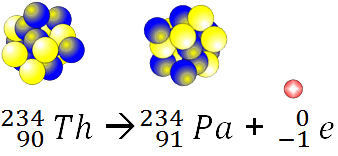
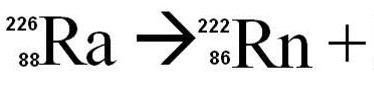
Complete the nuclear equation and determine the type of decay that is occurring in this reaction.
alpha, 42He
beta, 0-1e
gamma
none

What element is in place of the ?
146C --> 0-1e + ________


Which particle has the lightest mass?
He
e
H
n

What type of decay is below?
Alpha
Beta
Fission
Fusion

About how many MILLIONS OF YEARS is the Half Life of Uranium 235?
500
600
700
800

When two nuclei merge to form a single larger nucleus, _____________ has occured
Beta Decay
Alpha Decay
Nuclear Fusion
Nuclear Fission
How many half-life cycles must pass for only 25% of the original sample of U-235 atoms to remain? (you start with 100%)
1
2
3
4
What is the term for an ongoing series of nuclear reactions?
fission
chain reaction
fusion
nuclear
When a neutron turns into a proton in a nucleus, what sort of particle is emitted?
Alpha
Beta
Gamma
Photon
Gamma Rays have ______ charge.
None
+2
+1
__________ occurs when two nuclei combine to form another nucleus.
Nuclear Fission
Nuclear Fusion

What is one problem with studying nuclear fusion in the lab?
it is too expensive
materials are too big to fit in a lab
clean energy production
necessary pressure & temperatures can't be easily maintained

Fill in the blank for the missing part of the decay equation. What type of decay is this?
e
He
alpha
beta

Fill in the blank for the missing part of the decay equation. What type of decay is this?
U-238
U-240
alpha
beta

Using the band of stability graph, what is the ratio of neutrons to protons that is the most stable for elements 1-20?
3:1
1:1
1:1.5
1:2
What two opposing forces are working in the nucleus of an atom?
weak nuclear force holding the protons and neutrons together and electrostatic force that repels protons from each other.
strong nuclear force holding the protons and neutrons together and the Star Wars force
strong nuclear force holding the protons and neutrons together and electrostatic force that repels protons from each other.
electrostatic force that repels protons from each other and gravitational force that draws them closer to the earth
What is the charge of the following particle?
alpha particle
+2
+1
0
-1
What is the charge of the following particle?
Beta particle
+2
+1
0
-1
What is the charge of the following particle?
positron
+2
+1
0
-1
The nuclear forces that hold the protons and neutrons in the nucleus are________.
equal in strength to the electromagnetic repulsions between protons
stronger than the electromagnetic repulsions between protons
weaker than the electromagnetic repulsions between protons
either stronger or weaker than the electromagnetic repulsions between protons depending on the element.
The unstable isotope Radium-224 naturally undergoes alpha decay to become another isotope. Which isotope does it become after this decay?
Rn-220
Ac-224
Fr-223
Ra-222
If the half life of an isotope is 50 years, calculate the percent of original radioactive atoms that remain radioactive after 200 years.
none
50%
12.5%
6.25%
A researcher needs a lead and concrete barrier to shield himself against radiation produced in a lab experiment. Which type of radiation must the experiment produce?
alpha radiation
gamma radiation
free protons
free neutrons
Geiger counters are scientific instruments that detect alpha, beta, and gamma rays. Geiger counters are useful in gathering data on the
potential risks of different amounts of harmful radiation emitted
amount of energy needed to split a nucleus in nuclear fusion
possible damage caused by different bands of UV light
distance that certain radio wave frequencies are able to travel

