
 Worksheets
Periodic table
Total questions: 101
Worksheet time: 1hrs 7mins

What is located in the nucleus of an atom?
protons and neutrons
protons and electrons
electrons and neutrons
How is the Periodic Table arranged?
alphabetical order
atomic number
the year the element was discovered
Albert Einstein decided how to arrange it.
What is located on the horizontal rows on the Periodic Table?
families
groups
periods
In which direction would you find groups/families?
horizontal
vertical
How many different types of atoms make up an element?
1
2
3
How are symbols for elements written?
numbers
pictures
letters
What is the symbol for carbon?
Ca
C
Na
H is the symbol for____.
Helium
Hydrogen
Iron
What is the charge of a proton?
positive
negative
neutral
What is the charge of a neutron?
positive
neutral
negative
Negative is the charge for _____.
protons
neutrons
electrons
What is a subscript found in a formula?
letter
number that tells how many atom are needed
star
Found along the 'staircase'. Have properties of both metals and nonmetals.
Metal
Metalloid
Non-metal
Property
brittle , dull, poor conductors of heat and electricity, and have much lower melting and boiling points
metal
metalloid
non-metal
property
horizontal rows on the periodic table
Period
group
family
Ductility
vertical columns on the periodic table
periods
groups
conductivity
malleability
an element that is shiny and that conducts heat and electricity well
metal
non-metal
metalloid
malleability
A group of elements on the periodic table with similar physical and chemical properties
period
family
metal
non-metal
Characteristic used to describe something
Period
conductivity
ductility
property
The ability of an object to transfer heat or electricity to another object.
malleability
conductivity
ductility
luster
the ability of a substance to be drawn or pulled to produce a wire
malleability
conductivity
ductility
luster
the quality of giving off light, brightness, glitter, brilliance
malleability
conductivity
ductility
luster
the ability of a substance to be hammered or beaten into thin sheets
malleability
conductivity
ductility
luster
Name an element that is used as a fuel in nuclear reactors
Uranium
Sodium
Potassium
Helium
(a) is the only non-metal which is a good conductor of electricity.
What are the three main groups of the periodic table?
groups
metal
nonmetals
metalloids
periods
What do the vertical columns on the periodic table tell us?
The number of orbitals
The number of valence electrons (electrons on the outer most shell)
What does the number of proton tell us?
electrons
atomic number
atomic mass
neutrons
How do you calculate the number of neutrons? *
Mass = Atomic number - Neutrons
Mass - Atomic number = Neutrons
Atomic number = Neutrons

What is the name of the element? (Periodic table will be needed)
sodium
magnesium
vanadium

What group and period does this element belong in? *
period 1 and group 3
period 3 and group 1
period 2 and group 3
period 3 and group 2

How many protons and electrons does nickel have?
28
58.69
Define - Isotope
What does Dalton's theory state?
Signs of a reaction are
High melting point
Metal
Non-metal
Ductile
Metal
Non-metal
Not shiny
Metal
Non-metal
Bad conductors of heat and electricity
Metal
Non-metal
What are the two types of properties
(a)
Give examples of physical properties
Give examples of chemical properties
The elements were originally ordered by
(a)
The elements are ordered by
(a)

How many periods are in the periodic table?
5
4
2
7

How many groups are in the periodic table?
18
8
11
15

What does the C represent?
atomic mass
atomic number
element name
chemical symbol

What does the 6 represent?
atomic mass
atomic number
element name
chemical symbol

What does 12.011 represent?
atomic mass
atomic number
element name
chemical symbol
The letter, C, is a .................. of carbon.
Name
Nickname
Chemical Symbol
Pseudonym
The vertical (up and down) columns in the Periodic Table are called
groups
towers
periods
atomic numbers
The Modern Periodic Table of Elements is arranged by
atomic mass
atomic number
valence electrons
number of isotopes


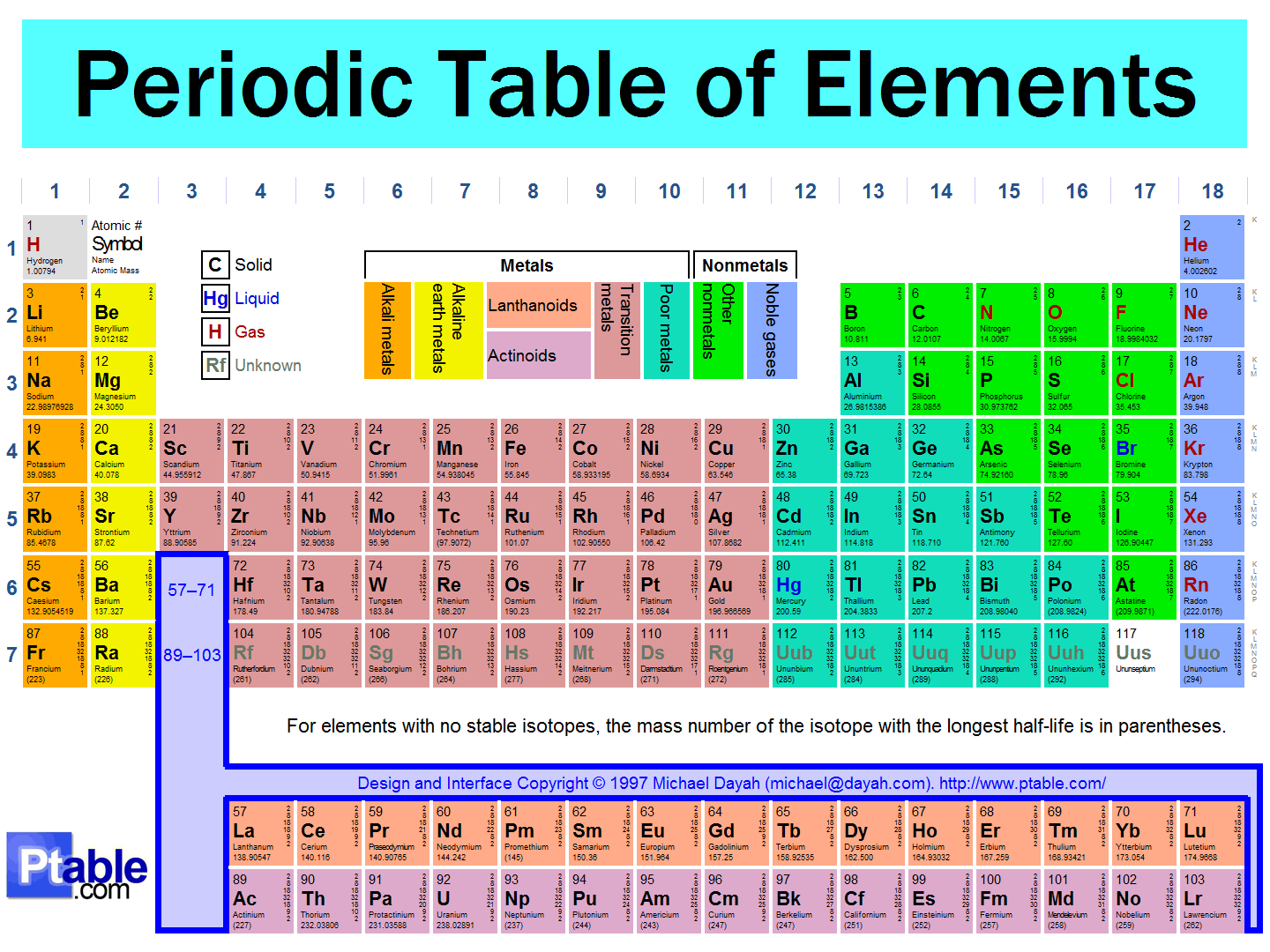
what is the big group of metals called found within the metals
transition metals
nonmetals
noble gases
halogens
a grouping of elements based on similar properties, arranged by columns in the periodic table; also known as a group
family
period
row
isotope
The distance between nucleus and outermost shell occupied electron
Atomic Radii
Ionization Energy
Electronegativity
Electron Afinity
Oxidation Number
The tendency of an atom to attract an electron
Atomic Radii
Ionization Energy
Electronegativity
Electron Afinity
Oxidation Number
high reactivity and unstable elements
high reactivity and found often alone in nature
The elements in this family are soft, silvery, and very reactive with water.
Alkaline Earth Metals
Alkali Metals
Transition Metals
Lanthanides
Which element is similar to Mg?
Ca
B
O
Cl
Which element is similar to He?
H
Ar
Au
Hg


Which of the following are found in the nucleus?
protons and electrons
protons ONLY
protons and neutrons
Electrons only
________________ have a positive charge, ___________________ have NO charge, and _____________________ have a negative charge.
Protons, Electrons, Neutrons
Neutrons, Electrons, Protons
Protons, Neutrons, Electrons
Electrons, Neutrons, Protons
Which of the following are found on the left side of the zig zag line on the periodic table?
Non-metals
metalloids
metals
compounds
_________________________ are the horizontal rows on the periodic table while _______________________ are the vertical columns.
periods/ groups(families)
groups(families)/periods
metals/non-metals
non-metals/metals

Which of the following elements is in (period 4 , group 2)
Carbon
Potassium
Calcium
Sodium

Which of the following has similar properties to potassium (K) because they are in the same group(family)
Sodium (Na)
Magnesium (Mg)
Calcium (Ca)
Gold (Au)
The element Zinc (Zn) has an atomic number of 30 and an atomic mass of 65 therefor each atom of zinc contains ___________protons, ______________neutrons, and _____________electrons.
30,30,35
30, 30, 25
30, 35, 30
35, 30, 30


number of electrons only
number of protons only
number of neutrons only
both electrons and protons in an atom

alphabetical order
number of neutrons
color
What group and period does this element belong in? *
period 1 and group 3
period 3 and group 1
period 2 and group 3
period 3 and group 2
Which group does Aluminum belong to?
Group 3
Group 13
Group 6
Group 26
Which period is Oxygen found in?
Period 1
Period 2
Period 3
Group 16
Which element is found in Period 4, Group 8?
Iron
Oxygen
Nickel
Silver
What is the ATOMIC NUMBER of the element found in Period 4, Group 1?
41
4
1
19
What is the factor that determines the chemical properties of an element?
The number of electron shells
The number of electrons in the innermost shell
The number of electrons in the outermost shell
The number of neutrons in the nucleus
Why does the reactivity of group 1 elements increases down the group?
It becomes more reactive
It becomes easier to accept an electron
It becomes easier to lose an electron
It becomes less reactive
Reactivity of halogen decreases going down the group because
The 8th electron difficult to attract by nucleus
Atomic size decreases down the group
Electrons are closer to the nucleus
Screening effect decreases

Table shows the relative atomic masses of two elements, H and J. Element H and J are located in Group 1 of the Periodic Table. Which statements is true about elements H and J?
H is more electropositive than J
The melting point of J is higher than that of H
The number of valence electrons in atom J is more than that of atom H
J reacts with cold water more vigorously than H
Element R forms an ion, R- with an electron arrangement of 2.8.8. The chemical properties of element R are similar to another element with a proton number of?
9
12
16
19
The following shows some information about element M.
1) element M forms ions with the formula M+
2) An M+ ion has an electron arrangement of 2.8
Element M will?
reacts with red-hot iron to form a brown solid
displaces hydrogen gas from cold water
forms an acidic oxide
cannot conduct electricity
Element G, L and J are located in Group 17 of the Periodic Table. Element J is more electronegative than element G. The reaction of red-hot iron wool with gas L is more vigorous than the reaction of red-hot iron wool with gas J. The reactivity of these three elements in ascending order is ?
G, J, L
L, J, G
L, G, J
J, G, L
Atom T has a proton number of 11 and a nucleon number of 23. Which of the following is true about element T?
It does not conduct electricity
If forms an oxide with the formula TO
It is a hard black solid
It reacts with water to form an alkaline solution

Table shows the electron arrangement of atoms X and atom Y. Which of the following statements is true about element X and Y?
Element Y is more electronegative than element X
Both the elements, X and Y, are good electrical conductors
An atom of X can accept an electron more readily than an atom of Y
An aqueous solution of element X is acidic but an aqueous solution of element Y is alkaline

Two chemical properties of element W are shown above.
Based on the information given which of the following is another property of element W?
W reacts with water to liberate hydrogen gas
W is very electropositive
W reacts with sodium hydroxide solution to form salts with the formulae NaW and NaOW
W is a good electrical conductor
Why do melting point (down the group) decreases in group 1 but increases in group 17?
Compare the reactivity of Group 1 and Group 17 element. Explain why.
What is electronegativity? Compare group 1 and group 17 elctronegativity
i. down the group
ii. over the period

