
Font size
 Worksheets
CH 1 & 2 Test
Total questions: 40
Worksheet time: 3hrs 20mins
Pick all examples of a living thing.
A maple tree
Dirt
A bacterial cell
Sand

A living thing can respond to stimuli.
True
False
Which of the following is true for ALL living things? (hint: more than one correct answer)
All living things use energy.
To make good qualitative observations, you only need to use one of your senses.
True, you can tell everything you need to know just by looking at it.
False, you should use many of your senses to learn more about it.
True, using only your sense of smell will do the trick.
False, you only need 2 of your senses to make good observations.

Which of the following is a quantitative observation?
The bird is very colorful.
A hummingbird visits a flower 7 times in 24 hours.
The bird has many, many feathers.
It is a bird.

What is the first step in solving a problem?
Make an observation
Design and conduct an experiment
Make a hypothesis
Share your results
A scientific theory is a guess about why something happens based on little evidence.
False
True
_________ is a logical interpretation based on prior knowledge, but is not testable.
hypothesis

The higher the pH, the more active Pepsin and Trypsin are.
True
False

In most cases, Monarch Butterfly appearance usually comes after Milkweed appearance.
True
False

1.2m is larger than 1120 mm. (hint: convert to the same units, then compare)
True
False

True or false: 2.5 kg = 2500 g
True
False

0.725 g = _________mg
725
7.25
72.5
0.000725
Which of the following is part of the Scientific Methodology process?
Hint: There is more than 1 correct answer.
Making a guess
Conducting experiments without a control group
Analyzing data
Forming hypotheses
Drawing conclusions

In the Marsh Experiment (from your textbook), what are the independent and dependent variables? (select all correct options)
Independent: Nitrogen Added
Independent: Increased Sunlight Exposure
Dependent: Grass Growth
Dependent: Nitrogen Added
What are the 4 qualities all good scientists have? (select all correct options)
Curiosity
Smart
Skepticism
Open-mindedness
Creativity
What is homeostasis?
Maintaining an internal balance
The process of a caterpillar changing into a butterfly
A sudden change in temperature
Instability within a system
pie chart

Attraction between molecules of different substances, demonstrated by this station activity.
adhesion
cohesion
covalent bond
ionic bond
attraction between molecules of the same substance
cohesion
adhesion
enzyme
protein
nonpolar molecule composed of carbon, hydrogen, and oxygen; includes fats, oils and waxes
lipid
amino acid
carbohydrate
nucleic acid
molecular subunit of a polymer; building block of a larger molecule
monomer
substrate
enzyme
ion
polymer of nucleotides; the genetic material of organisms
nucleic acid
carbohydrate
protein
lipid
large, carbon-based molecule formed by monomers
polymer
solution
ion
atom
polymer composed of amino acids linked by peptide bonds; folds into a particular structure depending on bonds between amino acids
protein
carbohydrate
lipid
nucleic acid
Proteins are polymers formed from the monomers...
lipids
amino acids
carbohydrates
nucleic acids
Which of the following has the function of storing and transmitting genetic information?
carbohydrates
proteins
lipids
nucleic acids
What does it mean when a molecule is polar?
that the molecule has unevenly distributed charges
it can be found only in the North and South Poles
that the molecule has evenly distributed charges
it turns into an ice cube
This property of water causes water molecules to be drawn together, which is why drops of water form beads on a smooth surface.
adhesion
cohesion
capillary action
heat capacity
Which of these is correct about carbohydrates?
Monosaccharides are made up of smaller polysaccharides.
Only some polysaccharides are made up of monosaccharides.
Glucose is a polysaccharide.
Monosaccharides (glucose) are used to build larger molecules like disaccharides and polysaccharides (starch).
A polar molecule ________________.
is caused by the unequal sharing of electrons
causes one side of a molecule to have a partial positive charge and the other side to have a partial negative charge
will bond with other polar molecules
all of the above are correct
Which of these are organic molecules (macromolecules). Select all that apply
Nucleic acids
Proteins
Carbohydrates
Water
Lipids
Draw a sketch of a water molecule. Include correct structure, label the atoms (use element symbols), and show which end is positive (+) and which is negative (-). Use correct colors.

Draw a Hydrogen Bond (H+ Bond) between any three water molecules in the picture. Accurately demonstrate where the bonds connect.


Question: The material covered in a two week period in Experiment 2 is the ______ variable.
Experiment 2: One of your pod group members decides to conduct an experiment to show how the amount of sleep students get affects their grades. She makes a survey that asks her peers how many hours of sleep they get on average on weekdays. After reading the results, she puts peers into 3 categories, Group 1: little sleep (4-5 hours), Group 2: moderate sleep (6-7 hours), Group 3: high sleep (8 or more hours). She hypothesizes that if students get more sleep, they will get better grades. To test her hypothesis, she asks Mrs. Ciarelli to give all her Biology students a fake pop quiz that covers the material we learned in class over the past 2 weeks. After analyzing the results of the quiz, she found that students who got more hours of sleep on average performed better on the fake pop quiz.
control
independent
dependent
Question: The amount of sleep (on average) in Experiment 2 is the ______ variable.
Experiment 2: One of your pod group members decides to conduct an experiment to show how the amount of sleep students get affects their grades. She makes a survey that asks her peers how many hours of sleep they get on average on weekdays. After reading the results, she puts peers into 3 categories, Group 1: little sleep (4-5 hours), Group 2: moderate sleep (6-7 hours), Group 3: high sleep (8 or more hours). She hypothesizes that if students get more sleep, they will get better grades. To test her hypothesis, she asks Mrs. Ciarelli to give all her Biology students a fake pop quiz that covers the material we learned in class over the past 2 weeks. After analyzing the results of the quiz, she found that students who got more hours of sleep on average performed better on the fake pop quiz.
control
independent
dependent
Question: The performance on pop quiz in Experiment 2 is the ______ variable.
Experiment 2: One of your pod group members decides to conduct an experiment to show how the amount of sleep students get affects their grades. She makes a survey that asks her peers how many hours of sleep they get on average on weekdays. After reading the results, she puts peers into 3 categories, Group 1: little sleep (4-5 hours), Group 2: moderate sleep (6-7 hours), Group 3: high sleep (8 or more hours). She hypothesizes that if students get more sleep, they will get better grades. To test her hypothesis, she asks Mrs. Ciarelli to give all her Biology students a fake pop quiz that covers the material we learned in class over the past 2 weeks. After analyzing the results of the quiz, she found that students who got more hours of sleep on average performed better on the fake pop quiz.
control
independent
dependent

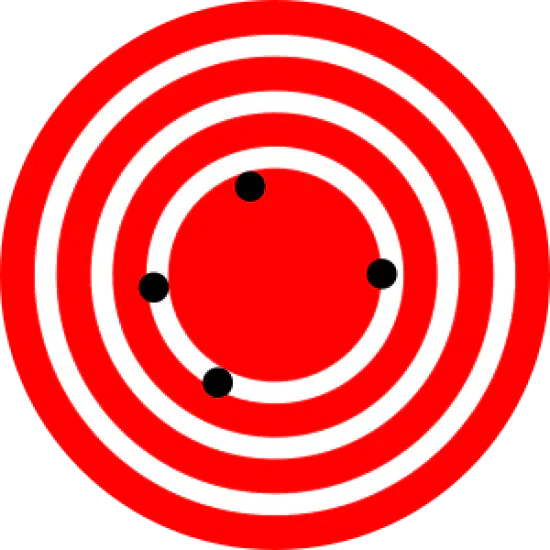
A pod group member is struggling to measure 30g of yeast on a scale for an experiment. She claims the scale is broken. To test her claim, you put a 100g weight on the scale. The scale reads 98.76g. This scale is not ________.
Precise
Accurate

