
 Worksheets
B24 #7-8 Reasons for Cell Divisions & Mitosis vs. Meiosis
Total questions: 57
Worksheet time: 29mins

Which of the following is least efficient?
A
B
C
D

CLICK ON IMAGE: Which cell would have the smallest surface area and largest volume?
1um cube (smallest)
2um cube (middle)
4um cube (largest)
Cells want a _______ Surface/Volume Ratio and a ______VOLUME.
Small; Small
Large; Large
Large; Small
Small; Large

Asexual reproduction is associated with what type of cell division?
Mitosis
Meiosis
Genetically identical offspring are _____________ the parent organism.
opposite of
clones of
superior to
inferior to
Some advantages of sexual reproduction include: (select all that apply - there are 3)
genetic variation
improves chances of adapting to the environment
helps species survive catastrophes
it doesn't take as much energy as asexual reproduction
What are some advantages of asexual reproduction are: (select all that apply - there are 3)
it only requires one organism
it takes less energy than sexual reproduction
offspring are easy to reproduce
there is a lot of genetic variety
How many parents are required for sexual reproduction?
0
1
2
3
How many parents are required for asexual reproduction?
0
1
2
3
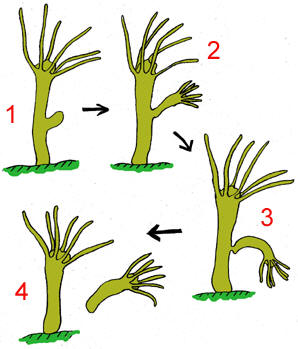
When an offspring grows off from the body of a parent organism it is called __________________.
budding
fission
fragmentation
sporulation
All Offspring of Sexual reproduction are diverse.
If the cell of a Multicellular organism divides, the organism will most likely ______.
grow and repair
reproduce
die
do nothing
If the cell of a Unicellular organism divides, the organism will most likely ______.
grow and repair
reproduce
die
do nothing
Recall the reason why bacteria need to undergo cell division.
To develop
To repair
To reproduce
To grow

This image shows how bacteria multiply. Recall the name of this process.
Asymmetrical replication
Sexual reproduction
Binary fission
Finary bission
A human skin cell contains 46 chromosomes. After the cell completes the process of mitosis and the cell divides, how many chromosomes will each of the new skin cells contain?
2
23
46
92
Two bacterial daughter cells of about the same size with identical DNA may be formed by the process of
budding.
meiosis
binary fission.
vegetative propagation.
In mitosis, interphase is the period when the cell begins preparations to divide. Which of the sequences below follows interphase?
prophase metaphase anaphase telophase
metaphase prophase telophase anaphase
anaphase telophase interphase anaphase
telophase anaphase metaphase prophase
An animal cell containing 32 chromosomes divides by meiosis. Each of the resulting daughter cells goes through meiosis. The cells that result each have
4 chromosomes.
8 chromosomes.
16 chromosomes.
32 chromosomes.
What is the final outcome of mitosis?
4 unique haploid cells
2 unique haploid cells
2 identical diploid cells
4 identical diploid cells.
Which are examples of asexual reproduction?
I. binary fission II. fertilization III. budding
I and II only
I and III only
II and III only
I, II, and III
Why is mitosis important in multicellular organisms?
Mitosis is essential for growth and repair.
Mitosis ensures that diploid reproductive cells divide twice, forming four haploid daughter cells.
Mitosis is responsible for passing on genetic variability and beneficial mutations to the next generation.
Mitosis allows tissue growth in multicellular organisms by resulting in the formation of gametes, which then form new cells.
A single prokaryotic cell can divide several times in an hour. Few eukaryotic cells can divide as quickly. Which of the following statements best explains this difference?
Eukaryotic cells are smaller than prokaryotic cells.
Eukaryotic cells have less DNA than prokaryotic cells.
Eukaryotic cells have more cell walls than prokaryotic cells.
Eukaryotic cells are more structurally complex than prokaryotic cells.
Which of the following events takes place during Synthesis (S) phase? (usually before mitosis meiosis in reproductive organs)
nuclear division
DNA replication
RNA redistribution
cell membrane pinching
The results of meiosis are:
2 diploid identical cells
4 haploid unique cells
46 diploid unique cells
23 haploid identical cells
*Two copies of chromosomes that share similar genes, but may have different alleles are called:
sister chromatids
Chromie Homies
Replicated chromosomes
homologous chromosomes
Germ cells (cells that make egg and sperm cells) go through:
mitosis
meiosis
DNA replication
Germ cells (cells that make egg and sperm cells) go through:
mitosis
meiosis
DNA replication
All of the following create genetic variation EXCEPT..
Mutations
DNA Replication
Law of Independent Assortment
Crossing Over
When does crossing over occur?
Mitosis
Meiosis
Prophase II
Anaphase I
Chromosomes exchange genetic material during Meiosis I are called


What is a mutation?
When stem cells turn into specialized cells
A change in an individuals DNA that has no effect on genetic variation
A change in an individuals DNA that can increase genetic variation
A change in an individuals DNA that can decrease genetic variation

The diagram below represents a change that occurred in a pair of chromosomes during the formation of an egg cell. The alteration that occurred will most likely be passed on to every cell that develops from the egg cell. Why would this type of alteration result in offspring with combinations of traits that differ from those found in either parent?
It converts sex cells into body cells.
It results in the formation of diploid gametes.
. It results in new combinations of genes on each chromosome.
It changes the chromosome number of the body cells that develop from the egg cell.
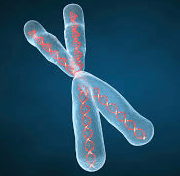
A pair of identical chromosomes (one inherited from mom and one inherited from dad) are called ______________________________.
homologous chromosomes
sister chromatids

When homologous chromosomes pair up together during Meiosis I (during crossing over), they form a ______
tetrad
sister chromatids
homologous chromosomes
mitosis cells

What are the ploidy (haploid/diploid) of the parent cells and daughter cells in mitosis?
Parent: haploid
Daughter: haploid
Parent: diploid
Daughter: haploid
Parent: haploid
Daughter: diploid
Parent: diploid
Daughter: diploid
What are the ploidy (haploid/diploid) of the parent cells and daughter cells in meiosis?
Parent: haploid
Daughter: haploid
Parent: diploid
Daughter: haploid
Parent: haploid
Daughter: diploid
Parent: diploid
Daughter: diploid
Why is meiosis important in multicellular organisms?
Meiosis is essential for growth and repair.
Meiosis is needed for sexual reproduction and production of gamete cells.
Meiosis is NOT responsible for passing on genetic variability and beneficial mutations to the next generation.
Meiosis allows tissue growth in multicellular organisms, which then form new cells.

Mitosis is represented by what letter?
A
B
C
D

#1 is_____
interphase
mitosis
synthesis
cytokinesis
#2 is_____
interphase
Gap 2 (G2)
synthesis
cytokinesis
#3 is_____
interphase
Gap 2 (G2)
synthesis
mitosis (M)
#5 is_____
cytokinesis
Gap 2 (G2)
synthesis
mitosis (M)
#4 is_____
cytokinesis
Gap 2 (G2)
interphase
mitosis (M)

