wayground logo

Free Printable Worksheets

Font size

S
M
L
XL
Worksheets

Beginning to Gas Laws

Total questions: 40

Worksheet time: 1hrs 20mins

Name
Class
Date
1.
The first person to ever talk about an atom was
a)
Democritus
b)
Rutherford
c)
Dalton
2.
All matter is made of what?
a)
energy 
b)
atoms 
c)
electrons 
d)
compounds 
3.
How did Rutherford discover the proton?
a)
Cathode tube ray experiment
b)
Gold Foil Experiment
c)
Planetary Model
d)
Plum Pudding Model
4.
Who stated that all atoms of the same element are excacty alike?
a)
Democritus
b)
Dalton
c)
Thomson
d)
Borh
5.
What scientist is best known for his "Plum Pudding" model of the atom?
a)
J.J. Tomson
b)
Ernest Rutherford
c)
John Dalton
d)
Democritus
6.
J.J. Thomson provided evidence that an atom...
a)
is the smallest particle of matter
b)
contains negatively charged particles
c)
has an overall negative charge
d)
has an overall positive charge
7.
Who came up with this model of an atom?
a)
J.J. Thompson
b)
Ernest Rutherford
c)
Neils Bohr
d)
James Chadwick
8.
What is the formula for density?
a)
density = mass x volume
b)
density = mass / volume
c)
density = mass + volume
d)
density = mass - volume
9.

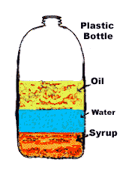
Which liquid is the least dense?

a)

oil

b)

water

c)

syrup

d)

none; the densities are equal

10.

Which box has a lower density?

a)

Box A

b)

Box B

c)

cannot be determined

d)

they are the same

11.

In general what is the most dense form of matter?

a)

solid

b)

liquid

c)

gas

d)

plasmas

12.
Calculate the density of the cube.
a)
2 g/cm3
b)
4 g/cm3
c)
6 g/cm3
d)
8 g/cm3
13.
What is the density of water?
a)
0 g/ml
b)
1 g/ml
c)
10 g/ml
d)
100 g/ml
14.
Which of these would be correct to put at the end of a density answer?
a)
g/cm
b)
cm3
c)
g/ml
d)
g/lb
15.
Helium balloons rise on earth because
a)
helium is less dense than air
b)
helium is more dense than air
c)
helium is cooler than air
d)
helium is warmer than air
16.
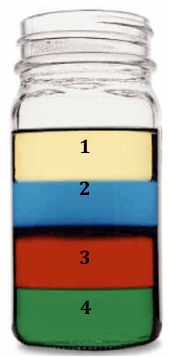
Put the liquids in order from most dense to least dense?
a)
4, 3, 2, 1
b)
1, 2, 3, 4
c)
3, 4, 2, 1, 
d)
4, 3, 1, 2
17.

This is a measurement of the amount of matter in an object or substance.

a)

volume

b)

density

c)

mass

d)

length

18.
An object with which of the following densities will float on water?
a)
0.7 g/cm3
b)
1.2 g/cm3
c)
3.5 g/cm3
d)
11.4 g/cm3
19.
The following liquids are poured together in a beaker: alcohol (density=0.79), corn syrup (density=1.38), water (density=1.0), and cooking oil (density=0.93).  Which of these liquids will sink to the bottom of the beaker?
a)
alcohol
b)
corn syrup
c)
water
d)
cooking oil
20.
Why do some substances float on water?
a)
they are warmer than water
b)
they are cooler than water
c)
they are more dense than water
d)
they are less dense than water
21.

True or False: The density of a specific type of material never changes, even if cut into smaller pieces.

a)

True

b)

False

22.
Why does ice float?
a)
Liquid water is less dense than solid water.
b)
Solid water is less dense than liquid water.
c)
Gaseous water is less dense than solid water.
d)
Liquid water is less dense than gaseous water.
23.

Hot air is ________dense than the air around it; that is how the balloon can rise.

a)

more

b)

less

24.

Why does a hot air balloon come back down to the ground?

a)

The air around it pushed it down.

b)

The air inside cooled and became more dense forcing the balloon to descend.

c)

The air inside the balloon heated up and the air was too hot to rise.

d)

The balloon may have had a hole in it.

25.

1 Meter = ______cm

a)

100

b)

10

c)

1

d)

1000

26.
1 cm = ________mm
a)
1
b)
100
c)
10
d)
1000
27.
1 Km = ______m
a)
1
b)
10
c)
100
d)
1000
28.
100 cm = ______m
a)
1
b)
10
c)
100
d)
1000
29.

Put the conversion steps in order from smallest to largest

(km, cm, mm, m)

4 lines
30.
How many total people took the survey?
a)
50
b)
150
c)
100
d)
200
31.
What is the range of the data?
a)
4
b)
8
c)
6
d)
2
32.
What was the total amount of candy sold during the school year shown in the graph?
a)
43
b)
35.5
c)
23
d)
27.5
33.

What are Gas Laws?

a)

The system of rules which a particular country recognizes as regulating the actions of its members.

b)

Statements describing the relations between the forces acting on a body and the motion of the body, first formulated by English physicist and mathematician Isaac Newton.

c)

Laws that relate the pressure, volume, and temperature of a gas.

d)

Also called private international law, the existence worldwide, and within individual countries, of different legal traditions, different specific rules of private law, and different systems of private law.
34.
What does Boyle's law relate to?
a)
Temperature and Volume
b)
Volume and Pressure
c)
Temperature and Pressure
35.
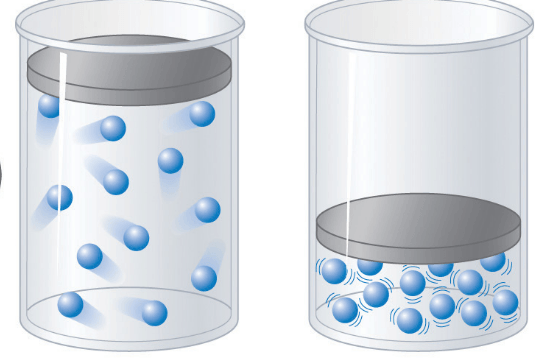
Which container will have a lower pressure?
a)
left
b)
right
c)
they both have the same pressure
d)
I don't know
36.
Gas Laws involve what three terms?
a)
Solid Liquid Gas 
b)
Speed Velocity Acceleration 
c)
Elements Compounds Mixtures 
d)
Pressure Temperature Volume 
37.
Gases have...
a)
A definite shape and volume
b)
A definite shape but no definite volume
c)
No definite shape but a definite volume
d)
No definite shape or volume
38.
You have a gas that has a pressure of 2 ATM and a volume of 10L.  What would be the new volume if the pressure was changed to 1 ATM?
a)
5 L
b)
20 L
c)
It would stay at 10L
d)
1 L
39.

If a nitrogen gas occupies a volume of 500 ml at a pressure of 0.971atm. Which equation will allow you to calculate the volume the gas will occupy at a pressure of 1.50 atm?  

a)
P1V1 = P2V2
b)
PV = nRT
c)
P1/T1 = P2/T2
d)
V1/n1 = V2/n2
40.

A sample of a gas has a volume of 852 mL at 298 K. Which equation would you use to calculate the temperature of the gas at a volume of 945 mL?

a)
Pt = P1 + P2 + P3 + ...
b)
P1V1 = P2V2
c)
V1/T1 = V2/T2
d)
P1V1/T1 = P2V2/T2