
 Worksheets
blue science 1st quarter study guide
Total questions: 69
Worksheet time: 35mins

How many different types of atoms are there in the following molecule?
7
6
3
8

Which of the diagrams below represent a mixture?
A
B
C
D
A __ mixture is a mixture in which the composition is not uniform throughout the mixture.
element
homogenous
heterogenous
compound
Which of the following is a homogeneous mixture?
sand in a bottle
lemonade
Mercury
salad
How many atoms are present in one molecule of glucose, C6H12O6
3
12
24
4
An element is a ___ that cannot be separated into simpler substances by physical or chemical means.
pure substance
mixture
solution
compound
__ is a pure substance containing two or more kinds of atoms.
Element
compound
mixture
solution
Water is made up of hydrogen and oxygen, two elements that were chemically combined. This makes water a(n)
atom
compound
element
mixture
What is aluminum (Al)?
Element
Compound
Mixture
What is table salt (NaCl)?
Element
Compound
Mixture
What is air?
Element
Compound
Mixture

What is an element?
A substance that is made up of one type of atom and can't be reduced to simpler substances.
A substance made of two or more different atoms chemically bonded to one another. They can only be destroyed by chemical processes.
A material containing two or more elements or compounds that are in close contact and are mixed in any proportion. They can be separated by physical means.
Which of the following is an example of an element?
Cu (copper)
H20 (water)
cereal
CO2 (carbon dioxide)
Where can you find examples of elements?
Dictionary
Periodic table of compounds
Periodic table of elements
Your neighbor

Which letter represents a mixture?
D
G
E
A

The vertical (up and down) columns in the Periodic Table are called
groups
towers
periods
atomic numbers
The letter, C, is a ... of carbon.
Name
Nickname
Chemical Symbol
Pseudonym
Which of the following are physical properties of metal?
Luster
Conductivity
Malleability
Ductility
True or False: The reactivity of metals tends to decrease as you move from left to right across the periodic table.
True
False
Name this group: These metals are the most reactive.


Name this group: These metals are the second most reactive.


Name this group: These metals are the second most reactive.
Name this group: These metals contain familiar metals such as gold, iron, and copper.


Name this group: These metals, located near the nonmetals, are never found uncombined in nature.


Find these groups: Locate Lanthanides and Actinides.


Which of the following could be properties of nonmetals?
Poor electrical conductivity
Poor thermal conductivity
Dullness
Brittleness
I am a metal
I am in group 2
I am in period 6
I am…
Mo
Re
S
Ba
I am a nonmetal
I am in period 2
I am in group 16/6A
Ba
Si
Ba
O
Find an element with similar chemical properties to Barium (Ba).
Ca an Ra, because they are in the same group and have similar chemical properties.
Cs and La, b/c they are in the same period number.
Ca and Y, b/c they are 90 degree angle and have similiar properties.
What kind of charge do electrons have?
Positive charge
No charge
Negative charge
Electric charge
How do you find the number of neutrons?
Mass number - Atomic number
Protons + Neutrons
Protons + Electrons
Mass number + Atomic number
Who organized the periodic table by atomic mass?
Moseley
J.J. Thomson
Bohr
Mendeleev

What element is located at group 5, period 6?
Hf
Ta
Mo
Cr
What are electrons in the outermost energy level called?
Valence electrons
Valence protons
Valence neutrons
Electron cloud
What has both metal and nonmetal properties?
Electrons
Metalloids
Protons
Metals
If an atom has an atomic mass of 27 and an atomic number of 13, how many neutrons does it have?
13
15
14
12
The majority of elements on the periodic table are
Nonmetals
Metalloids
Metals
Where are Electrons located?
In the nucleus
In the electron cloud
Next to the protons
The number located at the top of an element is the ____.
Mass number
Neutrons
Atomic number
Symbol
What are good conductors of heat?
Nonmetals
Metalloids
Metals
What has no charge?
Proton
Nonmetal
Neutron
Electron
Who created the model that showed the electrons moved in a circular path around the nucleus?
Niels Bohr
Ernest Rutherford
Henry Moseley
Democritus
How many electrons can the second energy level hold?
2
8
18
32
Who organized the periodic table by atomic mass?
James Chadwick
Democirtus
Mendeleev
Moseley


A pure substance that cannot be broken down into any other substance.
Elements
Compounds
Mixtures
Fe is the ___________________ for iron
Letters
Chemical Symbol
Equation
A(n) ______________ is formed when two or more elements chemically combine.
Compound
Element
Mixture
A ___________ is a combination of many different elements not chemically combined.
Element
Compound
Mixture
Brass is a metal that is bright red and gold. It is formed by combining, not chemically, two elements, zinc and copper. Based on the information, how would brass be classified?
an element
compound
mixture
suspension
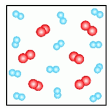
A student placed a small chip of limestone into a hydrochloric acid solution, and carbon dioxide gas was released. The carbon dioxide provided evidence that
only a physical change occurred.
a chemical change occurred.
only a loss of mass occurred.
the formation of an element occurred.
Humans absorb oxygen from the air they breathe in and exhale carbon dioxide gas, CO2. Carbon dioxide gas is
an element made of carbon and oxygen atoms.
a solution made of carbon and oxygen atoms.
a compound of carbon and oxygen atoms.
a mixture of carbon and oxygen atoms.

What type of change is this?
Chemical
Melting
Evaporation
Condensation
Sublimation
What makes elements and compounds different from mixtures? Elements & compounds-
have a constant composition (pure substances)
are made of gases
Will not change when heated
conduct electric current
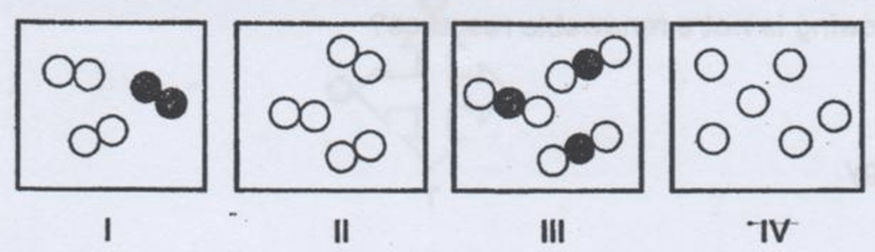
In the diagrams provided, the circles of different colors represent the atoms of different elements. Which diagram represents a mixture?
I
II
III
IV
Mixtures are different than pure substances because mixtures-
have lower boiling points
can be separated physically
are less dense than pure substances
contain only one type of atom

