
Font size
 Worksheets
PMA Review 1
Total questions: 43
Worksheet time: 26mins
2. The first organisms on Earth were likely:
prokaryotes and anaerobic
prokaryotes and aerobic
eukaryotes and anaerobic
eukaryotes and aerobic

3. The scientific theory of evolution is supported by different types of evidence. The diagrams below show the skeletons of two different animal species. How does comparing the skeletons of these animals provide support for the scientific theory of evolution?
It provides information about the organisms' habitats.
It shows possible common ancestry between organisms.
It provides information to determine the organisms' ages.
It shows possible chromosomal similarities between organisms.

5. What characteristic about the first organisms on Earth allowed them to survive during Stage 1?
Prokaryotic
Aerobic
Anaerobic
Eukaryotic

6. The diagram illustrates an embryonic stage of two organisms. Which of the following can be determined by observing the embryos shown in the diagram?
The organisms share a common ancestry.
The organisms belong to the same genus.
The organisms are native to the same geographic areas.
The organisms will grow into anatomically similar adults.
7. Over time hominid skull size increased. What inference can you make based on this trend?
Early hominids had larger brains
As skull size increased brain size increased
As skull size increased brain size decreased
Early hominids were better communicators
8. Which of the following would be considered an example of gene flow?
A human takes an exotic lizard from the Malaysian forest as a pet.
A bee transports pollen from one side of a river to the flowers on the other side of the river, producing floral offspring.
A volcano erupts and kills off a population of orchids in Hawaii.
A migrating moose is hit by a logging truck in Canada
9. Face mites are tiny organisms that live in your hair follicles. They feed off the oil produced by your skin. When you come into close contact with someone, such as giving a hug, these mites can be transferred. Which mechanism of evolution is represented in this example?
Genetic drift
Gene Flow

10. Scientists have found evidence that about 2.4 million years ago a gene regulating jaw muscles mutated and may have led to the more graceful human jaw we see today. The diagram below shows the skulls of 3 hominid species.
Which statement below most closely explains the link between jaw size and hominid evolution?
The jaws of hominids evolved to be smaller and less protruding over time.
The jaws of hominids evolved to be larger and more protruding over time.
There appears to be no change in the jaws of hominids over time.
The jaws of hominids changed over time due to a change in brain size.

11. Scientists are studying the evolutionary history of a group of plants in the United States, and they developed an evolutionary tree, as shown below. What information about the organisms best helps the scientists to determine the evolutionary relationships among them?
DNA sequences
Anatomical features
Habitat types
Reproductive Strategies
12. In the mid-1990s, the Florida panther population had decreased to an incredibly small amount. Data varies but it is estimated that 6-30 Florida panthers remained in the Florida wild. They were at risk of harmful DNA mutations due to breeding with close relatives within the population. In order to provide additional mates for breeding, a team of biologists introduced 8 Texas pumas into the Florida population. Which mechanism of evolution is this an example of?
Genetic drift
Gene Flow

14. The snakes shown in the image developed various adaptations based on the environment they live in. Which evidence of evolution is this an example of?
Comparative embryology
Observable change
Fossil Record
Biogeography

15. Which statement is most accurate about the organisms shown in the table below?
The three organisms are related because they share analogous structures.
The three organisms are related because they share homologous structures.
Organisms 2 and 3 are the most closely related because they share the same habitat.
Organisms 2 and 3 are the most closely related because they eat the same type of food.

16. The Miller-Urey experiment showed that, under certain conditions, organic compounds could form from inorganic molecules. What is the BEST resulting explanation of this experiment?
Scientists think that life could not have developed through natural chemical and physical processes.
The experiment proved that methane and ammonia will always give rise to organic molecules in any circumstance.
Scientists think it is possible that organic compounds formed from the inorganic (nonliving) compounds present on Earth billions of years ago.
The experiment used the exact inorganic compounds present on Earth billions of years ago and left little doubt about the mechanism of early life

Which of the brain regions marked on the diagram below is the frontal lobe?
A
B
C
D
Which of the brain regions marked on the diagram below is the frontal lobe?
A
B
C
D
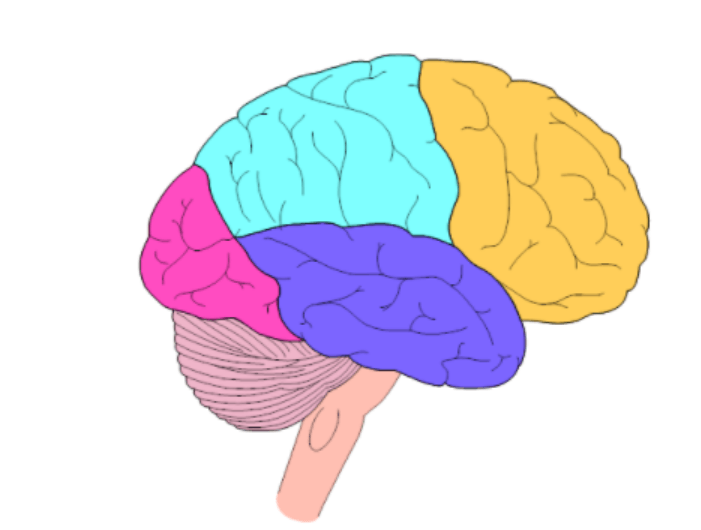
What lobe is bright pink in this picture?
Frontal
Parietal
Temporal
Occipital
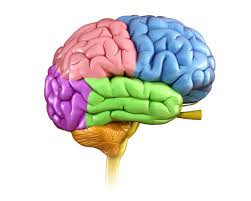
What lobe is green in this picture?
Frontal
Parietal
Temporal
Occipital
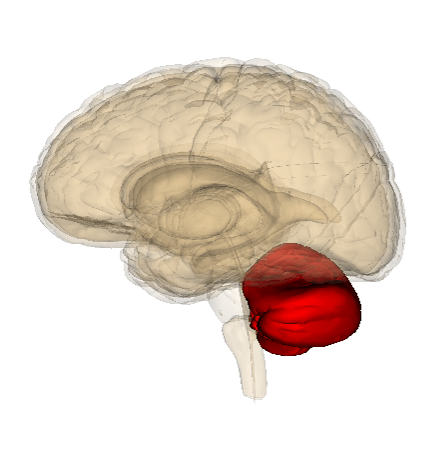
The red portion is the ________
Cerebrum
Cerebellum
Brain Stem
Diencephalon

Scientists studied the effect of water temperature on how fast a sugar cube dissolves. What was the independent variable?
Time to Dissolve
Amount of Water
Water Temperature
Beaker Size
Scientists tested the effect of water temperature on how fast a sugar cube dissolves. What was the dependent variable?
Amount of Water
Temperature of Water
Time for Sugar cube to Dissolve
Type of Beaker
What is a factor or condition in a scientific experiment that is purposefully kept the same?
Independent Variable
Dependent Variable
Controlled Variable
Hypothesis

This is an image of a Vespula vulgaris, wasp. What microscope would be used to look at this image?
Transmission Emission Microscope
Light Microscope
Scanning Emission Microscope
Dissecting Microscope

This is an image of the epidermis of an onion root. What microscope would be used to look at this image?
Dissecting Microscope
Light Microscope
Transmission Emission Microscope
Scanning Emission Microscope
I am a microscope that can only view organisms that are no longer living. I am best used to see surface objects in great detail and magnification that result in 3-D images of the specimens. What microscope am I?
Light Microscope
Scanning Emission Microscope
Transmission Emission Microscope
Dissecting Microscope
If blood volume decrease, then there's less blood available to pump causing blood pressure to
Increase
Stay the same
Decrease
Atherosclerosis is the buildup of cholesterol or other substances in blood vessels that causes
low blood pressure
high blood volume
low blood volume
high blood pressure
A student gets hit by a car and it causes extreme blood loss. What will happen to blood pressure?
Increase
Stay the same
Decrease


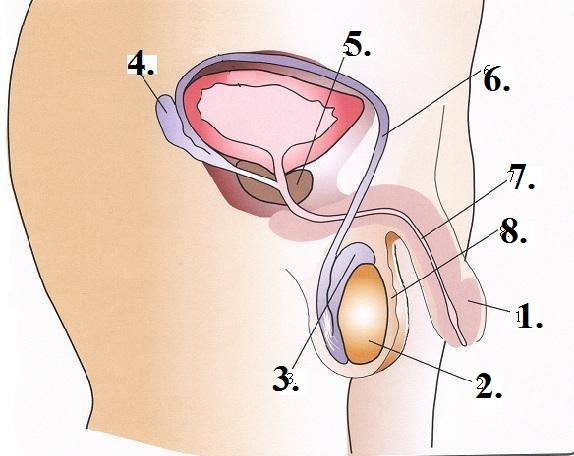

Which of the following was the result of an increased cranial capacity (brain size)?
Communication
Lower Common Sense
Development of Computers
Ability to create hunting tools

Which of the following sped up Hominid evolution by allowing us to stand up right and have better posture?
Cranial Capacity
Spinalism
Bipedalism
Homidism
According to hominid evolution, which of the following structures increased in size?
Brain Size
Jaw Size
Skull Size
Teeth Size

According to hominid evolution, which of the following decreased in size?
Jaw Size
Brain Size
Skull Size
Hip Size

The genetic code is essentially the same for all organisms. From this, one can logically assume which
of the following?
The more gene sequences in common, the more related
Each species has its own unique set of amino acids that is different from all other species.
The same codons in different organisms translate into different amino acids.
Proteins were the first genetic material.

A brown beetle moves from its population to a green beetle population to interbreed. Which of the following mechanisms of evolution will occur?
Genetic Drift
Gene Flow

Which of the following microscopes would be used for viewing the image shown?
Transmission Electron Microscope (TEM)
Scanning Electron Microscope (SEM)
Light Compound Microscope
Dissecting Microscope

