
 Worksheets
Electricity and Circuit
Total questions: 55
Worksheet time: 1hrs 6mins

If a fourth resistor was added, what would happen to the total voltage of the circuit?
total voltage would increase
total voltage would decrease
total voltage would stay the same
total voltage can't to calculate

What is the voltage at V1 (resistance is the same at all resistors)
3V
6V
9V
12V
A combination of two or more electric cells is called _____
Electric circuit
Battery
Terminals
None of these
_____ is an electric device which easily closes or opens an electric circuit.
Filament
Electric bulb
Electric switch
Electric cell
The electric current in a closed circuit always flows from the ____ terminal of the electric cell to the _____ terminal.
Negative to positive
Positive to negative
Positive to positive
None of these
Only one of the circuits below would work to light the light bulb. Choose the circuit below that would make the light bulb light up.


conducts electricity around a circuit
wire
insulator
light bulb
switch
the power source that pushes electricity around a circuit
light bulb
switch
battery
wire
Electrical energy can be changed to _____ energy in stoves, toasters, and ovens.
sound
light
heat
motion
An object with a negative charge will be most strongly attracted to which of the following?
an object with a weak positive charge
an object with a strong positive charge
an object with a weak negative charge
an object with a strong negative charge
Which of the following is a conductor.
Wood
Silver
Rubber
Plastic
which one of this is a very good conductor?
gold
copper
metal
silver
Which of these is not an insulator?
plastic
rubber
glass
graphite

This circuit has the following components;
battery, 3 lamps and a switch
power supply, and 2 lamps
power supply, 3 lamps and a switch
power supply and 3 lamps
what is the symbol for a open switch?


What does this symbol represent?
Amps
Ampere
ammeter
ammu

what is this symbol used for?
to measure the current
to measure the voltage
to measure the lenght of the wire
to measure the power of the battery

What is wrong with this circuit?
no switch
no + and - symbol on the battery
The battery is placed in the wrong way
the lamps are placed in a different way

name the circuit
series circuit
parallel circuit
normal circuit
simple circuit
what happens to the current in the series circuit ?
shared
stays the same
not used
saved
What happens to the voltage in parallel circuit?
shared
divides
stays the same
not used
What happens to current in parallel circuit ?
stays same
not used
shared
stored
_____ is an electric device which easily closes or opens an electric circuit.
Filament
Electric bulb
Electric switch
Electric cell
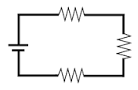
If each resistor 6 ohm resistance, what is total resistence ?
18 ohm
2 ohm
3 ohm
6 ohm
I=R/V
A higher resistance in a circuit causes a _____________.
higher voltage
larger current
smaller current
lower voltage

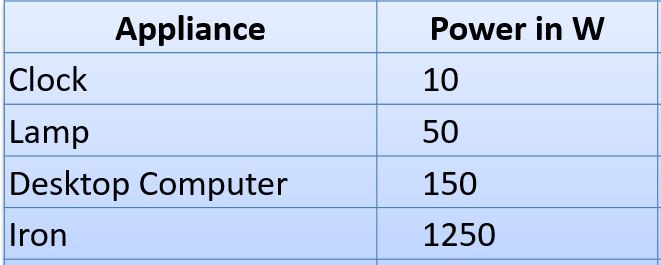
A lamp plugged into a standard american outlet (120 V) uses 0.8 A of current. What is the power in the circuit?
0.007 W
96 W
120 W
150 W

An iPod uses a standard 1.5 V battery. How much resistance is in the circuit if it uses a current of 0.01 A?
50Ω
100Ω
150Ω
200Ω

A circuit contains a 1.5 V battery and a bulb with a resistance of 3 Ω . Calculate the current.
0.5A
1A
1.5A
2A

What current flows through a hair dryer plugged into a 120 V circuit if it has a resistance of 25 Ω?
2.4A
3.6A
4.8A
6A

How much voltage would be necessary to generate 10 A of current in a circuit that has 5 Ω of
resistance?
10V
50V
100V
150V

An electric heater works by passing a current of 100 A though a coiled metal wire, making it red hot. If the resistance of the wire is 1.1 Ω, what voltage must be applied to it?
70V
90V
110V
130V
What is the unit of potential difference (p.d)?
Ampere (A)
Newton (N)
Ohm (Ω)
Volt (V)
This is related to the force/ push that causes electric charges to flow in a circuit:
Thrust

current
resistance
capacitance
Which of the following refers to the ability of a material to reduce the flow of charge through it?
current
inertia
resistance
voltage

The diagram shows a battery connected to two resistors.
Four students separately measure the electromotive force (e.m.f.) of the battery, the current in the resistors, and the potential difference (p.d.) across resistor R.
Their results are shown in the table below. Which row shows values with their correct units?
emf= 3.0 A
current= 0.30 V
p.d.=1.5A
emf= 3.0 A
current= 0.30 A
p.d.=1.5V
emf= 3.0 V
current= 0.30 V
p.d.=1.5A
emf= 3.0 V
current= 0.30 A
p.d.=1.5V


0.18Ω

