wayground logo

Free Printable Worksheets

Font size

S
M
L
XL
Worksheets

Biology Unit 1 Review

Total questions: 108

Worksheet time: 2hrs 9mins

Name
Class
Date
1.

Nucleic acids make up which of the two molecules listed below?

a)

FDA

b)

RNA

c)

DNA

d)

FDR

2.

Which macromolecule stores energy?

a)

Carbohydrates

b)

Proteins

c)

Lipids/Fats

d)

Nucleic Acids

3.

Which macromolecule is used as our main source of energy?

a)

Lipids/Fats

b)

Nucleic Acids

c)

Proteins

d)

Carbohydrates

4.

Which of the following is not one of the four major classes of macromolecules?

a)

Lipids

b)

Carbon

c)

Protein

d)

Carbohydrates

e)

Nucleic Acid

5.
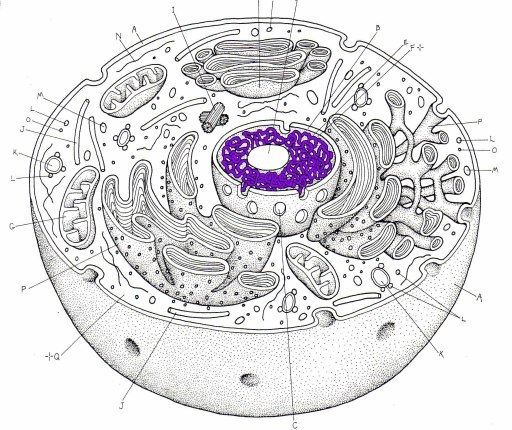
Which type of cell?
a)
Prokaryote
b)
Eukaryote
6.
Both prokaryotes and eukaryotes have a nucleus.
a)
True
b)
False
7.
Plants and animal cells are examples of ___ cells 
a)
prokaryotic cells 
b)
eukaryotic cells 
8.
Prokaryote are?
a)
simple, mostly single-celled organism that lacks a nucleus, or any other membrane-bound organelle.
b)
have a peptidoglycan cell wall and many have polysaccharide capsules.
c)
have a true nucleus, which means the cell's DNA is surrounded by a membrane.
d)
contain membrane-bound organelles, such as the nucleus
9.
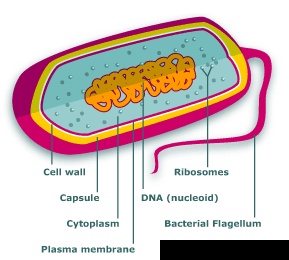
What kind of cell is this?
a)
Eukaryotic
b)
Prokaryotic
10.
What type of solution allows water to enter the plant cell?
a)
hypotonic solution
b)
hypertonic solution
c)
isotonic solution
d)
active transport
11.
What type of solution is this cell in?
a)
Isotonic
b)
Hypertonic
c)
Hypotonic
d)
diffused
12.
What type of solution is this cell in?
a)
Isotonic
b)
Hypertonic
c)
Hypotonic
d)
diffused
13.

What would happen to a cell placed in a hypertonic solution

a)

The cell would shrink

b)

The cell would expand and possibly burst

c)

The cell would remain the same

d)

The cell would dance and do the Nay Nay!

14.
In this picture, which way will the water move?
a)
Water will move into the cell
b)
Water will move out of the cell
c)
Water will move in and out of the cell
d)
Water will not move
15.
In this picture, how do you classify the solution?
a)
The solution is hypotonic
b)
The solution is hypertonic
c)
The solution is isotonic
d)
The solution is my tonic
16.
How does a cell maintain homeostasis?
a)
Regulates what enters and leaves the cell
b)
Flexibility
c)
Protective barrier
d)
Structure and support
17.
What protects carrot cells from swelling too much when it rains?
a)
They don't swell because rain is absorbed by the roots.
b)
They have pores in their cell membranes that keep them from swelling.
c)
The rain water is hypertonic to the cells so the cells lose water.
d)
They have cell walls that keep them from swelling too much.
18.

Which statement best describes passive transport?

a)

The movement of molecules from a high to low concentration without energy

b)

The movement of molecules from low to high concentration without energy

c)

The movement of water against the concentration gradient

d)

Passive transport requires ATP energy to go against the gradient

19.

Osmosis is the movement of _______ from a high concentration to a low concentration.

a)

Glucose

b)

Sodium

c)

Water

d)

Smell

20.

Which one is the definition of active transport?

a)

movement of particles through the cell membrane from a region of lower concentration to a region of higher concentration using energy in the form of ATP.

b)

passage of water molecules from a region of their higher concentration to a region of their lower concentration through a partially permeable membrane

c)

net movement of molecule from a region of higher concentration to region of lower concentration. Molecule down a concentration gradient

d)

net movement of molecule from a region of lower concentration to region of higher concentration. Molecule down a concentration gradient

21.
What are 3 types of active transport?
a)
Riding a bike, Running through the mountains, walking on the beach
b)
Osmosis, Diffusion, Facilitated Diffusion
c)
Sodium/potassium Pump, Endocytosis, Exocytosis
d)
Throwing a ball, Playing tennis, driving a car
22.
What is the difference between active and passive transport?
a)
Active does not need energy and passive uses ATP (energy)
b)
Active uses ATP (energy) and passive does not need energy
c)
Active stores transport proteins and passive releases 
d)
Active uses hormones and passive does not 
23.
Put the following stages of the cell cycle in order: G2, S, G1, M. 
a)
G1, S, G2, M
b)
S, G1, G2, M
c)
G1, M, G2, S
d)
M, G1, S, G2
24.
In mitosis, the two resulting cells are
a)
different from the starting cell and identical to each other.
b)
different from the starting cell and different from each other.
c)
identical to the starting cell and different from each other.
d)
identical to the starting cell and identical to each other.
25.

Which of the following is/are results of the cell cycle ?

a)

growth

b)

repair of damaged cells

c)

replacement of dying cells.

d)

All of the above

26.
Which of the following describes cancer?
a)
Nondisjunction of gamete cells
b)
Cell division without replication of DNA
c)
Mitosis without cytokinesis
d)
Uncontrolled cell division
27.
Humans have ________ pairs of chromosomes.
a)
21
b)
23
c)
46
d)
None of the above
28.
Why would it be important to replicate DNA before a cell divides in mitosis or meiosis?
a)
In order for genetic information to be transferred into daughter cells.
b)
In order for the cell to be able to increase in size.
c)
In order for the DNA to be contained in the nucleus.
d)
In order for the cell to re-order the DNA sequencing in the new cells.
29.
Fruit fly body cells have 8 chromosomes. After mitosis, you would expect a resulting fruit fly daughter cell to have -
a)
16 chromosomes.
b)
46 chromosomes.
c)
8 chromosomes.
d)
4 chromosomes.
30.

Fruit fly body cells have 8 chromosomes. How many chromosomes would be present in its gametes?

a)
16 chromosomes.
b)
46 chromosomes.
c)
8 chromosomes.
d)
4 chromosomes.
31.
Which of the following units are repeatedly joined together to form a strand of DNA?
a)
amino acids
b)
nucleotides
c)
fatty acids
d)
polysaccharides
32.
order of replication
a)
3, 4, 2, 1
b)
3, 1, 4, 2
c)
2, 1, 4, 3
d)
3, 4, 1, 2
33.
A process in which DNA has the unique ability to make an exact copy of itself.
a)
Replication
b)
Translation
c)
Transcription
34.
The process of DNA replication is called semi conservative because it results in
a)
none of these
b)
Two DNA molecules.  One original molecule and one with two new strands
c)
two exact copies with new strands
d)
two identical molecules, each with 1 original strand and one new.
35.

In DNA, Adenine bonds with ______________.

a)
Guanine
b)
Thymine
c)
Cytosine
d)
Adenine
36.

In DNA, Guanine bonds with ______________.

a)
Adenine
b)
Guanine
c)
Cytosine
d)
Thymine
37.
Which organelle is DNA usually found in?
a)
cell membrane
b)
vacuole
c)
chloroplast
d)
nucleus
38.

A nucleotide is composed of

a)

A phosphate, sugar and nitrogenous base

b)

A protein, sulfur and Guanine

c)

A phosphate, something and a base

d)

A protein, sugar and nitrogenous base

39.
Which sequence of DNA bases would pair with this partial strand
ATG TGA CAG
a)
ATG TGA CAG
b)
TAC ACT GTC
c)
GTA AGT GAC
d)
CAT TCA CTG
40.
The process to go from DNA to mRNA is _______
a)
translation
b)
transcription
c)
replication
41.

The process to go from mRNA to protein is _______

a)
translation
b)
transcription
c)
replication
42.
What is the difference between DNA and RNA in terms of bases?
a)
RNA contains uracil in place of thymine
b)
RNA contains uracil in place of adenine
c)
RNA contains uracil in place of guanine
d)
RNA contains uracil in place of  cytosine
43.
How many nucleotides make a codon?
a)
1
b)
2
c)
3
d)
6
44.

When these bond together, they form a protein

a)

Amino Acids

b)

Peptide Bonds

c)

Ribose

d)

Nucleotides

45.

Which of the following sequences of RNA will be transcribed from a hypothetical sequence of DNA given below?

TACGTACGTACGTACG

a)

UACGUACGUACGUACG

b)

AUGCAUGCAUGCAUGC

c)

UACGUACGUACGUACG

d)

AUGCAUGCAUGCAUGC

46.
What amino acid is represented by the codon UUA?
a)
Phenylalanine
b)
Tyrosine
c)
Leucine
d)
Stop codon
47.

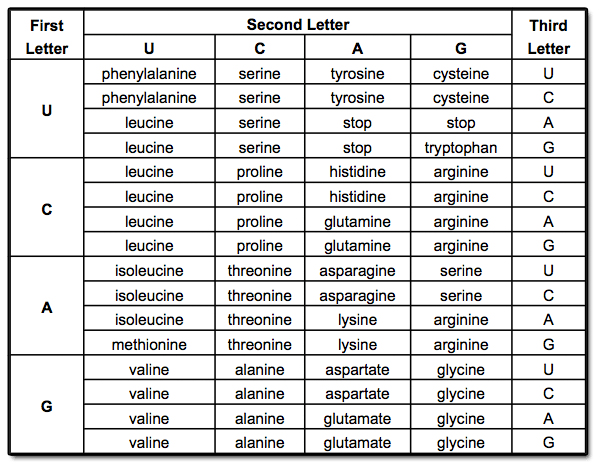
Use your codon chart to match the mRNA CUU to the correct amino acid

a)

VAL

b)

TYR

c)

LEU

d)

PHE

48.

Use your codon chart to match the mRNA ACU to the correct amino acid.

a)

Thr

b)

Ala

c)

Val

d)

Gly

49.

Amino Acids are built up to make_______

a)

DNA

b)

mRNA

c)

Lipids

d)

Proteins

50.
Any change in the sequence of DNA is...
a)
transgenic shift
b)
Single Genotype
c)
Monohybrid Trait
d)
Mutation
51.
Mutations are__________
a)
Harmful
b)
Harmful or beneficial
c)
Neutral
d)
Harmful, neutral, or beneficial
52.
What causes mutations?
a)
Mistakes in replication or environmental substances
b)
The amino acids
c)
Passed down by genetics
d)
It's how your born
53.
Why are insertion and deletion mutations so harmful?
a)
They change all of the codons from the mutation on down the line, which changes the amino acid sequence
b)
They insert things that an organism doesn't need.
c)
They often delete things that organisms need.
d)
Insertion and deletions are not any more harmful than substitution mutations.
54.
DNA molecule segment is : TTACGCAAG
The mutated DNA segment is TTCGCAAG. This is an example of ___ mutation.
a)
Substitution
b)
Deletion
c)
Insertion
d)
Inversion
55.
Normal-
GAG-CTC-GAC-AGA
Mutant
GAG CTC-CAC-AGA
a)
no mutation
b)
substitution
c)
insertion
d)
deletion
56.

Original: ATC CAT

Mutation: ATC GCAT

What mutation occurred?

a)

deletion

b)

insertion

c)

silent

d)

transverse

57.

True or false, mutations create genetic diversity?

a)

True

b)

False

58.

What is the role of dystrophin in muscle cells?

a)

Dystrophin is a regulatory protein in muscles that controls the levels of creatine kinase.

b)

Dystrophin is an enzyme in muscles that connects the myofibrils to the fascicles.

c)

Dystrophin is an enzyme in muscles that helps break sugars down into glucose.

d)

Dystrophin is a protein in muscles that anchors the muscle fibers to the cell membrane.

59.

Which of the following is INCORRECT about DMD?

a)

Exercises like weight lifting can irreversibly damage muscles of people with DMD.

b)

People with DMD can regain muscle mass by taking creatine supplements.

c)

People with DMD have muscles that get weaker when used instead of getting stronger.

d)

People with DMD get micro-tears in their muscles, which do not heal like typical muscles.

60.

Which of the following statements about DMD is most accurate?

a)

Patients lose muscle mass due to dystrophy.

b)

Patients lose muscle mass due to atrophy.

c)

Patients lose muscle mass due to hypertrophy.

d)

Patients lose muscle mass due to hypotrophy.

61.
A human usually has ______ chromosomes in their body cells.
a)
6
b)
22
c)
4
d)
46
62.
How many daughter cells are produced at the end of meiosis?
a)
1
b)
2
c)
3
d)
4
63.
What process, and which type of resulting cells are represented?
a)
mitosis, gametes
b)
mitosis, body cells
c)
meiosis, gametes
d)
meiosis, body cells
64.
Meiosis makes sperm and egg cells. In humans, sperm and egg cells each have _____ chromosomes. Therefore a fertilized human egg cell (sperm and egg cell combined) would create a cell with _____ chromosomes.
a)
23, 46
b)
46, 23
c)
2, 4
d)
50, 100
65.

The products of meiosis are genetically...

a)

different.

b)

identical.

66.

How many alleles do you inherit from EACH parent for a specific trait?

a)

1

b)

2

67.

The genetic makeup (alleles) for a trait is called the ...

a)

genotype

b)

phenotype

68.

The physical expression of a trait is called the ...

a)

genotype

b)

phenotype

69.

Genotype: Aa

a)

homozygous dominant

b)

homozygous recessive

c)

heterozygous dominant

70.

Genotype: rr

a)

homozygous dominant

b)

homozygous recessive

c)

heterozygous dominant

71.

Genotype: TT

a)

homozygous dominant

b)

homozygous recessive

c)

heterozygous dominant

72.

Cross 2 heterozygous tall pea plants. Tall (T) is dominant to short (t). What fraction of the offspring do you predict will be tall?

a)

1/4

b)

2/4

c)

3/4

d)

4/4

73.

In guinea pigs, black fur color is dominant to brown. What is the expected ratio of offspring if 2 heterozygous guinea pigs were mated?

a)

1BB: 2Bb: 1bb

b)

0BB: 2Bb: 2bb

c)

1BB: 1Bb: 2bb

d)

2BB: 2Bb: 0bb

74.
A calico cat shows both the traits for orange fur and black fur. What kind of allele expression is this?
a)
Incomplete Dominance
b)
Co dominance
c)
Independent assortment
d)
Recessive inheritance
75.
What do you call the non-Mendelian inheritance pattern that states that neither trait is dominant and the traits appear to blend together?
a)
Codominance
b)
Incomplete dominance
c)
Polygenic traits
76.

In roses, petal color can be white, red, or pink. What would be the expected genotypes and phenotypes if a red rose was crossed with a pink rose? What type of inheritance pattern is this?

a)

incomplete dominance; 2RR: 2PP: 0WW

b)

codominance; 2RR: 2PP: 0WW

c)

incomplete dominance; 2RR: 2RW: 0WW

d)

codominance; 2RR: 2RW: 0WW

77.

In horses, coat color can be brown, white or brown with white spots. What would be the expected genotypes and phenotypes if a white horse mated with a brown with white spots horse? What type of inheritance pattern is this?

a)

incomplete dominance; 0BB: 2BW: 2WW

b)

codominance; 0BB: 2BW: 2WW

c)

incomplete dominance; 1BB: 2BW: 1WW

d)

codominance; 1BB: 2BW: 1WW

78.
Which of the following statements is true regarding blood types?
a)
A and O are codominant, B is recessive.
b)
B and O are codominant, A is recessive.
c)
A and B are codominant, O is recessive.
d)
A , B and O are all codominant with each other.
79.

A man with type A blood and a woman with type B blood have 4 kids. Each child has a different blood type. What are the most likely genotypes of the man and woman?

a)

Man: IAIA

Woman: IBIB

b)

Man: IAi

Woman: ii

c)

Man: ii

Woman: IBi

d)

Man: IAi

Woman: IBi

80.
What does a filled in square represent?
a)
Not affected Female
b)
Not affected Male
c)
Affected Male
d)
Affected Female
81.
How many generations are shown in this pedigree?
a)
1
b)
2
c)
3
d)
4
82.
How many kids did the mother and father from the first generation have?
a)
2
b)
4
c)
5
d)
6
83.
If a trait SKIPS a generation, it is an indication that the trait is....
a)
dominant
b)
recessive
c)
incompletely dominant
d)
co-dominant
84.
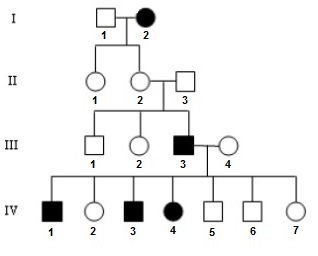
Is this trait (the shaded individuals) dominant or recessive?
a)
dominant
b)
recessive
85.
Give the genotype for person II-1, for this autosomal trait.
a)
GG
b)
Gg
c)
gg
d)
we cannot be 100% sure of the genotype
86.
If this pedigree shows an autosomal recessive disorder, what MUST the genotype of individual II-3 be?
a)
HH
b)
Hh
c)
hh
d)
None of the above
87.

In this pedigree, the shading represents people in the family with dark hair while the unshaded represents blondes. Is dark hair controlled by a dominant or recessive allele?

a)

Dominant

b)

Recessive

88.

Individuals that are shaded in have premature hair whitening. Is this trait dominant or recessive? How do you know?

a)

Dominant because it skips generations

b)

Dominant because it is present in every generation

c)

Recessive because it skips generations

d)

Recessive because it is present in every generation.

89.

Huntington's Disease is a dominant trait.

What is the correct genotype for individual I-2?

a)

HH

b)

Hh

c)

hh

d)

H?

90.

In a pedigree chart, a male is represented by a

a)

circle

b)

square

c)

rhombus

d)

triangle

91.

In a pedigree chart, a female is represented by a

a)

circle

b)

square

c)

rhombus

d)

triangle

e)

rectangular prism

92.

If the male or female has the trait listed in the pedigree chart, then the circle or square is _________________.

a)

empty

b)

fully shaded

c)

half-shaded

d)

spotted, like a leopard

93.
What is the mode of inheritance shown here?
a)
Autosomal Dominant
b)
Autosomal Recessive
c)
Sex Linked Recessive
d)
Co-dominant
94.
I have 2 X chromosomes. What am I?
a)
Male
b)
Female
95.
I have 1 X chromosome and 1 Y chromosome. What am I?
a)
Male
b)
Female
96.
If a gene is found only on the X chromosome and not the Y chromosome, it is said to be what?
a)
sex-linked trait
b)

autosomal dominant trait

c)

not a genetic trait

d)

autosomal recesssive trait

97.

Which labeled chromosome could you find the gene for an autosomal trait? Select all that apply.

a)

A

b)

B

c)

C

d)

D

98.
Hemophilia is a recessive x-linked disorder.
Which genotype represents a female who is a carrier for hemophilia?
a)
XHXh
b)
XhXh
c)
XHXH
d)
XhY
99.
Hemophilia is a recessive x-linked disorder.
Which genotype represents a male with hemophilia?
a)
XHXh
b)
XhXh
c)
XHY
d)
XhY
100.
The visual representation of an individual's chromosomes is a 
a)
phenotype
b)
genotype
c)
karyotype
d)
stereotype
101.
Colorblindness is a recessive x-linked disorder.
Which genotype represents a male with normal vision?
a)
XNXN
b)
XnXn
c)
XNY
d)
XnY
102.
Which of the following genotypes belongs in the red box in the Punnett square?
a)
XBXb
b)
XbXb
c)
XbY
d)
XBY
103.

In fruit flies, eye color is a sex linked trait. Red (R) is dominant to white (r). What is the sex and eye color of flies with the following genotype: X R X r ?

a)

male with white eyes

b)

female with red eyes

c)

male with red eyes

d)

female with white eyes

104.
If a trait is more likely to appear in one sex over the other......
a)
the trait is probably sex-linked.
b)
the trait is probably autosomal.
c)
the trait is probably co-dominant
d)
the trait if probably incompletely dominant
105.
If hemophilia is a sex-linked recessive trait, what genotype would individual III-3 have?
a)
XbX
b)
XbXb
c)
XbYb
d)
XbY
106.
This pedigree represents the inheritance of hemophilia in this family. How many of the females have the hemophilia trait?
a)
8
b)
5
c)
2
d)
3
107.

pedigreeWhat type of heredity is shown in the pedigree?

a)

Sex-Linked Recessive

b)

Autosomal Dominant

c)

Autosomal Recessive

108.

Fragile-X syndrome is a recessive sex-linked disorder located on the X chromosome.


Study the pedigree. What is the Genotype of #3?

a)

XHXh

b)

XhXh

c)

XHXH

d)

XHY