Wayground logo

Free Printable Worksheets

Font size

S
M
L
XL
Worksheets

Laws of Motion

Total questions: 44

Worksheet time: 48mins

Name
Class
Date
1.
What is Newton's First Law known as? The Law of
a)
Friction
b)
Mass
c)
Inertia
d)
Gravity
2.
What is Newton's First Law
a)
F=ma
b)
Every action has an equal and opposite reaction
c)
An object at rest stays at rest, an object in motion stays in motion. 
d)
Friction 
3.
What is the formula for force?
a)
F=M/A
b)
F=A/M
c)
F=M*A
d)
F=M*F
4.

Because of inertia, a resting object ________.

a)

will remain at rest

b)

will move at a constant speed

c)

will eventually move

d)

is unbalanced

5.

As more unbalanced force is applied to an object, its acceleration:

a)

stays the same

b)

decreases

c)

increases

6.

Newton's second law of motion states that an unbalanced force is equal to mass times:

a)

acceleration

b)

force

c)

motion

d)

inertia

7.

Newton's third law of motion states that for every action there is:

a)

an opposite, but equal reaction.

b)

an opposite and equal reaction.

c)

a reaction.

8.

Friction and air resistance are forces that:

a)

can make an object slow down or stop

b)

pulls an object toward the center of Earth

c)

changes an object's position

d)

can't be described

9.

A force is:

a)

a push

b)

a pull

c)

both

d)

neither

10.

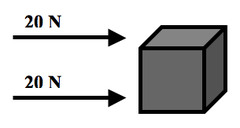
Which law is this picture illustrating?

a)

Law 1

b)

Law 2

c)

Law 3

11.

A book sitting on the table does not move.

a)

Law 1

b)

Law 2

c)

Law 3

12.

A 20 kg bike accelerates at 10 m/s2. What was the force?

a)

25 Newtons

b)

20 Newtons

c)

200 Newtons

d)

10 Newtons

13.
Which of Newton's laws is illustrated when a magician pulls a tablecloth out from under the dishes without disturbing them?
a)
first
b)
second
c)
third 
d)
fourth
14.
A person is pushed forward into their seat belt when a car stops.  Which law is this?
a)
1st
b)
 2nd
c)
2 and 3
d)
3rd 
15.
On which surface will a toy car travel the furthest?
a)
Carpet
b)
Polished Wood
c)
Ice
16.
Rougher surfaces have ...
a)
greater friction
b)
less friction
c)
the same level of friction
17.

Forces that are exerted on an object which are equal in size but opposite in direction

a)

Unbalanced force

b)

Balanced force

18.

Applied forces on an object are unequal in size but are the same or opposite in direction

a)

Unbalanced force

b)

Balanced force

19.

A card sliding across a table at a constant speed

a)

Unbalanced force

b)

Balanced force

20.
What is the net force?
a)
400 N Up
b)
400 N Down
c)
- 400 N Down
d)
800 N Down
21.
What is the net force?
a)
40 N left
b)
0 N Balalnced
c)
400 N right
d)
40 N right
22.

Calculate the resultant force.

a)

40N, Left

b)

40N, Right

c)

0N, Balanced

d)

75N, Right

23.
The unit for force is a called a: 
a)
Galileo
b)
Newton
c)
Aristotle
24.
The overall force acting on an object after all the forces are combined is called a 
a)
net force
b)
unbalanced force
c)
balanced force
25.
If there are two forces going in the same direction how would you find the net force?
a)
Subtract
b)
Add
c)
Neither
d)
Multiply
26.
What is the net force?
a)
17 N Right
b)
3 N Right
c)
3 N Left
d)
17 N Left
27.
A wheeled cart is moving to the right at a constant speed.  Two forces of equal magnitude are acting upon the cart. Which of the following best describes the forces and motion of the cart?
a)
Balanced Forces, Constant Speed
b)
Balanced Forces, Acceleration
c)
Unbalanced Forces, Constant Speed
d)
Unbalanced Forces, Acceleration
28.
You and your dad are moving the couch from one side to another. Your dad pushes with a force of 35 N to the right and you push with a force of 25 N right. What is the net force on the couch?
a)
60 N right
b)
10 N left
c)
60 n right
d)
50 N left
29.

When an object moves in a straight line, which statement is true?

a)

when the object moves at a constant speed, the resultant force is zero

b)

when the object accelerates, the resultant force is zero

c)

when the object moves at a constant speed, the forward force is greater than the resistive force

d)

the object requires a resultant force in order to move at a constant speed
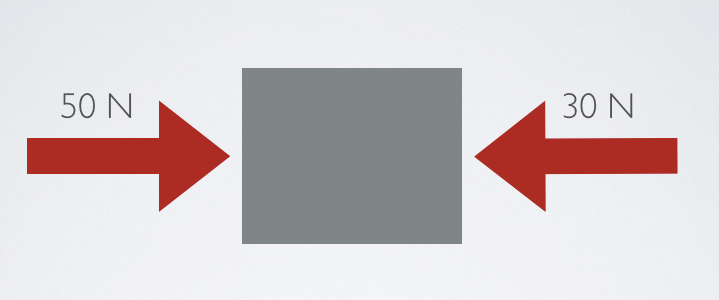
30.
How will this object move? 
a)
It won't move. 
b)
It will move to the right. 
c)
It will move to the left. 
d)
It will move up. 
31.
Why does a car accelerate as it round a corner at a constant speed?
a)
Its direction changes
b)
It doesn't
c)
It slows down
d)
Its speeds up  
32.

The SI unit for acceleration is

a)

m

b)

m/s

c)

m/s2

d)

s

33.
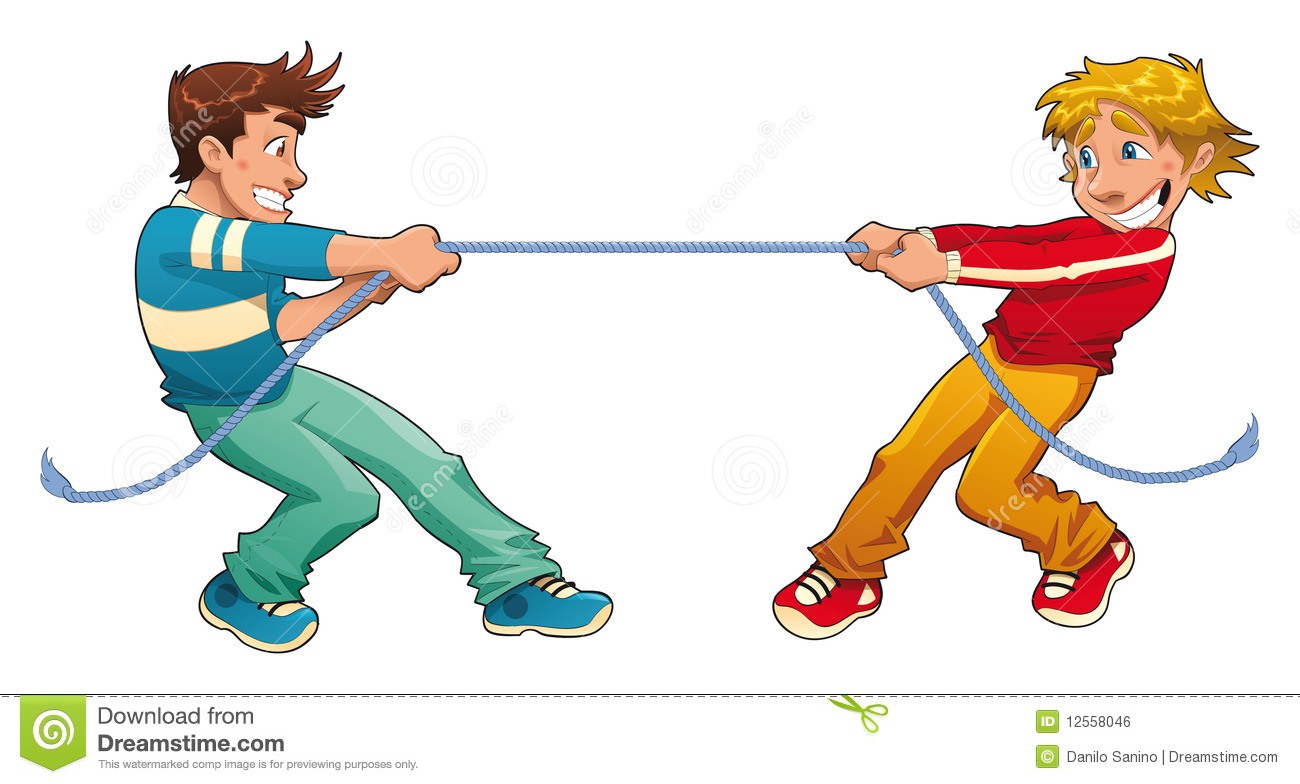
If these boys are pulling with the same amount of force.  What will happen?
a)
The boy in blue will win.
b)
They will not move at all.
c)
The boy in red will win.
d)
Both will fall down.
34.
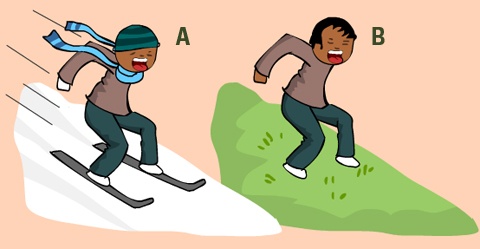
Why is it harder for the boy in Image B to get down the hill?
a)
Motion
b)
Friction
c)
Work
d)
Displacement
35.

Which of the following is NOT an example of acceleration?

a)

Speeding up

b)

Slowing Down

c)

Remaining at rest

d)

Stopping

36.

What causes a ball rolling across a rug to slow to a stop?

a)

Gravity

b)

Friction

c)

Temperature

d)

Pressure

37.

What part(s) of a moving car experience the most friction? Choose the best answer.

a)

b)

c)

d)

38.

Which of the following is a true statement about Newton’s second law?

a)

Acceleration only depends on mass

b)

Acceleration only depends on amount of force applied

c)

Acceleration depends on mass and amount of force applied

d)

Acceleration does not depend on mass nor amount of force applied

39.

If an unbalanced force acts on an object, what will happen

a)

It will not move at all

b)

It will accelerate in the direction of the force

c)

It will accelerate in the opposite direction to the force

d)

It will accelerate in a random direction

40.

A 20 kg bike accelerates at 10 m/s2. What was the force?

a)

25 Newtons

b)

20 Newtons

c)

200 Newtons

d)

10 Newtons

41.
A person is pushed forward into their seat belt when a car stops.  Which law is this?
a)
1st
b)
 2nd
c)
2 and 3
d)
3rd 
42.

A more massive object has more inertia than a less massive object.

a)

True

b)

False

43.
A car accelerates from a standstill to 70 m/s in 10 seconds.  What is the acceleration?
a)
0.7m/s2
b)
7m/s2
c)
14m/s2
d)
none of the above
44.
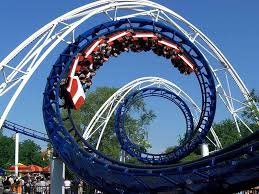
A roller coasters accelerates from an initial velocity of of 6.0 m/s to a final velocity of 70 m/s over 4 seconds.  What's the acceleration?
a)
24 m/s2
b)
18 m/s2
c)
16 m/s2
d)
16 m/s