
 Worksheets
Unit 1: C.O.L./Biomolecules/Microscope Summative Retest Review
Total questions: 44
Worksheet time: 30mins
A rock is considered ________ .
Living
Nonliving
Dormant
Dead
Something that once showed all the characteristics of life but no longer does and never will again?
Alive
Dead
Dormant
Nonliving
Stimulus is
organisms that are made up of more than one cell
a membrane-covered structure that contains all of the materials necessary for life.
a change that affects the activity of an organism.
the maintenance of a stable internal environment.
___________a molecule that is present in all living cells and that contains the information that determines the traits a living thing inherits and needs to live.
Cell
Stimulus
Homeostasis
DNA
Living things are made up of units called
DNA
Cells
Homeostasis
Seeds
Living things are based on a universal genetic
code. What molecule is responsible for that code?
RNA
Lipid
Protein
DNA
Which one is not a characteristic of all living things?
homeostasis
reproduce
breathing
grow and develop
A paramecium will move away from direct light. This is an example of which characteristic of life?
respond to stimuli
maintain homeostasis
made of cells
get energy
A turtle lays a hundred of eggs.
use energy
grow and develop
reproduce
evolve
A bacterium divides into two bacteria which are identical to, but smaller than, the original bacterium. This is an example of which characteristic of life?
grow and develop
have DNA
made of cells
reproduction
10. Your friend is feeling irritable, lightheaded and dizzy. They are also feeling a bit of confusion and brain fog. Which biomolecule would you recommend your friend consume?
Protein
Carbohydrates
Nucleic Acid
Lipid
2. Which biomolecules contains your genetic information?
Proteins
Lipids
Carbohydrates
Nucleic Acids
9. Amino Acids are the monomers of __________.
Nucleic Acids
Proteins
Carbohydrates
Lipids
6. The monomer of carbohydrates is _______.
Amino Acid
Fatty Acid
Nucleotide
A Simple Sugar
Just under an orca's skin lies a thick layer of blubber. Blubber helps insulate a whale from heat loss. Based on this information, which biomolecule is blubber primarily made of?
Lipids
Nucleic Acids
Proteins
Carbohydrates
7. Glycerol and fatty acids are the monomers of _________.
Lipids
Carbohydrates
Proteins
Nucleic Acids
3. Which biomolecules act as energy storage for the cell and also cushions and insulates organs?
Carbohyrdates
Lipids
Proteins
Nucleic Acids
8. The monomer of Nucleic Acids is known as _________.
Amino Acid
Fatty Acid
Nucleotide
Saccharide
Which of the following is the correct pair of biomolecules and their monomers?
Carbohydrate: Fatty Acids
Protein: Amino acid
Lipid: Nucleotide
Nucleic Acid: DNA
Cholesterol is a/an...
carbohydrate
lipid
protein
nucleic acid
Monosaccharides are the building blocks of which group of biomolecules?
protein
lipid
carbohydrate
nucleic acid
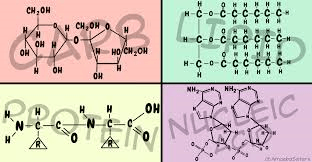

Which biomolecule makes up cell membranes?
Protein
Carbohydrate
Lipid
Nucleic acid
The main job of carbohydrates is
Weight gain
Create & store energy
Genetic material
Muscle development
Which of these is NOT an example of a carbohydrate?
Dextrose
Thymine
Galactose
Glucose
Select all the types of carbohydrates
Monosaccharide
Trisaccharide
Dissacharide
Polysaccharide
Lipids are...
polar
nonpolar

What piece controls the amount of light that enters the microscope ?
Aperture
Diaphragm
Light Source
Arm


Which microscope piece is labeled at number 4?
Coarse Adjustment Knob
Fine Adjustment Knob
Mirror/Light
Objective Lenses
When observing a specimen using the high-powered objective (40x), what is the total magnification that the specimen is being observed? (Remember that the eye piece has an additional 10x magnification!)
400X
40X
100X
4000X
How many objectives do our microscopes have?
3
2
1
10
Which knob CANNOT be turned when observing a specimen using the high-powered objective?
coarse adjustment
fine adjustment
nosepiece adjustment
objective adjustment

