
 Worksheets
Unit 1 Exam: Properties of Matter
Total questions: 62
Worksheet time: 2hrs 22mins
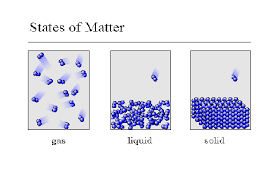
A gas
has a definite shape but no definite volume
has a definite volume but no definite shape
has fast-moving particles
Which state of matter has tightly packed particles?
solid
liquid
gas
What is matter?
anything that has mass and takes up space
anything that can be felt
anything that can behave in many different ways
anything that exist on Earth

Which form of matter has a definite shape and takes up space (has definite volume)?
liquid
solid
gas
clay


The particles in the picture are tightly held together with little movement. They have shape and energy. Therefore, the picture represents _________.
solid
liquid
gas
plasma
Particles move quickest in which state of matter
solid
liquid
gas
solid, liquid and gas
False


What does this picture represent?
solid
liquid
gas
plasma

Which of the following is not a matter?
a candle's heat
a candle
air inside a balloon
a melting ice cream
Blue color: Chemical or Physical Property
Reacts with acid: Chemical or Physical Property
Sour taste: Chemical or Physical Property
Odour (smell): Chemical or Physical Property
Properties that can be observed without changing the identity of the substance
Properties that describe how a substance changes into a completely different substance

the ability of a material to bend or be hammered into other shapes without breaking.
Ductility
Malleability
Toxicity
Solubility

the ability to pass electricity or heat through a substance
conductivity
ductility
oxidation
malleability

All matter is made up of tiny _______________
energy
particles (atoms and molecules)
bits
antimatter

The tool pictured here is...
a buret
an erlenmeyer flask
a graduated cylinder
a beaker
This tool is used to measure...
volume
mass
density
moles

In this image, the MASS of A is _____ the mass of B
equal to
greater than
less than
In this image, the VOLUME of A is _____ the volume of B
equal to
greater than
less than
In this image, the DENSITY of A is _____ the density of B
equal to
greater than
less than
Mass is the amount of _______ an object has
Matter
weight
What two types of measurements make up DENSITY?
Volume and Weight
Temperature and Mass
Mass and Volume
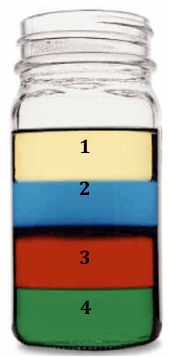
What does Matter make up?
solids
gases
liquids
all of the above
Mass changes when gravitational force changes
True
False
Mass is measured using what?
scale
glass
graduated cylinder
displacement
What type of formula is length X width X height
used to calculate the volume of?
gas
solid
liquid
plasma
A graduated cylinder is used to measure the volume of what?
plasma
liquid
solid
gas
What does density measures?
how much liquid is in an object
how tightly packed an objects particles are
The amount of space an object takes up
the amount of matter contained in an object
If the volume of an object is 5 cm3 and its mass is 55g, what is its density?
11g/ cm3
50cm 3/g
15 g/cm
275 g/ cm3

What is the volume of the water in the graduated cylinder? (TYPE THE NUMBER ONLY - DON'T TYPE MILLILITERS BEHIND THE NUMBER)
(a)
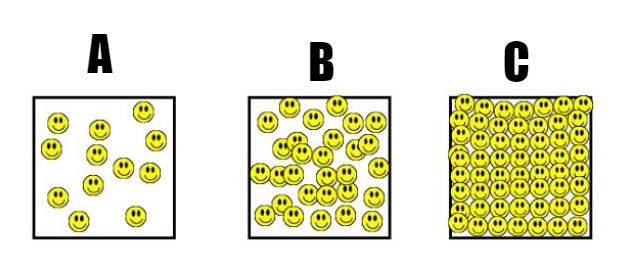
Which box shows the particles of an object that is the MOST DENSE?
A
B
C
they are all the same

What is the volume of the rectangular prism?
9
11
24
144
If an object is more dense than water, what will it do when placed in water?
it will disappear
it will sink
it will float
it will break apart
An average bowling ball has a mass of 7.26 kilograms. On Earth, it also weighs 7.26 kilograms. On the moon or in outer space where the force of gravity is much weaker, the ball’s mass would still be 7.26 kilograms. However, because gravity isn’t pulling it down as strongly, it would weigh much less.
Which of the options listed below would be true if you stood on the moon?
your mass would increase
you would weigh more than you do on Earth
you would weigh the same as you do on Earth
Your same mass would stay the same
Getting a hot air balloon ready to take a ride takes some work. First the empty balloon is spread out on the ground. Then an electric fan is pointed toward the opening of the balloon and turned on. How does the fan cause it to inflate?
Invisible particles of the fan push against the inside of the balloon as the fan is in motion.
The weight of the fan causes the balloon to inflate because the balloon is lighter than the fan.
The fan pushes invisible air particles into the balloon that push against the inside of the balloon.
The fan heats the air inside the balloon, so the balloon becomes lighter than the air inside of it.
All matter is made up of smaller pieces of matter called ____.
particles
space
weight
chemicals
How are the particles in each state of matter different?
The particles are different sizes
The particles are different materials
The particles are different shapes
The particles are arranged differently
What is a solid?
The particles are close together and locked in position, so they cannot move around each other and can only vibrate.
Shape and volume are not fixed.
Has a fixed volume and shape.
Particles are pretty far apart and able to move around easily.
What is a liquid?
Particles are pretty far apart and able to move around easily.
Shape and volume are not fixed.
The particles are close together but they are able to move about.
Has a fixed volume but does not have a fixed shape.
What is a gas?
The particles are spread apart and move freely in all directions.
Does not have a fixed volume or shape. The amount of space that it takes up can change.
Shape and volume of particles are fixed.
Particles are very tightly packed, can only vibrate.
How can matter change from state to state? Select all that apply.
Each time matter changes state, it is simply the movement of molecules in them speeding up or slowing down.
When heat is added to a solid, it turns into a liquid. When heat is added to a liquid, it evaporates and becomes a gas.
When heat is removed from a gas it condenses and turns back into a liquid. When a liquid freezes, it turns into a solid.
Matter can't change from state to state.
How can matter change from state to state? Select all that apply.
Each time matter changes state, it is simply the movement of molecules in them speeding up or slowing down.
When heat is added to a solid, it turns into a liquid. When heat is added to a liquid, it evaporates and becomes a gas.
When heat is removed from a gas it condenses and turns back into a liquid. When a liquid freezes, it turns into a solid.
Matter can't change from state to state.
Explain what physical properties and physical changes you observed in making your apple pie? (Your response should be 3-4 sentences and includes specific examples of physical properties/changes that you observed)
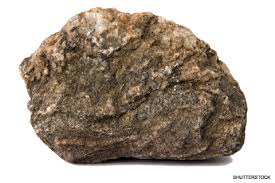
Please draw a picture of how you would measure the volume of a rock using displacement?

What are the chemical properties and/or examples of chemical change that occurred when you made your apple pie? (Be specific and write 3-4 sentences about how you know USE EVIDENCE a chemical change happened).
When we went over to the garden/greenhouse we made smoothies. Was making smoothies a chemical or physical change? Please explain your answer using 2-3 sentences.
Explain how leaves changing in the fall can be considered a physical or chemical change. A full credit answer will give an example of both a physical and chemical change in the leaves.
When you eat food like we did at the garden (trying carrots, peppers, ground cherries, etc.) describe what physical and chemical changes are happening. Full credit answer will be 2-3 sentences and include examples of physical and chemical changes the food undergoes.

