wayground logo

Free Printable Worksheets

Font size

S
M
L
XL
Worksheets

Unit 1- Classification and Ecological Relationships Test Review

Total questions: 52

Worksheet time: 1hrs 3mins

Name
Class
Date
1.

A pilot fish usually follows behind sharks to pick up food scraps that they leave behind. The fish gets food and the shark is unaffected. This is an example of:

a)

Mutualism

b)

Commensalism

c)

Parasitism

d)

Decomposition

2.
A clownfish uses a sea anenome as a safe place to live. While living there, the clownfish lures in food for the anenome. This is an example of what type of relationship?
a)
Predator-Prey
b)
Commensalism
c)
Mutualism
d)
Parasitism
3.
When predator numbers decrease, prey numbers ____________ because fewer of them are being consumed.
a)
decrease
b)
increase
c)
stay the same
d)
divide in half
4.

A mongoose eating ticks off a warthog, or a starling eating ticks off a cow are examples of what type of symbiotic relationship?

a)

Cooperation

b)

Parasitism

c)

Commensalism

d)

Mutualism

5.

A feeding relationship where one organism hunts and one is hunted, such as a Lynx hunting a snowshoe hare, is known as:

a)

Commensalism

b)

Decomposistion

c)

Mutualism

d)

Predator-Prey

6.

An organism that helps to recycle nutrients within an ecosystem by eating dead or decaying organisms, such as a mushroom, is a:

a)

Predator

b)

Autotroph

c)

Producer

d)

Decomposer

7.

A general term for a relationship that describes a close interaction between two different species is known as what?

a)

Biodiversity

b)

Symbiosis

c)

Predation

d)

Emigration

8.
A mosquito feeds off of the blood of different organisms. This usually causes discomfort to the organism and sometimes disease and death. This is an example of:
a)
Parasitism
b)
Decomposition
c)
Commensalism
d)
Mutualism
9.

A relationship between two organisms where one benefits while the other is harmed is known as what?

a)

Decomposition

b)

Consummerism

c)

Mutualism

d)

Parasitism

10.

Another word for a plant that makes its own food using energy from sunlight…

a)

photosynthesis

b)

producer

c)

heterotroph

d)

carnivore

e)

herbivore

11.
Where does the energy start in this food chain?
a)
Plant
b)
Sun
c)
Deer
d)
Wolf
12.

Which term describes this statement: All the populations of all the different species that live together in a particular area

a)

Mutualism

b)

Community

c)

Commensalism

d)

Predator/Prey

13.

A symbiotic relationship between two species in which one benefits and the other is unaffected, such as ants living in a tree, or birds nesting in a tree, is known as:

a)

mutualism

b)

commensalism

c)

parasitism

d)

community

14.

A scientist observes membrane-bound organelles in a cell. What kind of cell is it?

a)

bacterium

b)

virus

c)

prokayote

d)

eukaryote

15.

Here is a table that shows the level of classification for a dog. What is the correct label for X?

a)

Domain

b)

Genus

c)

Order

d)

Phylum

16.

Here is a table that shows the level of classification for a dog. What is the correct label for Y?

a)

Domain

b)

Genus

c)

Order

d)

Phylum

17.

Here is a table that shows the level of classification for a dog. What is the correct label for Z?

a)

Domain

b)

Genus

c)

Order

d)

Phylum

18.

Which of these animals listed are the MOST closely related?

(Select the two)

a)

dog

b)

lion

c)

robin

d)

swift fox

19.

What is the goal of taxonomy?

a)

to explain the differences between living organisms

b)

to classify living organisms into groups

c)

to predict the types of undiscovered organisms

d)

to establish relationships of organisms and their habitats

20.

The scientific name for a human is Homo sapiens. Select the two levels of classification this name represents.

a)

family

b)

order

c)

species

d)

phylum

e)

genus

21.

Which characteristic places the king snake in a different class from the giant panda?

a)

It is not a mammal

b)

It does not have a spine

c)

It eats other animals

d)

It sheds its skin

22.

What is the correct scientific name for the organism in the table?

a)

Reptilia testudines

b)

Chordata reptilia

c)

Emydidae terrapene

d)

Terrapene carolina

23.
The scientific name for an organism is made from the:
a)
class and family name
b)
genus and species name
c)
domain and kingdom name
d)
kingdom and phylum name
24.
Which of the following organisms are MOST closely related?
a)
organisms that share a domain
b)
organisms that share a family 
c)
organisms that share a genus 
d)
organisms that share an order  
25.
What is the most specific level of classification?
a)
Family
b)
Domain
c)
Species
d)
Carolus Linnaeus
26.

The modern Biological classification system is based on the pioneering work of:

a)

Carl Linnaeus

b)

Isaac Newton

c)

Charles Darwin

d)

John Meritus

27.

the largest classification category

a)

Kindgom

b)

Phylum

c)

Order

d)

Species

28.
Cells that do not have a true nucleus are called....
a)
eukaryote
b)
prokaryote
c)
unicellular
d)
multicellular
29.
Cells that have a true nucleus are called....
a)
eukaryotes
b)
prokaryotes
c)
unicellular
d)
multicellular
30.
Which terms best describe heterotrophs?
a)
Plants; producers
b)
Animals; producers
c)
Plants; consumers
d)
Animals; consumers
31.
Which terms best describe autotrophs?
a)
Plants; producers
b)
Animals; producers
c)
Plants; consumers
d)
Animals; consumers
32.
Which of the following organisms are LEAST closely related?
a)
organisms that share a domain
b)
organisms that share a family 
c)
organisms that share a genus 
d)
organisms that share a species 
33.
The 8 levels of classification, most broad to most specific.
a)
Domain, Genus, Family, Order, Class, Phylum, Kingdom, Species
b)
Domain, Species, Kingdom, Genus, Phylum, Family, Class, Order
c)
Domain, Kingdom, Phylum, Class, Order, Family, Genus, Species
d)
Order, Kingdom, Species, Domain, Phylum, Family, Class, Genus
34.
The science of describing, classifying, and naming living things is called:
a)
Geology
b)
Biology
c)
Taxonomy
d)
Chemistry
35.
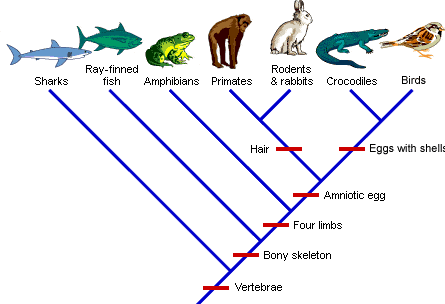
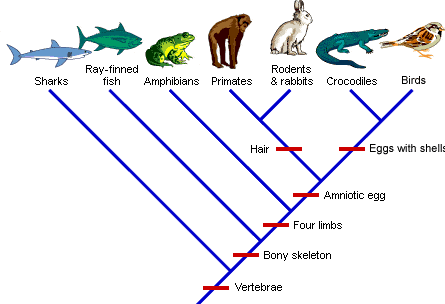
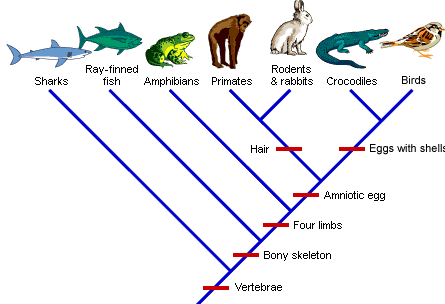
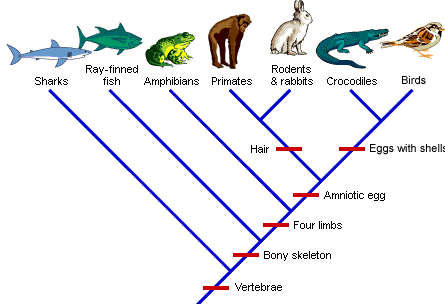
According to this cladogram, primates are most closely related to -
a)
Amphibians
b)
Rodents and rabbits
c)
Crocodiles
d)
Birds
36.
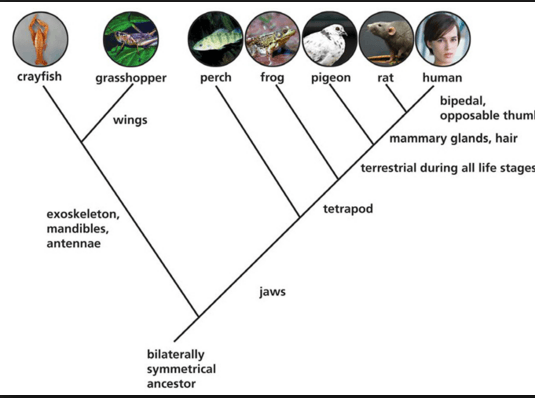
Which trait do only humans have, according to the cladogram?
a)
jaws
b)
mammary glands & hair
c)
terrestrial during all life stages
d)
opposable thumbs
37.
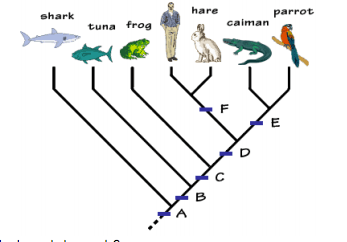
On the cladogram, which organism is the closest relative of the human?
a)
Frog
b)
Hare
c)
Caiman
d)
Parrot
38.
According to this cladogram, sharks are MOST closely related to which organism? 
a)
Amphibians
b)
Ray finned fish
c)
Crocodiles
d)
Birds
39.
According to the cladogram, which organism is most distantly related to the human?
a)
crayfish
b)
rat
c)
perch
d)
frog
40.
According to this cladogram, birds are LEAST related to: 
a)
Amphibians
b)
Sharks
c)
Ray Finned Fish
d)
Crocodiles
41.
Which trait do only humans have, according to the cladogram?
a)
jaws
b)
mammary glands & hair
c)
terrestrial during all life stages
d)
bipedal & opposable thumbs
42.
Which two orgainsms have hair? 
a)
Sharks & Ray Finned Fish
b)
Primates & Rodents
c)
Birds & Crocodiles
d)
Rabbits & Birds
43.
What trait separates sharks from ray-finned fish?
a)
Vertebrae
b)
Bony skeleton
c)
Four limbs
d)
None
44.

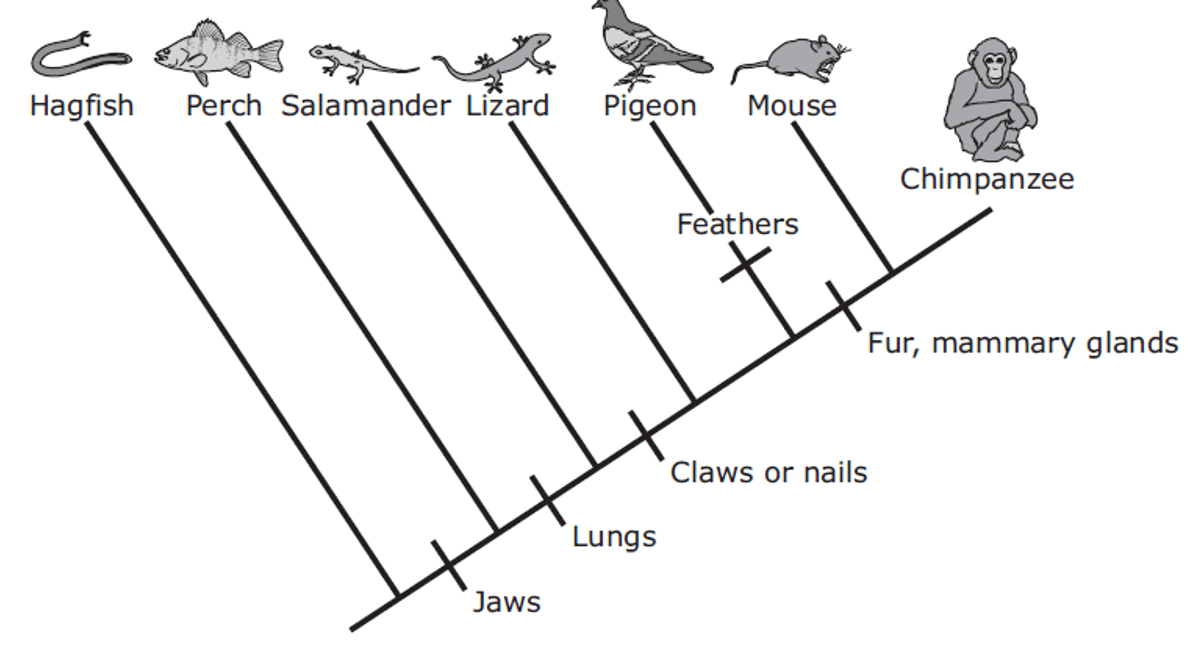
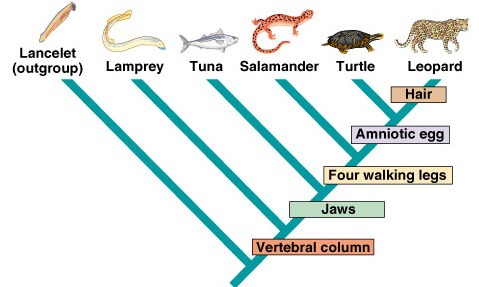
All the animals to the right of the salamander would have the common characteristic of...

a)

Fur

b)

Claws or nails

c)

Lungs

d)

Jaws

45.

Which is the newest trait?

a)

Amniotic egg

b)

Walking legs

c)

Jaws

d)

Hair

46.

The _____________ for an organism identifies the variations in the particular environmental conditions in which a particular species can successfully live and reproduce.

a)

carrying capacity

b)

tolerance range

c)

tolerance limits

47.
group of ecosystems that have the same regional climate communities
a)
habitat
b)
biome
c)
tolerance
d)
niche
e)
resource
48.
the place where a species lives
a)
habitat
b)
biome
c)
tolerance
d)
niche
e)
resource
49.
the range of abiotic and biotic factors a species needs + the species' job in that habitat
a)
habitat
b)
biome
c)
tolerance
d)
niche
e)
resource
50.
a range of environmental conditions that a species can survive and reproduce in
a)
habitat
b)
biome
c)
tolerance
d)
niche
e)
resource
51.

Imagine a disease struck the chipmunk population. Which organism would likely also see a decline as a result.

a)

Hawk

b)

Bush

c)

Caterpiller

d)

Fox

52.

In a tolerance graph, what does the optimal range represent?

a)

The conditions in which the species lives best

b)

The conditions the species can tolerate with some stress

c)

The conditions in which the species cannot survive