
 Worksheets
Space and earth
Total questions: 110
Worksheet time: 2hrs 9mins
Which unit is larger?
Astronomical Unit
Light-year
What property about Carbon-14 makes it ideal for dating fossils?
Radioactivity
It is very stable
It has a particular smell
Carbon-14 doesn't exist, you fool!

The absorption lines in the spectrum for Galaxy B are _____ when compared to the lines for the Milky Way.
Las líneas de absorción en el espectro de la Galaxia B son _____ en comparación con las líneas de la Vía Láctea.
red-shifted
blue-shifted

The absorption lines in the spectrum for Galaxy A are _____ when compared to the lines for the Milky Way.
Las líneas de absorción en el espectro de la Galaxia A son _____ en comparación con las líneas de la Vía Láctea.
red-shifted
blue-shifted

An object moving away from us will appear more ____.
Un objeto que se aleja de nosotros aparecerá más ____.
red
blue
An object moving toward us will appear more ____.
Un objeto que se mueva hacia nosotros aparecerá más ____.
red
blue
What happens to the frequency of light waves emitted from a star as the star moves away from us?
¿Qué sucede con la frecuencia de las ondas de luz emitidas por una estrella cuando la estrella se aleja de nosotros?
frequency increases
frequency decreases
What happens to the frequency of light waves emitted from a star as the star moves toward us?
¿Qué sucede con la frecuencia de las ondas de luz emitidas por una estrella cuando la estrella se mueve hacia nosotros?
frequency increases
frequency decreases
What happens to the wavelength of light waves emitted from a star as the star moves toward us?
¿Qué sucede con la longitud de onda de las ondas de luz emitidas por una estrella cuando la estrella se mueve hacia nosotros?
wavelength increases
wavelength decreases
What happens to the wavelength of light waves emitted from a star as the star moves away from us?
¿Qué sucede con la longitud de onda de las ondas de luz emitidas por una estrella cuando la estrella se aleja de nosotros?
wavelength increases
wavelength decreases

The spectral lines for the Distant Galaxy are ___, indicating it is moving ___ us.
Las líneas espectrales de la galaxia distante son ___, lo que indica que se mueve ___ hacia nosotros.
red-shifted, toward
red-shifted, away from
blue-shifted, toward
blue-shifted, away from

Which galaxy is moving at the fastest speed away from the Milky Way?
¿Qué galaxia se está alejando a mayor velocidad de la Vía Láctea?
Galaxy A
Galaxy B
Galaxy C





In this clip, the sound of the jet illustrates the doppler effect AS OBSERVED BY
The man on the ground
The pilot in the jet
Both the man on the ground and the pilot in the jet

From the perspective of the camera's position, the ambulance's siren sound should
rise in pitch.
fall in pitch.
stay the same pitch.
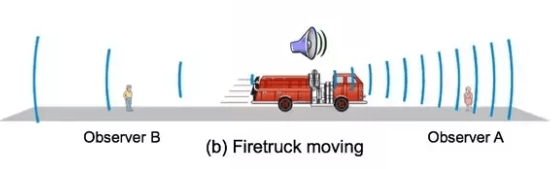
Look at the picture. Who is experiencing a lower pitched sound?
Observer A
Observer B
There is no difference
You are standing on the side of the road when a police car races past you with its siren on. After the police car passes you, what happens to the pitch of the siren?
It increases
It decreases
It turns red
The pitch of a sound wave relates to the wave's _________________.
Amplitude
Frequency
Wavelength
Period


Which discovery(ies) came from our understanding redshift/ blueshift?
The universe is expanding
Most galaxies are moving away from us
All of the above (and many more)

What energy is the shortest wavelength?
Radio
Infrared
X rays
Gamma
Doppler Red Shift is a proof that the Big Bang occurred. This helps support the idea that the universe is.....
Expanding
Contracting

You are the observer looking at the jet. As the Jet takes off, what is happening to the wavelength of sound and the pitch of the sound?
Longer wavelength and getting less loud
Longer wavelength and getting louder
Shorter wavelength and getting less loud
Longer wavelength and getting louder

What side of the spectrum is most harmful?
What side of the spectrum is harmless?
Right side is harmful
Left side is harmless
Left side is harmful
Right side is harmless
How do stars like the sun create energy that is later radiated away into space?
nuclear fusion changing hydrogen into helium
burning of carbon fuels
changes in state such as melting and evaporation
absorbing electromagnetic radiation from space
What is the single most important factor controlling the evolution of a star?
mass
rotation rate
element composition
temperature
Which process combines lighter elements into heavier elements and produces energy within the Sun and other stars?
fusion
insolation
conduction
radioactive decay
Which object forms by the contraction of a large sphere of gases causing the nuclear fusion of lighter elements into heavier elements?
comet
planet
star
moon
The probable fate of our sun is
to expand as a red giant, undergo a nova outburst and end as a white dwarf
to shrink to a white dwarf then eventually expand to a red giant
become hotter and expand into a blue supergiant
to become a black hole
What factor from the choices below determines whether a star will evolve into a white dwarf, a neutron star, or a black hole?
mass
percentage of helium
percentage of carbon
apparent brightness
According to our present theories of stellar evolution, our sun will change next into
a white dwarf.
a black hole.
a supernova.
a red giant.
What are the two most abundant elements in a main sequence star?
carbon and hydrogen
hydrogen and helium
helium and carbon
carbon and heavy metals
Which stars are the youngest?
Supergiants
White dwarves
Blue stars
Red dwarves
The explosion of a massive star near the end of its life is known as a
nova
supernova
pulsar
nebula

According to this flowchart, the sun will become
hotter and brighter in stage 2, then cooler and dimmer in stage 3.
cooler and dimmer in stage 2, then hotter and brighter in stage 3.
hotter and dimmer in stage 2, then cooler and brighter in stage 3.
cooler and brighter in stage 2, then hotter and dimmer in stage 3.

All stars begin their life cycle as a ______.
supernova
Nebula which is a cloud of dust and gas
protostar
Black hole
Has a higher temperature during it's main sequence phase.
Low mass stars
High mass stars
Spends a longer time in it's main sequence phase.
Low mass stars
High mass stars
Creates elements heavier than Fe
Low Mass Stars
High Mass Stars
Process stars make light and energy
Fission
Fusion
Confusion
Diffusion
True or False
Stars fuse heavier elements into lighter elements.
True
False

Which phase of the stars life cycles have the greatest luminosity?
Blue giants
Red Super Giants
White Dwarfs
Main Sequence Stars

Our sun is a .........
Yellow Super Giant
Main Sequence Star
White Dwarf
Blue giant

True or False
Blue giants are hotter than red dwarfs
True
False
Low mass stars end their life as neutron star and high mass stars end their life as a black hole.
True
False
Massive stars and super massive stars end their lives as..............., respectively
Black holes and black dwarfs
neutrons stars and black holes
white dwarf and black dwarf

1. Copy this into your notes to study.
2. List the elements from the diagram in order from lightest to heaviest that are formed by star life phases. Complete the list using only the symbols in order with a coma and space after each: H, He, _
(a)

What is the final stage of a low mass star?
White Dwarf
Black Hole
Red Giant
Neutron Star
What is the final stage of a high mass star?
White Dwarf
Black Hole
Red Giant
Neutron Star
What is the final stage of a very high mass star?
White Dwarf
Black Hole
Red Giant
Neutron Star

Which star is likely to be the hottest? Use the H-R diagram
Type B Star
White Dwarf
Red Giant
Type G Star (Sun)

Which mass of star will have the shortest life span?
Low Mass Star
Medium Mass Star
High Mass Star
Very High Mass Star

Which stage of life is the sun currently in?
White Dwarf
Planetary Nebula
Main Sequence
Red Giant

What is the name of the cosmic cloud of dust and gas that is the first stage in the birth of a star?
Protostar
Spiral Galaxy
Quasar
Stellar Nebula

A stellar nebula will eventually condense into a hot ball of mostly hydrogen called a __________. At this point, nuclear fusion has not yet started but it will soon.
Protostar
White Dwarf
Brown Dwarf
Main Sequence
In a low-medium mass star, at the end of the red giant stage, the red giant's atmosphere expands outward to create a...
White Dwarf
Planetary Nebula
Supernova
Neutron Star
In a low-medium mass star, after the end of the red giant phase, a hot inner core of the star is left over. This core is a called a __________. There is no longer nuclear fusion happening at this stage.
White Dwarf
Planetary Nebula
Supernova
Neutron Star
In a high mass star, at the end of the red giant phase, the gravity causes the star to rapidly collapse. This collapse causes a massive explosion called a __________
White Dwarf
Planetary Nebula
Supernova
Neutron Star
In a very high mass star, a supernova triggers the formation of a __________ which has a gravitational pull so strong that even light cannot escape.
White Dwarf
Neutron Star
Stellar Nebula
Black Hole

Which elements are found in a main sequence star?
Hydrogen (H)
Helium (He)
Carbon (C)
Oxygen (O)

Which is one of the heaviest element found in a red giant star?
Nitrogen (N)
Iron (Fe)
Sulfur (S)
Magnesium (Mg)

Here on Earth, living organisms are mostly made of Carbon (C), Hydrogen (H), Oxygen (O), Nitrogen (N), Phosphorous (P), Sulfur (S), Calcium (Ca), and Potassium (K). Where do all of these elements come from?

an enormous cloud of dust and gas occupying the space between stars and acting as a nursery for new stars.
nebula
main sequence star
mass
luminosity

contracting mass of gas which represents an early stage in the formation of a star, before nucleosynthesis has begun
supervona
black hole
protostar
gravity

stars that are fusing hydrogen atoms to form helium atoms in their cores.
super redgiant
red giant
Nebula
main sequence star

very large star of high luminosity and low surface temperature, thought to be in a late stage of evolution when no hydrogen remains in the core to fuel nuclear fusion.
nuclear fusion
main sequence star
core collapse
red giant

a small very dense star that is typically the size of a planet, formed when a low-mass star has exhausted all its central nuclear fuel and lost its outer layers as a planetary nebula.
black dwarf
white dwarf
super redgiant
mass
Which process contributes carbon dioxide to the atmosphere?
anaerobic respiration
photosynthesis
protein synthesis
tree farms
Which process removes carbon dioxide from the atmosphere?
deforestation
tree farms
burning fossil fuels
cellular respiration
Which statement is correct?
matter cycles; energy cycles
matter cycles; energy disintengrates
matter cycles; energy converts
matter converts; energy cycles
What is the greatest contributor to atmospheric carbon?
burning garbage
burning biomass
transportation
household usage
Which form of carbon is the most potent greenhouse gas?
CO2
CH4
C6H12O6
C3H8O3

What organisms form fossils?
animals
plants and animals
CaCO2
sedimentary rocks
All of the carbon in existence is continually recycled in the carbon cycle.
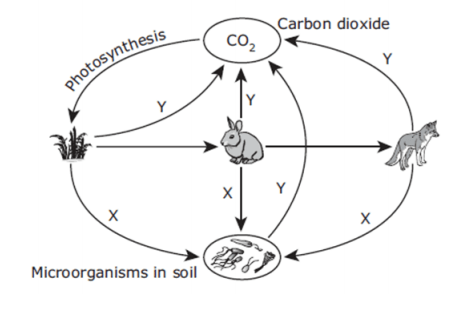
Y : Predation
Y : Decomposition
Y : Nitrogen Fixation
Y : Respiration
Which nitrogen cycle process is occurring when bacteria convert ammonium to nitrite and then into nitrate?
nitrogen fixation
nitrification
denitrification
ammonification
assimilation
Which of these nitrogen cycle processes converts atmospheric nitrogen to a soil form of nitrogen that is usable by plants?
nitrogen fixation
nitrification
denitrification
ammonification
assimilation



