wayground logo

Free Printable Worksheets

NEW

Font size

S
M
L
XL
Worksheets

Continental Drift & Plate Tectonics Practice

Total questions: 40

Worksheet time: 32mins

Name
Class
Date
1.

Alfred Wegener thought which 2 continents looked like puzzle pieces that could fit together?

a)

Antarctica and Asia

b)

South America and Africa

c)

South America and Australia

d)

Africa and Pangaea

2.
What is represented by the picture? 
a)
Sea-floor spreading
b)
Pangea
c)
How the continents are arranged today
d)
Volcanoes
3.

What geologic feature was evidence to support the theory that the continents used to be joined?

a)

Same rocks were found on different continents

b)

Glacial grooves were found on different continents

c)

Fossilized evidence of the same organism found on different continents

d)

Africa and South America look like puzzle pieces that fit together

4.
How does fossil evidence support Wegener's hypothesis of continental drift?
a)
Similar fossils are found along continental margins that appear to join together.
b)
Fossils are found in areas where the present-day climate could not have supported the organisms that made the fossils.
c)
Similar fossils of giant, land-dwelling dinosaurs are found on continents separated by oceans.
d)
all of the above
5.

What evidence of an ancient organism was used to support the theory that the continents used to be joined?

a)

Same rocks were found on different continents

b)

Glacial grooves were found on different continents

c)

Fossilized evidence of the same organism found on different continents

d)

Africa and South America look like puzzle pieces that fit together

6.

What was Pangaea?

a)

It was a supercontinent, made of all of the landmasses on Earth.

b)

It was 2 separate landmasses, one on the Northern Hemisphere and one on the Southern Hemisphere.

c)

It was a supercontinent made of 3 landmasses

d)

It was the name of an ancient organism

7.

What was Alfred Wegenerś Continental Drift theory?

a)

The continents used to be joined together to form a supercontinent.

b)

The continents have since drifted apart to their current location

c)

Pangaea was formed around 250 million years ago

d)

All of the above

8.

Where did Wegener find plant fossils that today would not be able to survive on that type of land?

a)

North America

b)

Antarctica

c)

China

d)

India

9.

What are two pieces of evidence used to support the theory of continental drift?

a)

Fossils and Pangaea

b)

South America and Rocks

c)

Rocks and Fossils

d)

Fossils and Africa

10.

The youngest rocks on the ocean floor are located ____.

a)

near continents

b)

at mid-ocean ridges

c)

far from mid-ocean ridges

d)

near Asia

11.
Massive pieces of land that are part of the Earth's crust and upper mantle
a)
Tectonic plates
b)
Trenches
c)
Divergent boundary
d)
Continental shelves
12.
The deepest part of the ocean; long, narrow ditches
a)
Tectonic plates
b)
Trenches
c)
Divergent boundary
d)
Continental shelves
13.
___________ help explain why Earth is not getting any larger even though the tectonic plates are always moving.
a)
earthquakes
b)
subduction zones
c)
fossils
d)
volcanoes
14.
The OLDEST seafloor is located? 
a)
Closest to the mid-ocean ridge
b)
Farthest from the mid-ocean ridge
15.
True or False : Sea-floor Spreading adds new material to the ocean floor?
a)
True
b)
False
16.
What happens when Subduction occurs?
a)
Parts of the crust fall into the mantle
b)
Parts of the crust fall into the core
c)
Parts of the crust fall into space
d)
None of these
17.
True or false : Deep-Ocean Trenches are underwater canyons?
a)
False
b)
True
18.
What are Mid-Ocean Ridges?
a)
A chain of underwater waterfalls 
b)
A chain of underwater volcanos
c)
A chain of underwater mountains
d)
A chain of underwater rocks
19.
What process takes place at the trenches? 
a)
divergent boundaries
b)
subduction
c)
new crust is formed
d)
mountain ranges
20.
The oceanic crust _________ when it reaches the continental crust.
a)
sinks
b)
rises
c)
expands
21.
New crust is always formed at the...
a)
mid-ocean ridge
b)
deep-ocean trench
c)
asthenosphere
22.

What do we call the continuously moving parts of Earth's crust?

a)

Plates

b)

Crust

c)

Earthquakes

d)

Volcanoes

23.

What happens when tectonic plate shift suddenly?

a)

Thunderstorm

b)

Volcano

c)

Earthquake

d)

Landslide

24.

What do we call the place where two tectonic plates meet?

a)

Plate

b)

Fault

c)

Focus

d)

Epicenter

25.

Most earthquakes happen along _________________. 

a)
coast
b)
faults
c)
desert
d)
directions
26.

What is the name of the process occurring in the mantle that moves the tectonic plates?

a)

Coastal erosion

b)

Subduction

c)

Convection Currents

d)

Convergence

27.
What are the three types of plate boundaries?
a)
Transform, Convergent, Divergent
b)
Apart, Together, Slide
c)
Slide, Pull away, Push together
28.
Why do volcanes form?
a)
From plate(s) getting stuck, pushed further, and folding
b)
From a plate subducting, melting, & rising
c)
From one plate being more dense & sinking creating a low spot
d)
All answers
29.
Plates move towards one another at ______________ boundaries.
a)
divergent
b)
convergent
c)
transform
d)
detergent
30.
What geologic feature/event would you most likely to find at a convergent boundary between two pieces of continental crust?
a)
Volcano
b)
Mountain
c)
Rift
d)
Island Arc
31.
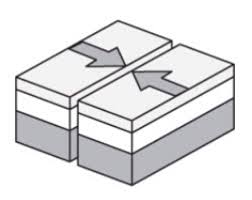
Name the boundary
a)
convergent boundary
b)
divergent boundary
c)
transform boundary
d)
sergent boundary
32.
The area where two or more plates meet is called a __________________.
a)
fault
b)
plate boundary
c)
plate edge
d)
ring of fire
33.
Why is there a trench in the water?
a)
Because of the basalt 
b)
Because of the melting oceanic crust
c)
Because the oceanic plate is subducting making a low spot
d)
Because the oceanic plate is stuck and folds downward
34.
In which type of boundary do the plates move away from each other?
a)
convergent
b)
normal
c)
divergent
d)
transform
35.
At which type of plate boundary does seafloor spreading occur?
a)
Tranform
b)
Convergent
c)
Divergent
d)
Subductive Zone
36.
Which of these events can ONLY happen on a DIVERGENT BOUNDARY?
a)
Rift Valley
b)
Mountain
c)
A peninsula
d)
An Insanely complex, long answer that you will click out of instinct. 
37.
Which scientist posed the theory of continental drift?
a)
Harry Hess
b)
Drummond Matthews
c)
Fred Vine
d)
Alfred Wegener
38.

What type of Boundary is this? What event will occur at this boundary?

a)

Transform / Earthquakes

b)

Subduction / Volcano Eruption

c)

Tornado / Rain

d)

Mountain Building / Volcanism

39.

A ______ is a location on Earth's surface where water, heated by the mantle, bursts through the crust.

a)

geyser

b)

waterfall

c)

stalagmite

d)

resevoir

40.

The Himalayan Mountains were formed by the _________ plate boundary between the Indian Plate and Eurasian Plate.

a)

divergent

b)

convergent

c)

strike slip