wayground logo

Free Printable Worksheets

NEW

Font size

S
M
L
XL
Worksheets

BAMM Forces Review

Total questions: 67

Worksheet time: 2hrs 40mins

Name
Class
Date
1.
The x-axis shows
a)
time
b)
carbon dioxide concentration
c)
science
2.
The y-axis shows
a)
time
b)

CO2 concentration

c)
science
3.

According to the pie chart, how much of a house's water usage is for showers?

a)

26.7%

b)

13.7%

c)

21.7%

d)

16.8%

4.

What type of graph would you make to show how many of your classmates were born in each month of the year?

a)

line

b)

bar

c)

circle

d)

scatter plot

5.
How many more people have purple for a favorite color than red?
a)
3
b)
5
c)
7
d)
9
6.

What is a data table?

a)

Is a visual tool that uses that uses bars to compare data among categories

b)

Used to compare the parts of a whole

c)

Any display of information in tabular form, with rows and or columns named

d)

Is a visual tool that uses that uses lines to compare data among categories

7.
What is this graph missing?
a)
Axes
b)
Title
c)
Categories
d)
None of these
8.

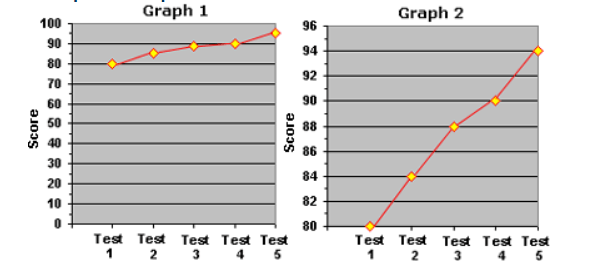
A sneaky student wants to impress his parents by showing them a graph of his performance progress on the last 5 science tests.


Which graph should he use to impress his parents?

a)

Graph 1

b)

Graph 2

c)

Neither

d)

Both

9.

You want to make a graph for an experiment you did about plant growth over a two week period of time. What type of graph would you use?

a)

Column graph

b)

Line graph

10.

What conclusions can you draw from this graph?

a)

The deer population went down over time.

b)

The deer population went up over time.

c)

The dear population went up quickly, then down, but then stayed the same.

d)

There are less dear because of hunters

11.
T11 - What can you infer about the temperature for E.coli bacterial growth?
a)
E. coli does not grow well at low and high temperatures.
b)
E coli will continue to grow at very high temperatures.
c)
E.coli grows best at very low temperatures
d)
E.coli grows best at very high temperatures.
12.
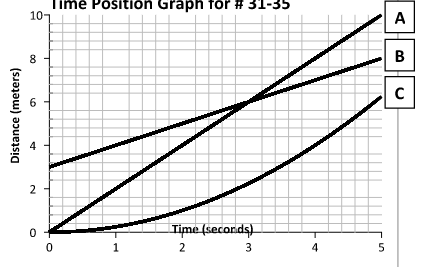
Which runner had a head start?
a)
A
b)
B
c)
C
d)
none
13.
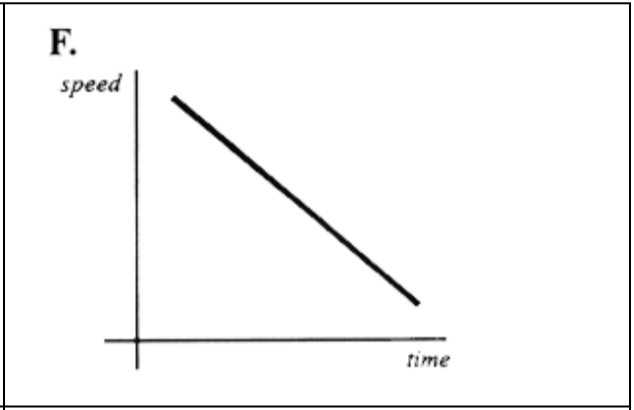
What is this graph showing?
a)
Constant Speed
b)
Acceleration (speeding up)
c)
Deceleration (slowing down)
d)
No motion
14.
from 3rd second to 5th second, the object is
a)
moving at a constant speed
b)
speeding up
c)
not moving
d)
slowing down
15.
What is happening at D?
a)
Stationary
b)
Accelerating
c)
Fast steady speed; moving away from the starting position
d)
Slower steady speed; moving away from the starting position
16.
On a distance vs. time graph, the steeper the slope _____
a)
the slower the speed
b)
the faster the speed
c)
less acceleration
d)
greater acceleration
17.
What is happening between 4 and 5 seconds?
a)
The object is slowing down in a negative direction.
b)
The object is slowing down in a positive direction.
c)
The object is slowing down in a negative direction.
d)
The object is speeding up in a negative direction.
18.
What is the total distance covered by 2 pm?
a)
40 miles
b)
30 miles
c)
60 miles
d)
10 miles
19.

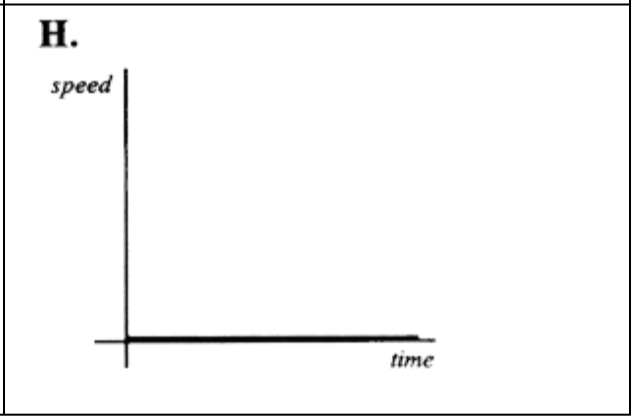
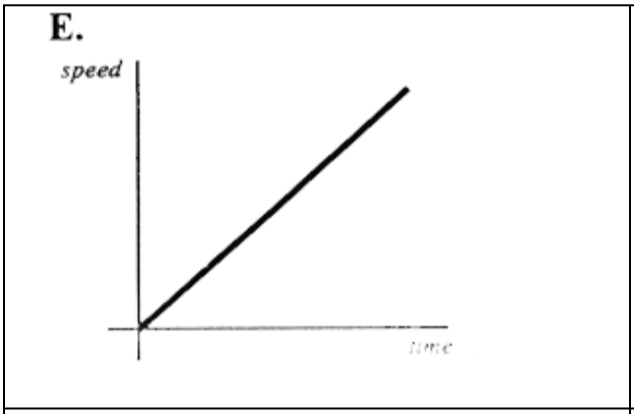
Match the graph to the description:

"The car is stopped."
a)
b)
c)
d)
20.

Match the graph to the description:

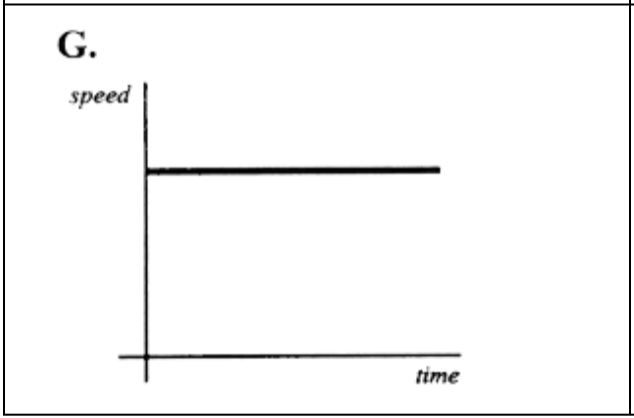
"The car is traveling at a constant speed."

a)
b)
c)
d)
21.
During which interval is the object slowing down?
a)
A to B
b)
D to E
c)
E to F
d)
G to H
22.

What segment of the graph shows no motion, or standing still?

a)

A - B

b)

B - C

c)

C - D

d)

None

23.

Describe motion of C - D.

a)

Constant velocity away from the origin

b)

Slowing down away from the origin

c)

Slowing down away from the origin and then slowing down towards the origin

d)

Slowing down away from the origin and then speeding up towards from the origin

24.

Describe the motion from B - C.

a)

Standing still

b)

Constant velocity of 60 m/min

c)

Constant velocity of 0 m/min

d)

Accelerating

25.
Bill jogs 400 meters to Andy's house, turns around, and runs 400 meters back home.  He does so in 267 seconds.  What is Bill's average speed?
a)
about 3 m/s
b)
about 1.5 m/s
c)
0
d)
about 4 m/s
26.
What is the formula to calculate speed?
a)
S = t/d
b)
S = d/t
c)
S = d x t
d)
S = t x d
27.

A runner races in the 100 meter dash. It takes her 10 seconds to finish. What is her average speed?

a)

10 m/s

b)

1000 m/s

c)

100 seconds

d)

10 seconds

28.
Which of the following is a unit of time?
a)
sec
b)
mi
c)
m/s
d)
km
29.
Which of the following is a unit of speed ?
a)
sec
b)
mi
c)
m/s
d)
min
30.
Which of the following is a unit of distance ?
a)
miles/hr
b)
mi
c)
s
d)
min
31.
A train travels 25 km in .5 hrs. How fast is the train going?
a)
25 miles/hr
b)
5 miles/hr
c)
125 km/hr
d)
50 km/hr
32.
The baseball park is 4200 m from Camden's house.  I took him 30 minutes to get there.  What was Camden's speed?
a)
.007 m/min
b)
12.60 m/min
c)
140 m/min
d)
126 m/min
33.

___ refers to how fast an object is moving.

a)

Speed

b)

Velocity

c)

Acceleration

d)

Motion

34.

Which two factors does speed depend on?

a)

distance and direction

b)

direction and time

c)

distance and time

d)

distance, time and direction

35.

Which is an example of velocity?

a)

A car driving 55 miles per hour south.

b)

A bicyclist traveling 10 meters per hour.

c)

A roller coaster is traveling 10 meters per second.

d)

A rocket blasting off at 2,500 meters per second.

36.

Speed or Velocity?:

A turtle is crawling 34 cm/min.

a)

Speed

b)

Velocity

c)

Neither

d)

Both

37.

Acceleration is a speeding up, slowing down or a change in direction. Is the following acceleration and if so, which one?


A dancer is warming up. She turns on music with a good beat and does 10 pirouettes in a row perfectly on the beat. (pirouette is a body spin in ballet)

a)

Yes, this is acceleration since the dancers is going a certain speed.

b)

Yes, this is acceleration since the dancer is changing direction when she spins.

c)

No, this is not acceleration since there is no speeding up, slowing down, or change in direction.
38.
Acceleration of an object happens when things ________
a)
slow down
b)
go faster
c)
change direction (turn)
d)
All of the above
39.
Velocity is both ____ and _____. 
a)
speed , direction 
b)
direction, mass
c)
volume, density 
d)
direction, magnitude 
40.
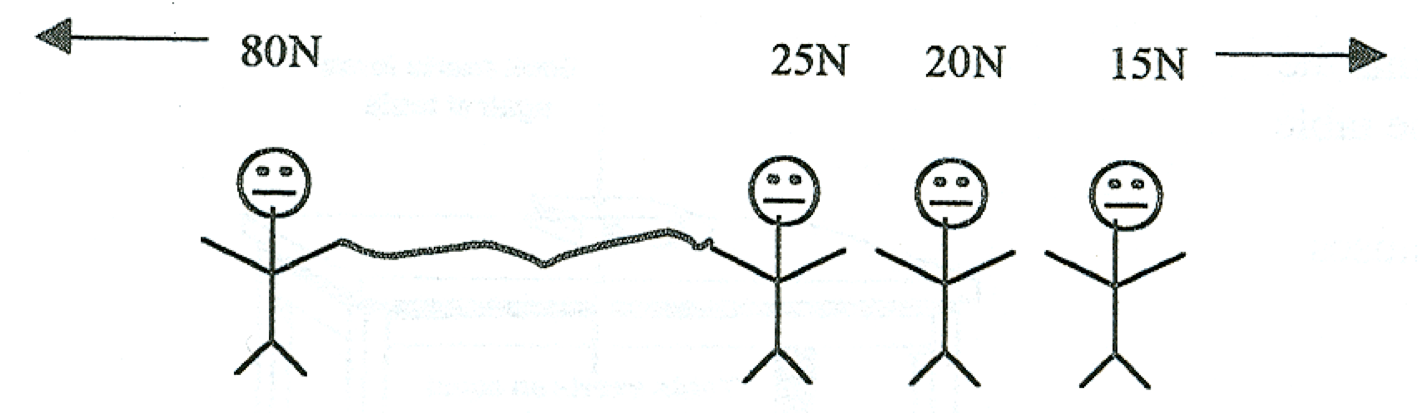
Who wins the tug of war with what net force?
a)
The person on the left with 20 N
b)
The person on the left with 80 N
c)
The people on the right with 20 N
d)
The people on the right with 100 N
41.

What is the unit to MEASURE force?

a)

Kilogram

b)

Meter

c)

Pounds

d)

Newton

42.

A ____________ is a push or a pull on an object.

a)

friction

b)

force

c)

magnet

d)

gravity

43.
The sum of all forces acting on an object.
a)
Contact Force
b)
Balanced Force
c)
Unbalanced Force
d)
Net Force
44.
What is the net force?
a)
20 N 
b)
0 N 
c)
400 N 
d)
40 N 
45.
What is the net force?
a)
10 N
b)
0 N
c)
25 N
d)
1 N
46.
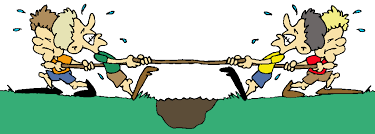
If these teams are pulling with the same amount of force what will happen?
a)
The boy in blue will win.
b)
They will not move at all.
c)
The boy in red will win.
d)
Both will fall down.
47.
Balanced or unbalanced?
a)
balanced
b)
unbalanced
48.
What will cause an object to move?
a)
Applied forces
b)
Balanced forces
c)
Unbalanced forces
49.
What force holds the planets in motion around the sun?
a)
Magnetic
b)
Electrical
c)
Gravitational
d)
Air Resistance
50.

The gravitational attraction between two objects would increase if both masses are –

a)

increased, and the distance between them is increased.

b)

increased, and the distance between them is decreased.

c)

decreased, and the distance between them is decreased.

d)

decreased, and the distance between them is increased.

51.

Why do planets orbit the Sun?

a)

The Sun is the only celestial object that has a gravitational pull.

b)

The Sun’s chemical composition makes it attract planets.

c)

Only celestial bodies that emit light, like the Sun, can be at the center of an orbit.

d)

The Sun is the most massive object in our solar system, so it exerts the greatest gravitational pull.
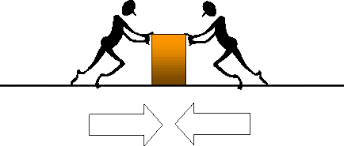
52.
Any object with mass has gravity.
a)
True
b)
Sometimes
c)
False
d)
Never
53.
As distance between two objects increase the pull of gravity 
a)
Increases
b)
Decreases
c)
Stays the same
54.
A person would weigh less on on the Moon than on the Earth because . . .
a)
Moon has more mass, and therefore more gravity
b)
Moon has less mass, and therefore more gravity
c)
Moon has more mass, and therefore less gravity
d)
Moon has less mass and therefore less gravity
55.
What is a PUSH or PULL of an object?
a)
Motion
b)
Force
c)
Friction
d)
Gravity
56.
If an object is stationary (not moving) the forces acting upon it are _____________
a)
unbalanced
b)
weak
c)
balanced
d)
Hulk Smash!
57.
Which one is balanced?
a)
top
b)
bottom
c)
both
d)
neither
58.

The more mass an object has, the _______ force it takes to accelerate it.

a)

more

b)

less

59.
The amount of matter in an object is 
a)
pressure
b)
weight
c)
mass
d)
force
60.

What statement is true?

a)

Mass never changes. Weight does.

b)

Weight never changes. Mass does.

c)

Both mass and weight change because they are affected by gravity.

d)

Neither mass nor weight change. They are always the same.

61.
The mass of an object ___________ as it moves away from the center of Earth
a)
stays the same
b)
decreases
c)
increases
d)
doubles
62.

Weight is the measure of the force of ______ on an object.

a)

Density

b)

Mass

c)

Matter

d)

Gravity

e)

Velocity

63.

6) Which measurement would be different if you were on the Moon versus on Earth?

a)

Mass

b)

Weight

64.

Find the weight of a 20g object

a)

~200N

b)

~20g

c)

~0.2N

d)

~0.02kg

65.

Define Weight

a)

pull of gravity on an object

b)

amount of matter in an object

c)

Force that pull pair of gravity together

d)

ability to do work

66.

Your weight on the earth's surface is 600 N, so your weight on the moon's surface ........ N

a)

6

b)

60

c)

100

d)

10

67.

The mass of a body on the moon's surface is 10 kg , so its mass on the earth's surface .......

a)

10N

b)

10Kg

c)

60kg

d)

60N