wayground logo

Free Printable Worksheets

NEW

Font size

S
M
L
XL
Worksheets

Classifying Matter

Total questions: 70

Worksheet time: 57mins

Name
Class
Date
1.
(Target M2) Matter is defined as anything that
a)
has a definite volume
b)
can be weighed on a balance C.  has a fixed volume and weight D.  has mass and takes up space
c)
has a fixed volume and weight
d)
has mass and takes up space
2.
(Target M2, M3) Compounds and solutions are different because 
a)
A.  only compounds are a form of matter.
b)
compounds are pure substances while solutions are not.
c)
A.  a compound can be physically separated.
d)
A.  only compounds have uniform composition.
3.
(Target M2) Complete the statement correctly. Seawater is classified as a
a)
mixture because its composition is not consistent from sample to sample.
b)
mixture because it has two elements combined together in a compound.
c)
pure substance because it has two elements combined together in a compound.
d)
pure substance because its composition is not consistent from sample to sample.
4.
(Target M2, M3)  __________ is a  __________ 
a)
bronze, heterogeneous mixture
b)
skim milk, homogeneous mixture
c)
beach sand, homogeneous mixture
d)
air, pure substance
5.
(Target M4)  Several chemistry students must separate a mixture of salt and water.  Which of the following lab items should they use?   
a)
Graduated cylinder, porous barrier
b)
Hot plate, beaker, filter paper
c)
Beaker, test tubes, funnel
d)
Bunsen burner, evaporating dish and ring with stand
6.
(Target M5) The amount of substance present influences
a)
extensive properties
b)
intensive properties
c)
external properties
d)
chemical properties
7.
Combinations of 2 or more substances (elements and compounds) that are physically blended together. 
a)
Compound
b)
Mixture
c)
Element
d)
Substance
8.
A type of substance containing atoms of two or more elements chemically bonded together is a mixture.
a)
Ture
b)
False
9.
Pure oxygen (O) is an example of...
a)
an element
b)
a mixture
c)
a compound
10.
If a mixture has components you can see it is a...
a)
solution
b)
compound
c)
homogeneous mixture
d)
heterogeneous mixture
11.
Italian Salad Dressing
a)
heterogeneous mixture
b)
homogeneous mixture
12.
What is Kool-aid?
a)
element
b)
Heterogeneous Mixture
c)
Homogeneous Mixture
d)
Compound
13.
TRUE OR FALSE:
Every compound is a molecule but not every molecule is a compound.
a)
TRUE
b)
FALSE
14.
Are these molecules also compounds?
a)
YES
b)
NO
15.
Are these molecules also compounds?
a)
YES
b)
NO
16.

Granite

a)

Element

b)

Compound

c)

Homogeneous Mixture

d)

Heterogeneous Mixture

17.

Quartz

a)

Element

b)

Compound

c)

Homogeneous Mixture

d)

Heterogeneous Mixture

18.

Aluminum

a)

Element

b)

Compound

c)

Homogeneous Mixture

d)

Heterogeneous Mixture

19.

Water

a)

Element

b)

Compound

c)

Homogeneous Mixture

d)

Heterogeneous Mixture

20.

Brass

a)

Element

b)

Compound

c)

Homogeneous Mixture

d)

Heterogeneous Mixture

21.

Pickle Relish

a)

Element

b)

Compound

c)

Homogeneous Mixture

d)

Heterogeneous Mixture

22.

Gold

a)

Element

b)

Compound

c)

Homogeneous Mixture

d)

Heterogeneous Mixture

23.

Salt water

a)

Element

b)

Compound

c)

Homogeneous Mixture

d)

Heterogeneous Mixture

24.

Which statement identifies why oxygen is classified as a pure substance and air is classified as a mixture?

a)

Oxygen is more reactive than air.

b)

Oxygen has a higher density than air.

c)

Oxygen goes under a phase change, whereas air is always a gas.

d)

Oxygen contains only one substance, but air contains several substances.

25.

This image is a model of...

a)

an element

b)

a compound

c)

a homogenous mixture

d)

a heterogeneous mixture

26.

This picture is a model of...

a)

an element

b)

a compound

c)

a homogenious mixture

d)

a heterogeneous mixture.

27.

This picture is a model of a...

a)

element

b)

compound

c)

homogeneous mixture

d)

heterogeneous mixture

28.

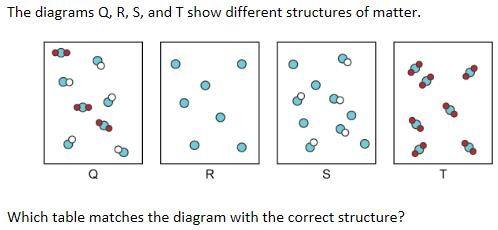
Which answer correctly matches the diagram with the correct description?

a)

Q- Multiple compounds R-A single element S-An element and a compound T- A single compound

b)

Q- A single element, R- An element and a compound S-A single compound T-Multiple compounds

c)

Q- A single compound, R- A single element, S- Multiple compounds, T- An element and a compound

d)

Q- An element and a compound, R- a single compound, S- a single element, T- multiple compounds

29.

What does this illustrate

a)

Elements

b)

Compunds

c)

Mixture of Elements and Compunds

d)

Mixture of Compounds

30.

What does this pic illustrate?

a)

Element

b)

Mixture of Compunds

c)

Mixture of elemets

d)

Compounds

31.
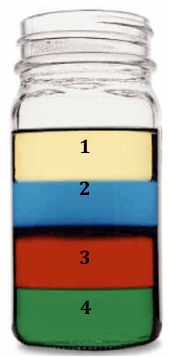
Put the liquids in order from most dense to least dense?
a)
4, 3, 2, 1
b)
1, 2, 3, 4
c)
3, 4, 2, 1, 
d)
4, 3, 1, 2
32.
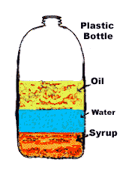
Which liquid is the least dense?
a)
oil
b)
water
c)
syrup 
d)
plastic bottle
33.
What is the formula for density?
a)
density = mass x volume
b)
density = mass / volume
c)
density = mass + volume
d)
density = mass - volume
34.
Frank has an eraser. It has a mass of 4g, and a volume of 2cm3. What is its density?
a)
8 g/cm3
b)
2 g/cm3
c)
1/2 g/cm3
d)
24 g/cm3
35.
Helium balloons rise on earth because
a)
helium is less dense than air
b)
helium is more dense than air
c)
helium is cooler than air
d)
helium is warmer than air
36.
I have two objects with the same volume but different masses.  Which object will be more dense?
a)
The object with less weight.
b)
The object with more weight.
c)
The object with more mass.
d)
The object with less mass.
37.
Which liquid has the highest density? 
a)
corn syrup
b)
lamp oil
c)
rubbing alcohol
d)
honey
38.
What is the volume of 150 grams of lead if it has a density of 11.3 g/cm3?
a)
13.3 g
b)
13.3 cm3
c)
.075 g
d)
1695 cm3
39.
An empty beaker has a mass of 60 grams.  When mercury is added to the beaker, it has a mass of 200 grams. What is the mass of the mercury?
a)
140 grams
b)
200 grams
c)
140 mL
d)
260 g
40.
Archimedes used density to discover if the crown of gold was real because
a)
Substances have their own unique densities
b)
Substances can change densities depending on their size
c)
Substances can change densities depending on their mass
d)
Substances can change densities depending on their volume
41.

Blue color

a)

Physical Property

b)

Chemical Property

42.

Density

a)

Physical Property

b)

Chemical Property

43.

Flammability

a)

Physical Property

b)

Chemical Property

44.

Solubility

a)

Physical Property

b)

Chemical Property

45.

Melting point

a)

Physical Property

b)

Chemical Property

46.

Reacts with water

a)

Physical Property

b)

Chemical Property

47.

Boiling point

a)

Physical Property

b)

Chemical Property

48.

Heat changes H2O to steam

a)

Physical Change

b)

Chemical Change

49.

Sugar dissolves in water

a)

Physical Change

b)

Chemical Change

50.

A piece of ice melts and reacts with sodium

a)

Physical Change

b)

Chemical Change

51.

Length

a)

Intensive Property

b)

Extensive Property

52.

Density

a)

Intensive Property

b)

Extensive Property

53.

Combustibility

a)

Intensive Property

b)

Extensive Property

54.

Melting point

a)

Intensive Property

b)

Extensive Property

55.

Color

a)

Intensive Property

b)

Extensive Property

56.

Volume

a)

Intensive Property

b)

Extensive Property

57.

Magnetic permeability

a)

Intensive

b)

Extensive

58.

Properties that DO depend on the amount of matter present.

a)

Mass

b)

Hardness

c)

Extensive

d)

Intensive

59.

Properties that depend on the identity of substance.

a)

Mass

b)

Hardness

c)

Extensive

d)

Intensive

60.
A student removes a loaf of bread hot from the oven. The student cuts a slice off the loaf and spreads butter on it. 
a)
Physical Change
b)
Chemical Change
61.
You forgot to dry the bread knife when you washed it and reddish brown spots appeared on it. 
a)
Physical Change
b)
Chemical Change
62.
You blow dry your wet hair. 
a)
Physical Change
b)
Chemical Change
63.
In baking biscuits and other quick breads, the baking powder reacts to release carbon dioxide bubbles. The carbon dioxide bubbles cause the dough to rise. 
a)
Physical Change
b)
Chemical Change
64.
You take out your best silver spoons and notice that they are very dull and have some black spots. 
a)
Physical Change
b)
Chemical Change
65.
grass grows on a lawn
a)
physical change
b)
chemical change
66.
tire inflated with air
a)
physical change
b)
chemical change
67.
water absorbed by a paper towel
a)
physical change
b)
chemical change
68.
ethyl alcohol boils at 79⁰C
a)
physical change
b)
chemical change
69.
clouds form in the sky
a)
physical change
b)
chemical change
70.
milk sours (goes bad)
a)
physical change
b)
chemical change