Wayground logo

Free Printable Worksheets

Font size

S
M
L
XL
Worksheets

Quarter 2 Review

Total questions: 58

Worksheet time: 2hrs 32mins

Name
Class
Date
1.

According to the pie chart, what uses the most water in a house?

a)

Shower

b)

Faucet

c)

Clothes Washer

d)

Toilet

2.

According to the pie chart, how much of a house's water usage is for showers?

a)

26.7%

b)

13.7%

c)

21.7%

d)

16.8%

3.
The x-axis shows
a)
time
b)
carbon dioxide concentration
c)
Mauna Loa volcano
d)
science
4.

Which of the following statements about hypotheses is true?

a)

Hypotheses can never be

changed.

b)

Hypotheses are always proven to be true.

c)

Hypotheses can be accepted or rejected

d)

Hypotheses can be proven true without evidence.

5.
Dilcia wants to know how drinking milk affects how tall a Monica grows. Which is the independent variable?
a)
Monica's growth
b)
drinking milk
6.
Ramone wants to know: does the distance a person kicks a soccer ball effect how well they will do on their math test.  What is the dependent variable?
a)
How far they kick the soccer ball
b)
who the person is
c)
how well they do on the math test
d)
Type of soccer ball.
7.
What would the INDEPENDENT variable be in an experiment testing which types of paper airplane goes furthest?
a)
the paper used
b)
the type of paper airplane
c)
the distance of each plane's flight
d)
how hard the plane is thrown
8.
An experiment is performed on plants to see how different liquids affect plant growth. Each plant in the experiment is given a different liquid; water, apple juice, or milk. Each plant has the same amount of soil, sunlight, and listens to the same music. In this investigation, the independent variable is ...
a)
The type of plant
b)
The amount of sunlight
c)
The type of music
d)
The type of liquid
9.

What type of investigation does this represent?

a)

model

b)

experimentation

c)

observation

d)

recording

10.

What should a scientist do if a hypothesis is NOT supported by data?

a)

Carry out further investigations.

b)

Stop investigating the question.

c)

Change the hypothesis to match the data

d)

Change the data to support the hypothesis

11.

The one factor that a scientist controls during an experiment. This goes on the x-axis.

a)

Independent Variable

b)

Dependent Variable

12.

The variable that is measured. It goes on the y-axis.

a)

Independent Variable

b)

Dependent Variable

13.
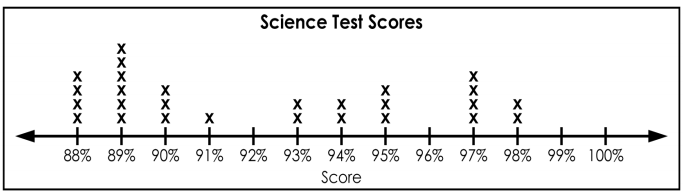
How many total students are in the science class?
a)
13
b)
6
c)
27
d)
25
14.
How many students scored between 95 and 100?
a)
6
b)
6
c)
9
d)
14
15.
This data set shows that
a)
there is more CO2 in the atmosphere now than ever before
b)
Hawaii will be most affected by global warming
c)
global temperatures are rising
d)
there is more CO2 in Hawaii than anywhere else
16.

When should a pie chart be used?

a)

When comparing parts of a whole

b)

When showing change over time

c)

When comparing data between different groups of categories

d)

Whenever you want

17.

When should a line graph be used?

a)

When comparing parts of a whole

b)

When showing change over time

c)

When comparing data between different groups of categories

d)

Whenever you want

18.

When should a bar graph be used?

a)

When comparing parts of a whole

b)

When showing change over time

c)

When comparing data between different groups of categories

d)

Whenever you want

19.
Which variable do "I" change intentionally?
a)
Independent variable
b)
Dependent variable
c)
Constant
d)
s
20.
Which variable may change and probably will change in the experiment, but "I" don't change it?
a)
Independent variable
b)
Dependent variable
c)
Constant
21.
Which of the following hypotheses is written correctly?
a)
Frozen tennis balls will not bounce as high.
b)
If I heat up a tennis ball it will bounce high.
c)
If I freeze a tennis ball, then it will not bounce as high.
d)
If a tennis ball is frozen, then it won't bounce as high as one that is not frozen.
22.
Sabrina wants to test which brand of popcorn pops the most kernels.  She picked a store brand, Orville Redenbacher, and PopSecret.  All three bags started with the same number of kernels.  She popped each for 3 minutes in the same microwave, and then counted the number of kernels left over.  What is her independent variable?
a)
Number of kernels left over
b)
Brand of popcorn
c)
number of kernels before popping
d)
length of time cooking
23.
What is the first step in competing the scientific method?
a)
project experimentation
b)
analysis
c)
conclusion
d)
research
24.

Students observe plant and animal cells under the microscope and use a Venn diagram to compare what they observe.

a)

Descriptive

b)

Comparative

c)

Experimental

25.
What are the three types of investigations?
a)
Procedure, Experiment, Results
b)
Descriptive, Comparative, Experimental
c)
Hypothesis, Variables, Experiment
d)
Research, Constants, Control
26.
Which type of investigation does not have a hypothesis?
a)
Descriptive
b)
Comparative
c)
Experimental
27.
Which type of investigation does not have a control group?
a)
Descriptive
b)
Comparative
c)
Experimental
28.
Which type of investigation has a control group?
a)
Descriptive
b)
Comparative
c)
Experimental
29.
In which type of investigation would you count the number of leaves on a plant?
a)
Descriptive
b)
Comparative
c)
Experimental
30.
In which type of investigation would you look for similarities between 2 different plants?
a)
Descriptive
b)
Comparative
c)
Experimental
31.
In which type of investigation would you compare the growth of pants given different amounts of fertilizer to a plant that was not given any fertilizer?
a)
Descriptive
b)
Comparative
c)
Experimental
32.
Students measure and record the speed of
a rollie pollie bug.
a)
Descriptive
b)
Comparative
c)
Experimental
33.
Students see how bacteria grows when different types of antibiotics are added compared to bacteria grown without antibiotics.
a)
Descriptive
b)
Comparative
c)
Experimental
34.
Students identify the color of a variety of substances.
a)
Descriptive
b)
Comparative
c)
Experimental
35.
Students compare the amount of sugar in different foods.
a)
Descriptive
b)
Comparative
c)
Experimental
36.

The process to develop a model is as follows:

a)

Observation

b)

Hypothesis

c)

Patterns

d)

Develop a model and test for accuracy

37.
Steve wanted to see if the type of fertilizer made sunflowers grow larger. What is the independent variable 
a)
Type of fertilizer
b)
Size of sunflower
c)
type of sun flower
38.
Steve wanted to see if the type of fertilizer made sunflowers grow larger. What is the dependent variable 
a)
Type of fertilizer
b)
Size of sunflower
c)
Type of sunflower
39.
Molly investigated if the age of students caused them to be better drivers. What is the independent variable?
a)
Type of car
b)
Skill of driving
c)
Age of student
40.
Molly investigated if the age of students caused them to be better drivers. What is the dependent variable?
a)
Type of car
b)
Skill of driving
c)
Age of student
41.
Sam wanted to know if the color of the chair you sat in when taking a test affected your test grade. What is the independent variable.
a)
Color or chair
b)
Grade on test
c)
Age of students
42.

An experiment is performed on plants to see how different liquids affect plant growth. Each plant in the experiment is given a different liquid; water, apple juice, or milk. Each plant has the same amount of soil, sunlight, and listens to the same music. In this investigation, the control group is ...

a)

Water

b)

Apple Juice

c)

Milk

d)

None of these

43.

50 weightlifters are given vitamin supplements before they lift and 50 different weightlifters are given no supplements and change in muscle mass is recorded after 4 months. Which of the following would be standardized variables for this experiment? (Bubble all that are true)

a)

amount and type of food eaten during day

b)

% increase in muscle mass

c)

amount of supplement given

d)

type of exercise

e)

being given supplements or not

44.

The part of the experiment that does not contain the independent variable. Used for comparison.

a)

Control Group

b)

Experimental Group

c)

Results

d)

Data

45.

Look at the chart. What is the control group?

a)

Usual route

b)

alternate B

c)

alternate C

d)

time in minutes

46.

In this table, the distance is -

a)

constant

b)

variable

47.

How many people have two or less books in their desk?

a)

4

b)

5

c)

6

d)

7

48.
Question Image

Match the following

a)

A

1.

Title

b)

B

2.

Legend

c)

C

3.

Dependent variable

d)

D

4.

Independent Variable

49.
A scientific ____________ is a statement that describes what always happens under certain conditions in nature.
a)
law
b)
theory
c)
method
d)
variable
50.
A scientific ____________ is a broad explanation for events that is widely accepted as true.
a)
law
b)
theory
c)
observation
d)
method
51.
Laws tells us that it happens but doesn’t describe how or why.
a)
True
b)
False
52.
A possible explanation to a problem that has not yet been tested. 
a)
data
b)
theory
c)
hypothesis
d)
fact
53.

Force = mass x gravity

a)

Hypothesis

b)

Theory

c)

Law

54.

Humans will live on Mars after 50 years.

a)

Hypothesis

b)

Theory

c)

Law

55.
True or False.  Theories change because new technology improves our ability to observe the natural world.
a)
True
b)
False
56.
True or False.  Laws DO NOT change with new evidence.
a)
True
b)
False
57.
Another word for prediction or educated guess is: ________________
a)
hypothesis
b)
conclusion
c)
experiment
d)
data
58.

For every action, there is an equal and opposite reaction.

(hint: Newton)

a)

Hypothesis

b)

Theory

c)

Law