
 Worksheets
8.10AC
Total questions: 125
Worksheet time: 1hrs 21mins
Where do most hurricanes develop?
Near the Equator
Middle of the United States
Near the Poles
Antarctica
The name of the system that causes the winds to spin in a hurricane
The Circular Wind Phenomenon
The Coriolis Effect
The Corleone Affect
The East-West Effect

The circulation of warm and cold matter is called...
Convection
Wind
Evaporates
Rises
Which of the following factors contributes most to formation of hurricanes?
gravitational pull of the moon and sun
toxic chemicals in the atmosphere by industry
Glaciers melting in polar regions
solar radiation heating the oceans by equator
The pressure inside of a hurricane is ______,
High
Low
Why are regions that receive more solar energy more likely to develop hurricanes?
Plants are more likely to thrive in those regions.
Those regions have more water evaporation.
Regions that receive more solar energy are typically drier.
Those regions are always located at high elevations.
Which condition is critical for the formation of a hurricane?
lower latitudes between 8 and 20 degrees of the equator
80 degrees or warmer water
low pressure
All of the above

Hurricanes are a very strong type of __________.
tornado
blizzard
tropical storm
tsunami

Which location will have the largest difference between the daytime high temperature and night time low temperature?
A
B
C
D
Which location will have the least change in temperature from day to night?
A
B
C
D


A
B
C
D

An illustration of how a convection current creates a wind, called a land breeze, is provided.Which of the following best explains what creates this convection current?
The rotation of Earth makes the air above it rotate, but not the same over land and water.
Because of its mass, Earth’s gravity creates a high pressure area over both the land and water.
Salt in the ocean makes it more dense than the land, so its gravity pulls more on the air above it.
During the evening, the land cools off more quickly than the water, so the air is different temperatures.


An illustration of how a convection current creates a wind, called a sea breeze, is provided. Which of the following best explains what creates this convection current?
Salt in the ocean makes it more dense than the land, so its gravity pulls more on the air above it.
During the day, the Sun’s energy heats up the land faster, which makes the air above it warmer.
The rotation of Earth makes the air above it rotate, but not the same over land and water.
During the day, Earth’s gravity creates a high pressure area over both the land and water.

Which of the following correctly shows the direction of convection currents in water?
A
B
C
D
Where do most hurricanes develop?
Near the Equator
Middle of the United States
Near the Poles
Antarctica
The name of the system that causes the winds to spin in a hurricane
The Circular Wind Phenomenon
The Coriolis Effect
The Corleone Affect
The East-West Effect
The circulation of warm and cold matter is called...
Convection
Wind
Evaporates
Rises
Which of the following factors contributes most to formation of hurricanes?
gravitational pull of the moon and sun
toxic chemicals in the atmosphere by industry
Glaciers melting in polar regions
solar radiation heating the oceans by equator

This is the calmest part of a hurricane.
eye wall
rain bands
eye
eye and rain bands
The pressure inside of a hurricane is ______,
High
Low

Which factors would make an hurricane die? Select two.
Entering colder waters
Entering warmer waters
lack of pressure
lack of fuel (warm/humid air)
One of the major ways oceans contribute to weather systems is that the oceans -
provide a diverse habitat for many organisms.
store and transport the Sun’s heat energy.
experience changes in amounts of dissolved salt.
reach depths that can be as much as 12,000 meters.
Most of the water vapor in the atmosphere comes from evaporation of water from oceans. Most of this evaporation occurs where there is the greatest solar radiation, which is -
along the coast of Europe.
around islands in the Pacific.
near the Equator.
at both of the poles.
Which of the following correctly identifies the major source for the energy that creates hurricanes?
Sun's radiation
Ocean currents
Moon's gravity
Earth's rotation
Which of the following is a major way in which oceans contribute to weather systems?
Ocean water has high salinity.
Oceans transfer energy from the Sun.
Most volcanic activity occurs in the ocean.
Oceans have high levels of biodiversity.
Why are regions that receive more solar energy more likely to develop hurricanes?
Plants are more likely to thrive in those regions.
Those regions have more water evaporation.
Regions that receive more solar energy are typically drier.
Those regions are always located at high elevations.
Which condition is critical for the formation of a hurricane?
lower latitudes between 8 and 20 degrees of the equator
80 degrees or warmer water
low pressure
All of the above

What destroys a hurricane?
strong vertical winds
Cold water
Movement over land
All of the above
Select 2 other names for a hurricane.
typhoon
cyclone
blizzard
earthquake
Hurricanes are a very strong type of __________.
tornado
blizzard
tropical storm
tsunami

Which location has an ocean surface temperature that will make hurricanes more likely to form?
A
B
C
D

Which of the following statements are supported by the map of ocean currents?
The west coast of the United States recieves more rain because there is a cold ocean current next to it.
The west coast of the United States recieves less rain because there is a cold ocean current next to it.
The west coast of the United States recieves more tain because there is a warm current next to it.
The west coast of the United States recieves less rain because there is a warm current next to it.

Warm air rises above cooler air. This is an example of
conduction
condensation
radiation
convection

Hot particles
are more dense and rise
are less dense and sink
are less dense and rise
are more dense and rise
Cold air is more dense and sinks.
True
False
________ is the movement of wind and water to the right and left that is caused by Earth's rotation.
El Nino
Coriolis effect
La Nina
None of the above
What are the ingredients necessary for the formation of a hurricane?
warm waters
moist air
rain
light upper winds
Warm water is ___ dense and ___
more
less
sinks
rises
Cold air is ___ dense and ___.
more
less
sinks
rises
The process of water vapors turning back into liquid water is ____.
radiation
condensation
convection
conduction

Air moves in circular patterns called _______ cells.
convection
prison
solar
What are the 2 conditions for hurricanes to form?
cold water and low pressure
warm water and low pressure
warm air and high pressure
cold air and high pressure
Decreasing temperatures mean...
The temperature outside is getting hotter.
The temperature outside is staying the same
The temperature outside is getting cooler
The temperature outside is neutral
What is an explanation for consistent temperatures of the Earth?
Wind and ocean currents help distribute the sun's energy.
Rotation causes even distribution.
The different season's distribute the temperatures evenly.
Winds moving from West to East distribute temperatures evenly.
Which area of the world do most hurricanes form?
The North Pole
The Equator
The South Pole
The Tropic of Cancer
What conditions will decrease the strength of a hurricane?
High pressure
Land
Cold water
All of the above
High pressure systems have what type of weather?
Cloudy skies
Rainy
Clear and Sunny skies
thunderstorms
Low pressure systems typically have what type of weather?
Clear and sunny skies.
Cloudy with a chance of meatballs.
Cloudy rainy skies with very humid air.
low humidity.
More dense air, sunny clear skies and clockwise direction
Low Pressure
Warm Front
High Pressure
Cold Front
Less dense air, cloudy rainy skies, counter-clockwise direction
Low pressure
Warm Front
High Pressure
Cold Front
The weight of the atmosphere.
Air Pressure
Tire Pressure
Under Pressure
Wind Pressure
Ocean currents affect weather patterns by -
regulating when tides occur in coastal areas
trapping heat at the equator to regulate the global climate
distributing heat from the uneven absorption of solar energy
increasing the rate of evaporation to transport water to areas experiencing droughts
Winds in our atmosphere are created as a result of which of the following processes?
Energy that is absorbed in the atmosphere
Gravitational attraction from the Moon
Density of the air particles in the atmosphere
Uneven heating of the air in the atmosphere

The Jet Stream is a global pattern of atmospheric movement that influences patterns in local weather. Based on the information provided in the weather map, which city shown will likely see a drop in temperature in the near future?
Albany
Bismarck
Nashville
San Diego
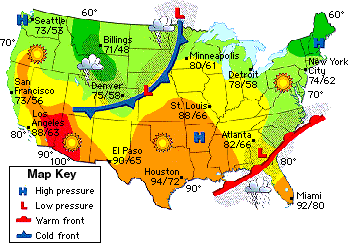

Why would St. Louis have the possibility of having thunderstorms in the next 24 hours?
It is in a high-pressure area
A cold front and low pressure are approaching
It is not located near an ocean
It recently experienced a warm front
Convection is the type of heat transfer that occurs in which of the following?
Empty space
Liquids and gases
Objects in contact
Solid materials
Winds in the Northern Hemisphere shift in a clockwise direction. What causes this change in direction?
The magnetic field of Earth
The rotation of Earth
The gravitational pull of the Moon
The heat generated by the Sun’s energ
The energy that generates wind comes from what source?
Solar radiation
Magnetic attraction
Moon’s gravity
Coriolis effect

Salt in the ocean makes it more dense than the land, so its gravity pulls more on the air above it.
During the day, the Sun’s energy heats up the land faster, which makes the air above it warmer.
The rotation of Earth makes the air above it rotate, but not the same over land and water.
During the day, Earth’s gravity creates a high pressure area over both the land and water.

Most people visit the shore during the day and are not there at night.
The air above the land heats up and cools off more quickly than the air over the water.
The seawater is capable of having salt dissolved in it, but the land cannot.
The shape of the land is constantly being changed by the motion of the seawater.

Amarillo
Detroit
Orlando
Reno

Albany
Bismarck
Nashville
San Diego

Based on the information provided in the weather map, which city shown most recently saw a rise in air pressure?
Baltimore
Jacksonville
Portland
Rapid City
Hurricanes experienced in Texas are the result of the heat energy absorbed and the water evaporated from -
natural springs in Texas.
oceans in the tropics or equator
large lakes in South America.
reservoirs heated by industry.
Which of the following factors contributes most to theformation of hurricanes?
Glaciers melting in the polar regions of the earth
Solar radiation being absorbed by oceans on the Equator
Toxic chemicals added to the atmosphere by industry
The gravitational pull of the moon and the Sun


What is the source of the thermal energy that heats our planet’s atmosphere?
Earth's core
Green plants
The Sun
Fossil Fuels
The Sun warms the atmosphere and drives convection currents because -
warm air is less dense, so it rises.
the warmed air cools and makes rain.
the cooler land pushes away warm air.
warm air, in contact with cool air, rotates.
Winds in our atmosphere are created as a result of which of the following processes?
Energy that is absorbed in the atmosphere
Gravitational attraction from the Moon
Density of the air particles in the atmosphere
Uneven heating of the air in the atmosphere
The major patterns of movement of air and water on Earth are the result of –
different densities of seawater and fresh water.
diversity in the height of coastal landforms.
uneven heating and the rotation of Earth.
irregular durations of daytime and nighttime.
What is one effect of the uneven heating of Earth caused by the Sun?
Rotation of Earth
Generation of wind
Oceans losing salt
Plants failing to grow
Which of the following changes would remove the source of energy that generates the convection which makes wind here on Earth?
Growing more vegetation in barren areas.
Removing all the salt from sea water.
Blocking all solar radiation.
Reversing the rotation of Earth.
Winds in our atmosphere are created as a result of which of the following processes?
Energy that is absorbed in the atmosphere
Gravitational attraction from the Moon
Density of the air particles in the atmosphere
Uneven heating of the air in the atmosphere
Michael and Isabella are working together on an assignment. They must search some illustrations to find an example of heat transfer by convection. Which illustration best represents convection?
An illustration of heat being transferred by wind
An illustration of heat being transferred by objects in contact
An illustration of heat being transferred between rocks
An illustration of the Sun’s heat moving through empty space
An illustration of how a convection current creates a wind, called a land breeze, is provided.Which of the following best explains what creates this convection current?
The rotation of Earth makes the air above it rotate, but not the same over land and water.
Because of its mass, Earth’s gravity creates a high pressure area over both the land and water.
Salt in the ocean makes it more dense than the land, so its gravity pulls more on the air above it.
During the evening, the land cools off more quickly than the water, so the air is different temperatures.
The energy that generates wind comes from what source?
The energy that generates wind comes from what source?
Solar radiation
Electromagnetic waves
Severe thunderstorms
Convection is the type of heat transfer that occurs in which of the following?
Empty space
Solid materials
Liquids and gases
Objects in contact
Winds in the Northern Hemisphere shift in a clockwise direction. What causes this change in direction?
The magnetic field of Earth
The gravitational pull of the Moon
The rotation of Earth
The heat generated by the Sun’s energy
The energy that generates wind comes from what source?
Solar radiation
Magnetic attraction
Moon's gravity
Coriolis effect
An illustration of how a convection current creates a wind, called a sea breeze, is provided. Which of the following best explains what creates this convection current?
Salt in the ocean makes it more dense than the land, so its gravity pulls more on the air above it.
During the day, the Sun’s energy heats up the land faster, which makes the air above it warmer.
The rotation of Earth makes the air above it rotate, but not the same over land and water.
During the day, Earth’s gravity creates a high pressure area over both the land and water.

The illustrations show the usual wind pattern at the shore during the day and night.What is the most important factor that creates these wind patterns?
Most people visit the shore during the day and are not there at night.
The air above the land heats up and cools off more quickly than the air over the water.
The seawater is capable of having salt dissolved in it, but the land cannot.
The shape of the land is constantly being changed by the motion of the seawater.
What fuels a hurricane's strength?
Wind
Warm Water
Sunlight
Cold Water
The pressure inside of a hurricane is ______,
High
Low
Where do most hurricanes develop?
Near the Equator
Middle of the United States
Near the Poles
Antarctica
The name of the system that causes the winds to spin in a hurricane
The Circular Wind Phenomenon
The Coriolis Effect
The Corleone Affect
The East-West Effect
The sea water that starts a hurricane gets warm from __________.
Volcanoes
Lightning
The Sun
The Moon
Select two other names for a hurricane.
Thunderstorm
Typhoon
Cyclone
Earthquake
What are two of the five factors hurricanes need to form?
Warm water (above 80 degrees)
Near the Poles
High Pressure
Low Pressure
Most of the water vapor in the atmosphere comes from evaporation of water from oceans. Most of this evaporation occurs where there is the greatest solar radiation, which is -
along the coast of Europe.
around islands in the Pacific.
near the Equator.
at both of the poles.
The circulation of warm and cold matter is called...
Convection
Wind
Evaporates
Rises
Which of the following factors contributes most to formation of hurricanes?
gravitational pull of the moon and sun
toxic chemicals in the atmosphere by industry
Glaciers melting in polar regions
solar radiation heating the oceans by equator
Where does the Storm Start?
Over Cold Water
Over Antarctica
Over Warm Water
Overseas
Hurricanes are the result of heat energy and water evaporated from which of the following.
natural springs in Texas
reservoirs heated by industry
oceans in tropics
large lake in Africa
This phenomenon that forces winds to spin.
Rain bands
Eye
Eye Wall
Coriolis effect
The reason some states far north such as Washington have mild(calm) winters is because..
heavily populated state
located near the ocean
has mountains
receives more solar energy

