
 Worksheets
DMS Cells Cumulative
Total questions: 60
Worksheet time: 40mins
Which phrase best describes the function of mitochondria?
Located in the cytoplasm
Bacteria-sized organelle
Converts energy for cell use
Contains a folded inner membrane
Which cell organelle stores DNA?
Cell wall
Cell membrane
Vacuole
Nucleus
The purpose of the cell wall is to-
regulate what goes into and out of a cell
control the functions of a cell
convert energy from food into energy for a cell
provide structure for a cell
Which of the following statements accurately represents the differences in plant and animal cells?
Only plant cells have a cell wall, chloroplasts, and a large vacuole.
Only animal cells have a cell wall, chloroplasts, and a large vacuole
Only plant cells have a cell membrane, mitochondria, and cytoplasm
Only animal cells have a cell membrane, mitochondria, and cytoplasm
A school’s cafeteria kitchen has a large, walk-in refrigerator where food is stored for lunch later in the week. Which cell organelle has a function that is similar to the refrigerator?
Vacuole
Nucleus
Chloroplast
Mitochondrion
What types of organisms have cells with very large vacuoles?
Animals
Bacteria
Fungi
Plant
What is the basic structural and functional unit of all living things?
atom
cell
bacteria
animalcules
What does it mean to say that a cell membrane is semipermeable/selectively permeable?
it allows some materials to pass through
it allows nothing to enter the cell, only to leave
It only allows things into the cell and not out
it allows all materials to pass through
What is the function of an organelle?
to take up space
to carry out a specific function in the cell
to carry out all the functions of a cell
to create new cells
What organelle do many ribosomes connect themselves to?
lysosome
mitochondria
endoplasmic reticulum(rough)
golgi apparatus
What is the function of the mitochondria?
to capture energy from the sun and turn it to sugar
to release usable energy for the cell
to store energy for when the cell needs it
to remove waste from the cell
What organelle allows plants to create their glucose?
Mitochondira
Lysosome
Ribosome
Chloroplast
What is the difference the key difference between prokaryotic and eukaryotic cells?
Prokaryotes have a nucleus, Eukaryotes do not
Eukaryotes have a nucleus, Prokaryotes do not
Prokaryotes have a cell membrane, Eukaryotes do not
Eukaryotes have ribosomes, Prokaryotes do not

What type of cell is this?
Plant
Animal
Prokaryote
Which of these is made up of prokaryotic cells?
Protista
Fungi
Plants
Bacteria
Animals
Nucleic acids such as DNA provide___________ for the cells so it functions properly.
energy storage
genetic information
structure and transport
quick energy

Which cell structure acts as a brain/control center for the cell?
Cell wall
Vacuole
Nucleus
Cytoplasm
Breaks down sugar molecules into energy
Nucleus
Cell membrane
Mitochondria
The goal of mitosis is to
make a new parent cell
make two new daughter cells with the same DNA
make two new daughter cells with different DNA
to grow a larger toe
How many chromosomes are in each human cell?
1
146
46
1,000,000
Why do our body cells undergo mitosis or cell division?
fun and games
checks and balances
growth and repair
to build bigger muscles
Plant cells make their own food by taking in
oxygen and water.
oxygen and hydrogen.
carbon dioxide and water.
carbon dioxide and oxygen.
endoplasmic reticulum
Which of these is a product of cellular respiration?
ATP
Carbon dioxide
Water
All of these are a product of cellular respiration

What are the reactants/requirements (taken into) of cellular respiration? (Mark all of them!)
oxygen
glucose
carbon dioxide
water
energy
Where do animals get the glucose that is needed for cellular respiration?
from the exercise they get
from the water they drink
from the food they eat
from the sunlight they get
What are the small openings on an underside of a leaf through which carbon dioxide and oxygen are exchanged? This is where gases can enter and leave the plant.
stem
stomata
chlorophyll
chloroplasts
In photosynthesis, what are the products (output, what is released or made)?
oxygen
water
glucose
carbon dioxide
Cellular Respiration involves the chemical breakdown of _____ to form ATP Energy
Fats
Fructose
Glucose
Proteins
Photosynthesis is ...
The process in which organisms convert/transfer energy from glucose to ATP.
The process in which organisms exchange carbon dioxide and oxygen in their lungs.
The process of taking a picture.
The process of plants converting/transferring solar energy to chemical energy to make their food.
Fermentation
Cell Transport
Photosynthesis
AERObic Cell respiration
ANAERObic Cell respiration
Glucose --> ATP + Alcohol or Lactic Acid + Carbon Dioxide
ANAEROBIC cell respiration /fermentation
AERObic Cell respiration
Photosynthesis
Cell Transport
During diffusion particles move from an area of ____ concentration to an area of _____ concentration.
high, low
low, high
What does equilibrium mean?
balance
imbalance
flexible
rigid
Osmosis is the diffusion of
water
cytoplasm
only oxygen
all particles
How do the particles move in diffusion?
From a region of low concentration to a region of high concentration
From a region of high concentration to a region of low concentration
From a region of low concentration to a region of low concentration
From a region of high concentration to a region of high concentration
What does a 'region with high concentration' mean?
An area with a SMALL number of particles
An area with a LARGE number of particles
An area with an UNEVEN number of particles
An area with no particles
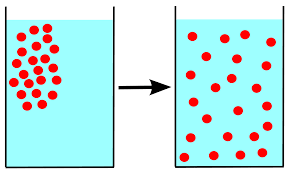


Assume the particles shown here are water molecules. Which way will the water molecules move during osmosis?
Out of the cell, so the cell shrinks.
Out of the cell, so the cell swells.
Into the cell, so the cell shrinks.
Into the cell, so the cell swells.
Particle of movement from an area of lower concentration to an area of higher concentration that requires energy.
Active transport
Passive transport
Which of the following is true?
External respiration involves oxygen moving into our bodies so that our cells can use it.
External respiration involves oxygen being used by cells to make ATP.
Internal respiration involves oxygen moving from the lungs into the blood.
External respiration and internal respiration are the same thing.
Materials can move in or out of cells using more than one process. Which process or processes move particles DOWN the concentration gradient?
osmosis only
diffusion only
active transport
osmosis and diffusion
Why is it necessary for cells to have enough water in their cytoplasm?
to keep the cells plump
many of the chemical reactions in cells require water to be present
so that the cells don't shrink
so there can be something in the vacuoles
When would it be UNLIKELY that your muscle cells would perform the process of anaerobic respiration or fermentation? Check all that are correct.
when you are asleep at night
while sitting in class
at a hard core football practice
while eating lunch
For animals, cellular respiration produces water waste. How is this released? Check all that are correct.
through urine
through tears
through sweating
as you exhale
A typical human body cell, when place in 100 percent pure water...
would probably not change at all because water is at equilibrium
would probably swell because it would take in water
would probably shrink because it would lose water
would probably swell because it would lose water
Fermentation and cellular respiration produces equal amounts of ATP.
True
False
Why can't you make your own glucose?
you don't have mitochondria in your cells
you don't have golgi bodies in your cells
you don't have chloroplasts in your cells
you don't have ribosomes in your cells
Chains of amino acids form proteins. Which of the following would give the INSTRUCTIONS for the ORDER in which to chain these amino acids so that the correct proteins are made for proper cell function?
the nucleolus
the ER
the ribosomes
DNA in the nucleus
Glucose is another name energy.
True
False
Which organelle must chain amino acids correctly, with instructions from DNA, so that the correct proteins are made?
ribosomes
golgi bodies
ER
mitochondria
When water, carbon dioxide, and oxygen enter and leave cells by osmosis and diffusion, these materials must move through....
carrier proteins
protein channels
pores in the cell membrane
vesicles
Mitosis is just the division of a cell's nucleus, while the cell cycle is the division of one cell into two seperate identical cells.
True
False

