
NEW
Font size
 Worksheets
Ecology Review
Total questions: 50
Worksheet time: 49mins

90% of the energy that gets lost as you move up a food pyramid or chain gets lost as
pollution to the environment
heat to the environment
energy for decomposers
gets recycled
What percentage of energy is passed on to the next trophic level?
5%
10%
50%
90%
In some environments, wolves prey on deer for their source of food. If all of the wolves were taken from the environment, what would most likely happen to the deer population?
A The deer population would increase and begin to compete for food.
B The deer population would become larger and healthier animals.
C The deer population would decrease, because there would be an increase in disease.
D The deer population would change color, because they would not have to hide from wolves.
High biodiversity is a sign of a healthy ecosystem.
True
False
When brown tree snakes were accidentally introduced onto the island of Guam, they had no natural predators. These snakes sought out and ate many eggs of insect-eating birds. What probably occurred following the introduction of the brown tree snakes?
The insect population began to seek a new food source.
The bird population increased.
The bird population began to seek a new food source.
The insect population increased
The living parts of an ecosystem
Biotic factors
Abiotic factors
Mother Earth
Flowers
What is a producer?
an organism that gets energy from eating other organisms
an organism that uses sunlight or chemical energy to make its own food
an organism that gets energy from eating dead organisms, non-living material or waste
An organism that gets energy from eating other organisms is a ______________.
producer
consumer
decomposer
prey
A tree is an example of a ....
composer
decomposer
producer
omnivore


Which member of the food web gets all of its energy from producers?
Foxes
Owls
Birds
Rabbits

Which organism consumes the snake?
frog
green plants
hawk
rabbit

The original source of energy for a food web is...
plants
sun
producers
decomposers
3. How do decomposers help other organism in an ecosystem?
They help disperse seeds for plant growth.
They shows how energy is transferred from one living organism to another via food.
Decomposers do not help other organisms in an ecosystem.
They break down dead organisms and add nutrients back to the soil that plants use.
4. What kind of organisms that eat a variety of meat, fruits and vegetable?
carnivores
herbivores
omnivores
producers
Both species benefit
symbiosis
parasitism
mutualism
commensalism
One species benefits, the other species is harmed
symbiosis
parasitism
mutualism
commensalism
Clownfish live inside sea anemones. They eat creatures that harm anemones, while anemones protect clownfish from predators. This is an example of:
Mutualism
Commensalism
Parasitism
Amensalism
What would be a good example of a primary consumer?
carnivore
detrivore
decomposer
herbivore
In which type of symbiotic relationship does one species benefit while the other species is unaffected?
Commensalism
Parasitism
Mutualism
Predation
A certain species of bird follows cows through a pasture and eats insects that cows stir up. The cows are not affected. Which type of symbiotic relationship is described?
Commensalism
Parasitism
Mutualism
Predation
A shrimp is warned of danger by a fish and the fish gets a home dug by the shrimp. Which type of symbiotic relationship is this?
Commensalism
Parasitism
Mutualism
Predation

This graph shows a _______________- curve
dispersion growth
density dependent growth
exponential growth
logistic growth

What is the name for the maximum amount of rabbits shown in the graph?
S-curve
climax point
carrying capacity
density dependent limit

During which month were the rabbits in exponential growth?
May
June
August
September

What type of population growth is shown in the graph?
carrying capacity growth
density-dependent growth
exponential growth
logistic growth
The first species to take hold in a barren area after a disaster has occurred is called a
climax community
parasite
pioneer species
carnivore
Primary succession occurs in an area that has:
Has Soil
Has No Soil
Has Some Soil
none of these
What is the term that describes a steady and stable community?
peak community
turf community
climax community
disturbed community
Which is faster: Primary or Secondary Succession?
Primary Succession
Secondary Succession
Both Take The Same Amount of Time
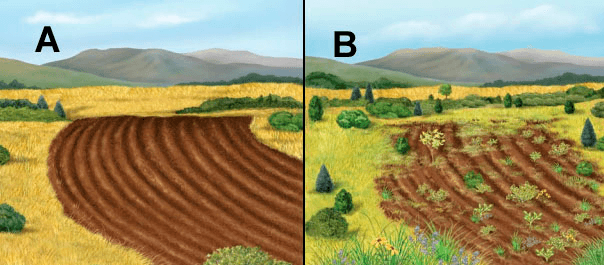
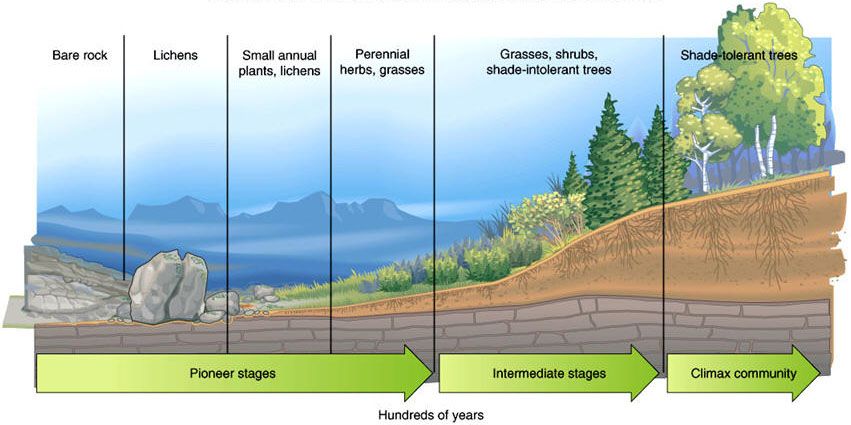


What cycle are fossil fuels part of ?
carbon
oxygen
nitrogen
phosphorus
Nitrogen fixation is the process in which certain bacteria convert nitrogen gas into
liquid nitrogen
nitrates
nitrites
ammonia and then Nitrates

According to the diagram, geologic activity, such as volcanoes,
Increases the levels of CO2 in the atmosphere.
Decreases the levels of CO2 in the atmosphere.

In evaporation, water _______
turns from a liquid state to vapor (gas)
falls from the sky like rain or snow
forms clouds
gets locked into ice
The only ways to fix atmospheric nitrogen into useable chemical compounds are what?
virus
bacteria and lightening
carbon
none of these
This is a process where water vapor cools and turns into liquid droplets
Evaporation
Precipitation
Transpiration
Condensation
This process in the nitrogen cycle refers to converting nitrates into nitrogen gas.
Nitrogen Fixation
Nitrification
Ammonification
Denitrification
This is a process in the nitrogen cycle in which bacteria convert the nitrogen gas to ammonia
Nitrogen Fixation
Nitrification
Ammonification
Denitrification
One organism hunts and eats another organism.
predation
mutualism
carnivore
parasitism
The way that an organism interacts with the living and nonliving parts of its environment is called ..............................
an ecosystem
a population
a niche
a Community
The organism being eaten is the ...............
Community
population
prey
predator

