
 Worksheets
Year 10 Bio Revision
Total questions: 70
Worksheet time: 42mins

The picture below shows an enzyme unwinding and unzipping DNA.
What is the name of this enzyme?
DNA Helicase
DNA Ligase
DNA polyermase
RNA Polymerase
Which of the following DNA nucleotides are paired with the correct corresponding DNA nucleotide? (mark all that apply)
Adenine with Thymine
Guanine with Cytosine
Thymine with Cytosine
Adenine with Uracil.
Uracil with Thymine
Which is the role of DNA polymerase?
Unwinds the original DNA strand
Lays down RNA primer for new nucleotide bases.
Builds new strands by bringing in new nucleotide bases.
Remove Okazaki fragments for new nucleotides.
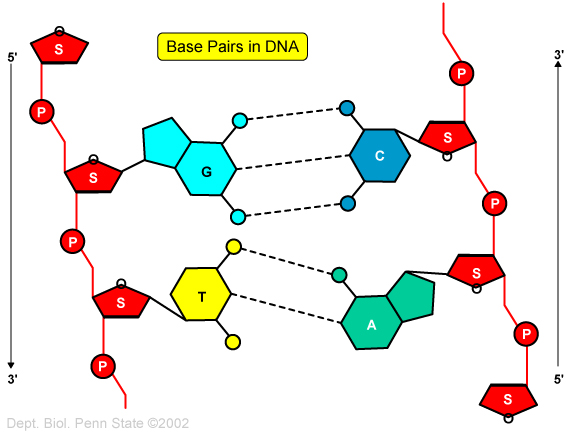

What makes up the SIDES of a DNA ladder?
nitrogen bases
sugars & phosphates
genes & chromosomes
RNA

If one strand of a DNA molecule has the following order of bases, what will be the correct order of bases on the complementary (matching) strand?
AATTGGCC
AATTGGCC
TTAACCGG
GGCCAATT
GACTGACT
Choose the correct complementary nucleotide sequence for the following:
AAA - GTA - CCC
CCC - TGA - AAA
AAA - CAG - GGG
TTT - CAT - GGG
GGG - TGA - CCC
Choose the correct complementary nucleotide sequence for the following:
CCC - ACT - GGG
CCC - TGA - AAA
AAA - CAG - GGG
TTT - CAT - GGG
GGG - TGA - CCC


Crossing over occurs in meiosis, select the correct answer. Crossing over....
increases genetic variation
takes place in prophase I
where genetic materials changes within homologous pairs
all are correct
Which part of meiosis produces diversity in gametes?
DNA replication
Prophase
Crossing-over
Cytokinesis
Involved in growth and repair
mitosis
meiosis

The process on the right is:
Right: meiosis
Right: cloning
Right: meiosis
Right: mitosis
Why are insertion and deletion (frameshift) mutations so harmful?
They change all of the codons from the mutation on down the line, which changes the amino acid sequence
They insert things that an organism doesn't need.
They often delete things that organisms need.
Insertion and deletions are not any more harmful than substitution mutations.
The mutated DNA segment is TTCGCAAG. This is an example of ___ mutation.
GAG-CTC-GAC-AGA
Mutant
GAG CTC-CAC-AGA
Point mutation is the chance of a SINGLE nucleotide
True
False
Inserting or deleting
one or more
nucleotides indicated what type of mutation
Chromosome
Point
Frameshift
None of these
a photograph or picture of chromosomes grouped in ordered pairs is a ______________
pedigree
Punnett Square
Venn Diagram
Karyotype


A person with Turner syndrome has only one X chromosome. What would you call this?
Trisomy X
Monosomy X
Trisomy 21
Monosomy 15

Identify the chromosomal disorder
Monosomy
Trisomy 18 (Edwards syndrome)
A missing sex chromosome
Trisomy 21 (down syndrome)
In pea plants, round seeds (R) are dominant to wrinkled seeds (r). Which of the following represents the genotype of a pea plant that is heterozygous?
RR
round
Rr
wrinkled
rr
In pea plants, round seeds (R) are dominant to wrinkled seeds (r). Which of the following represents the genotype of a pea plant that is homozygous dominant?
RR
round
Rr
wrinkled
rr

In mice, black fur (B) is dominant to white fur (b). According to the Punnett square shown, the offspring in box 4 would:
be white.
be heterozygous.
be gray.
be homozygous.
In mice, black fur (B) is dominant to white fur (b). According to the Punnett square shown, how many offspring would be black?
0
1
2
3
4
In humans, having freckles (F) is dominant to not having freckles (f).
Two people with freckles get married and give birth to three children. Two of the kids have freckles and one does not.
Both parents must have which genotype?
FF
Ff
ff

For haemophilia, let H be the normal allele and h the mutant allele.
Which is the genotype of the unaffected male?
XhY
XHXH
XHXh
XHY
Color blindness is carried by the X chromosome.
A mother is a carrier of color blindness. Her husband has normal vision.
The probability of having a color blind offspring is (a) percent.

A student performed a gel electrophoresis experiment. The results are represented in the diagram
below. Compared to the fragments at the top of the gel, the fragments at the lower end are
larger, and move slower
larger, and move faster
smaller, and move faster
smaller, and move slower


This is a recessive disease pedigree. What is the genotype of the male in generation I?
Rr
RR
R?
rr

This pedigree shows affected people with the recessive trait. What is the genotype of someone with a shaded in shape?
AA
Aa
A?
aa
The combined genetic information of all members of a particular population forms a
phenotype
gene pool
population
niche
The variety of different types of genes in a species or population
Speciation
Genetic variation
Artificial selection
Evolution
Evolutionary change on a small scale
macroevolution
microevolution
coevolution
parallel evolution
Process by which unrelated organisms develop similarities due to living in similar environments
family descent
survival of the fittest
convergent evolution
divergent evolution
Process by which closely related organisms develop differences due to living in different environments
family descent
survival of the fittest
convergent evolution
divergent evolution
A virus killed most of the seals in the North Sea (e.g. dropped the population from 8000 to 800). In an effort to help preserve the species, scientists caught 20 of the remaining seals and used them to start a new population in the northwest Pacific Ocean. Which of the following statements would accurately describe the new population?
The new seal population is genetically less diverse than the original population
The new seal population is genetically more diverse than the original population
There is equal genetic variety compared to the original population
None of the answers
Happens only in small populations, and is the change in the frequency of a gene variant (allele) in a population due to random sampling of organisms.
Extinction
Genetic Drift
Gene flow
Mutations
This mechanism of evolution occurs when populations migrate.
Extinction
Gene flow
Genetic drift
Natural Selection
If a new trait DOES help an organism survive, what may happen to it?
It dies and its DNA is not passed on
It survives and its DNA is passed on
It changes its traits to adapt and survive
Which of the following is an example of natural selection?
Bald Eagles are hunted until near extinction, population recovers.
Small group of iguanas floats to an island, starts a new population.
Red fox pups are more likely to survive in a snowy environment if they are born white.
Farmer chooses seeds from largest apples to plant next year. This results in larger apples from year to year.
A random change in allele frequencies over generations brought about by chance.
genetic drift
gene flow
When allele frequencies change due to individuals leaving a population
genetic drift
gene flow
Phenotypic forms at both ends of the range are favoured and the intermediate forms are selected against.
directional selection
stabilizing selection
disruptive selection
Genetic drift is change in the allele frequency of a population due to...
random chance
natural selection
non-random mating (sexual selection)
artificial selection

Select the best answer based on the image
Gene flow
Genetic drift
Yellow toucan birds seek out one another to make babies together and tend to avoid the green toucan birds.
Nonrandom mating
gene flow
mutation
natural selection

