
 Worksheets
Climate Change
Total questions: 57
Worksheet time: 22mins

What is the period of Earth's eccentricity?
26,000 years
40,000 years
100,000 years
400,000 years

The type of plate boundary between South American Plate and Nazca plate is
convergent
divergent
uncertain/complex
The wobbling of Earth's axis as it orbits the Sun is called ___.
eccentricity
obliquity
precession

a valley formed by the separation of tectonic plates
deep ocean trench
rift valley
oceanic ridge

1. Which of the following is a natural cause of climate change?
Volcanoes
Pollution
Earthquakes
Nuclear waste

This is the type of boundary that occurs when tectonic plates move apart.
convergent
divergent
transform

2. The greenhouse effect is a natural phenomenon.
True
False

According to the data, what should be happening to Earth's climate?
Earth's climate should be cooling.
Earth's climate should be warming.
Earth's climate should not be changing.
What is the period of Earth's precession?
26,000 years
40,000 years
100,000 years
400,000 years

5. Which of the following is not a greenhouse gas?
Carbon dioxide
Nitrogen oxide
Methane
Ammonium nitrate

Which variable of the Milankovitch Cycles is animated here?
eccentricity
obliquity
precession

6. The Earth is currently in a period of natural warming.
True
False

7. Which of the following is not a cause of the increased greenhouse effect?
Deforestation
Fertilizers
Sea level rise
Fossil fuel burning

Which variable of the Milankovitch Cycles is animated here?
eccentricity
obliquity
precession
What is the period of Earth's obliquity?
26,000 years
40,000 years
100,000 years
400,000 years

9. Which of the following is not evidence of climate change?
Increase in livestock
Increase in global temperature
Extreme events
Shrinking of ice sheets
Changes in the shape of Earth’s orbit around the Sun are called ___.
eccentricity
obliquity
precession
If you decrease the axial tilt of the Earth, what will happen to the seasons?
milder summers and milder winters
hotter summers and colder winters
cold summer and cold winters
extreme summers and extreme winters
If you increase Earth's axial tilt (obliquity), what will happen to the seasons?
milder summers and milder winters
hotter summers and colder winters
cold summer and cold winters
extreme summers and extreme winters
How can we stop air pollution?
Choose TWO answers.
Buy a big car.
Use trains, bicycles and buses.
Use less energy.
Eat more hamburgers.
Which country releases the biggest quantity of carbon dioxide into the atmosphere?
China
the USA
Russia
Germany
Climate change can cause frequent rainfall.
True
False
The increase in burning of fossils fuels has led to an ____________ in carbon dioxide in the atmosphere.
increase
decrease

When Earth is farther from the Sun, like in position 1, it is in______.
aphelion
ellipses
perihelion
What is the difference between weather and climate?
They are the same.
Weather is day to day, while climate is observed over a long periods.
Climate is day to day, while weather is observed over a long period.
Weather changes, while climate does not.
Which variable of the Milankovitch Cycles is most responsible for the different seasons on Earth?
eccentricity (the shape of Earth's orbit)
obliquity (the tilt of Earth's axis)
precession (the wobble of Earth's axis)
An effect of climate change is stronger storms.
True
False
How do slight increases in the acidity (change in pH) of seawater impact ocean organisms with shells?
it strengthens their shells
has no observable effect on
it weakens their shells
it mutates their shells
The ocean can absorb CO2 from the atmosphere.
True
False
Which of the following has been linked to climate change?
Droughts
Intense Storms
Melting of Polar Ice Caps
All of these
will help polar bears move into southern areas
will make ocean currents warmer
The angle of Earth’s tilt as it orbits the Sun is called ___.
eccentricity
obliquity
precession

Climate change makes hurricanes stronger because
warm ocean water evaporates to form hurricanes.
the hot air moves more to form hurricanes.
there are more clouds.
the drought causes hurricanes
When Earth is closer to the Sun, like in position 2, it is in______.
aphelion
ellipses
perihelion

Which variable of the Milankovitch Cycles is animated here?
eccentricity
obliquity
precession

What is one effect of birds migrating North earlier in the spring?
Birds have more mosquitoes to eat.
Birds have more habitat.
Birds can die from lack of food
Plants have more diseases
How do stronger wildfires and droughts relate to climate change.
warmer temperatures mean hotter fires
more evaporation from the ground makes the soil drier
fires need carbon dioxide to burn
greenhouse gases reduce the amount of water vapor in the air

What is depicted in the photo?
oil rig
pylon
solar panel
power station

A group of compounds that are able to trap heat in the atmosphere, keeping the Earth's surface warmer than it would be if they were not present.
CO2 emissions
greenhouse gases
climate change

Global Warming is MAINLY caused by...
...the Sun
...the Greenhouse Effect.


enhanced-less heat escapes to space
enhanced-more heat escapes to space
The average, year-after-year conditions of temperature, precipitation, winds, and clouds in an area:
Tropical Zone
Climate
El Niño
La Niña
Dark, cooler regions on the surface of the sun that causes Earth's temperature to rise:
Ice Age
Monsoon
Sunspots
Leeward
A warm-water event that can change weather patterns causing heavy rains or droughts:
El Niño
La Niña
Sunspots
Global Warming
Chlorine compounds that are the main cause of the ozone hole:
Greenhouse Gas
CFCs
Global Warming
Monsoon
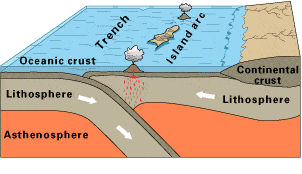
Observe this diagram of a plate boundary. One statement BEST describes what is happening. It is that
the denser ceanic crust is subducting under the less dense oceanic crust
volcanic islands are forming.
the tectonic plates are moving away from each other.

What is the correct order (starting from the surface) of Earth’s layers?
crust, outer core, inner core, mantle
mantle, outer core, inner core, crust
crust, mantle, outer core, inner core

This is when one plate goes under another
Transform
Subduction
Divergent

The Galapagos Hot Spot is located closest to what type of tectonic plate boundary?
Divergent
Convergent
Uncertain or Complex

