
Font size
 Worksheets
CHEMICAL ENERGETICS
Total questions: 95
Worksheet time: 2hrs 33mins
State whether 'melting of ice' is physical or chemical change?
physical
chemical
State whether 'burning of magnesium' is physical or chemical change?
physical
chemical
State whether 'evaporation of ethanol' is physical or chemical change?
physical
chemical
State whether 'dissolving of sugar in water' is physical or chemical change?
physical
chemical
State whether 'burning of magnesium' is exothermic or endothermic?
exothermic
endothermic
State whether 'condensation of steam to water' is exothermic or endothermic?
exothermic
endothermic
State whether 'addition of concentrated sulfuric acid to water' is exothermic or endothermic?
exothermic
endothermic
State whether 'evaporation of a volatile liquid' is exothermic or endothermic?
exothermic
endothermic
If the reaction is endothermic, _____________.
the temperature decreases
the temperature increases
energy is taken in
energy is given out
If the reaction is exothermic, _____________.
the temperature decreases
the temperature increases
energy is taken in
energy is given out
If ΔH < 0, __________________.
the reaction is exothermic
energy is given out
temperature increases
temperature decreases

What is A?
activation energy
enthalpy change
reactants
products
What is B?
activation energy
enthalpy change
reactants
products
What is D?
activation energy
enthalpy change
reactants
products
This reaction is __________.
endothermic
exothermic
Which of the following is true about the formation of bonds between molecules?
Energy is given off when bonds are formed between molecules.
Energy is absorbed by the molecule when bonds are formed.
Energy is neither given off nor absorbed when bonds are formed.
Which of the following statement is true about the breaking of bonds between molecules?
To break a bond between molecules, energy must be released by the molecule
To break a bond between molecules, no energy is needed.
To break a bond between molecules, energy must be absorbed by the molecule.


The energy level diagram for the reaction between magnesium and hydrochloric acid is shown.
Energy is given out during the reaction
The products are at a lower energy level than the reactants
The reaction is endothermic.
Which reaction is endothermic?
acid neutralising alkali causing a temperature increase
adding magnesium to hydrochloric acid
calcium carbonate decomposing when heated combustion of fossil fuels
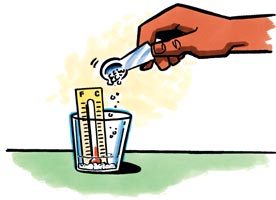

The initial temperature was measured to be 20oC and the final temperature was 10oC. The reaction was
exothermic
endothermic
The initial temperature was measured to be 20oC and the final temperature was 45oC. The reaction was
exothermic
endothermic

What type of reaction is this?
Exothermic
Endothermic
Energy Producing
No way to tell

The graph above is from which type of reaction?
Endothermic reaction
Exothermic reaction
Is the following equation balanced?
Al + O2 ---> 2Al2O3
YES
NO
What is the number before a chemical formula called?
Example: 2H2 + O2 ---> 2H2O
Coefficient
Atom
Subscript
Equation
Complete the sentence.
During a chemical reaction, atoms ________.
can appear
can disappear
get rearranged
stop moving and vibrating
What is the Law of Conservation of Mass?
It states that matter cannot be created or destroyed.
It states that energy cannot be created or destroyed.
It states that matter can be created or destroyed.
It states that sound can be created or destroyed.
Mg + __HCl ---> MgCl2 + H2
2H2 + O2 --> 2H2O
Example: H2
Balance the following equation:
___ H2+ ___ O2→___ H2O
1, 1, 3
2, 2, 2
1, 2, 1
2,1, 2
Balance the following equation:
___ Mg+ ___ O2→___ MgO
1, 1, 3
2, 1, 2
1, 2, 1
2, 2, 2
Balance the following equation:
___ SeCl6+ ___ O2→___ SeO2+____Cl2
1, 1, 1, 3
2, 1, 2, 1
1, 2, 1, 2
2, 2, 2, 4
What coefficient for O2 demonstrates the law of conservation of mass?
CH4(g) + __O2(g) → CO2(g) + 2H2O(g)
1
2
3
4
Al + O2 --> 2Al2O3
H2O
2C2H2 + 5O2 --> 4CO2 + 2H2O
Which of the following is true about the formation of bonds between molecules?
Energy is given off when bonds are formed between molecules.
Energy is absorbed by the molecule when bonds are formed.
Energy is neither given off nor absorbed when bonds are formed.
Which example would be considered exothermic?
Melting Ice
Photosynthesis
Making ice cubes
Cooking an egg
Which reaction is endothermic?
acid neutralising alkali causing a temperature increase
adding magnesium to hydrochloric acid
calcium carbonate decomposing when heated combustion of fossil fuels
Which fuel does not produce carbon dioxide when it burns?
Coal
Hydrogen
Methane

A
B
C
D
Which of the following best describes why increasing temperature increase reaction rate?
Activation energy is reduced.
Collisions become more frequent.
Collisions become more energetic.
Collisions become more frequent and more energetic.
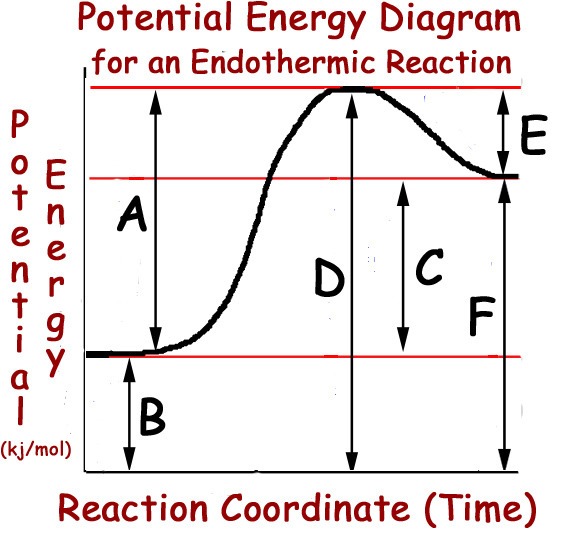
What letter represents the activation energy?
A
B
C
D

Is this equation endo- or exo-thermic?
PCl3 (s) + Cl2 (g) --> PCl5 (s) + energy
endothermic
exothermic
When new chemical bonds form, energy ____________.
is taken into the system.
is released from the system.
stays the same in the system.

A
B
C
D
The initial temperature was measured to be 20oC and the final temperature was 10oC. The reaction was
exothermic
endothermic
The initial temperature was measured to be 20oC and the final temperature was 45oC. The reaction was
exothermic
endothermic
What type of reaction is this?
Exothermic
Endothermic
Energy Producing
No way to tell
The graph above is from which type of reaction?
Endothermic reaction
Exothermic reaction
Is this equation endo- or exo-thermic?
PCl3 (s) + Cl2 (g) --> PCl5 (s) + energy
endothermic
exothermic
What is the left part of a chemical equation called?
2H2 + O2 ---> 2H2O
Reactants
Yields
Products
Chemical equation
What is the right part of a chemical equation called?
2H2 + O2 ---> 2H2O
Reactants
Yields
Products
Chemical Equation
How many Mn atoms are found in the following compound?
2MnO4
1
2
4
8
What is the little number after an element in a chemical equation called?
Example: H2
Coefficient
Atom
Subscript
Equation
Is the following equation balanced?
Al + O2 ---> 2Al2O3
YES
NO
What is the number before a chemical formula called?
Example: 2H2 + O2 ---> 2H2O
Coefficient
Atom
Subscript
Equation
Which of the following equations are correctly balanced?
12CO2 + H2O ---> C6H12O6 + O2
CO2 + H2O ---> 3C6H12O6 + O2
CO2 + 9H2O ---> C6H12O6 + O2
6CO2 + 6H2O ---> C6H12O6 + 6O2
Balance this equation:
H2 + Cl2 ---> HCl
It is balanced.
H2 + Cl2 ---> 2HCl
3H2 + Cl2 ---> 6HCl
H2 + 3Cl2 ---> 6HCl
Complete the sentence.
During a chemical reaction, atoms ________.
can appear
can disappear
get rearranged
stop moving and vibrating
What is the Law of Conservation of Mass?
It states that matter cannot be created or destroyed.
It states that energy cannot be created or destroyed.
It states that matter can be created or destroyed.
It states that sound can be created or destroyed.
What are the numbers that you CANNOT change in a chemical equation?
Subscripts
What is the right ratio of chemicals for the balanced chemical equation?
__Ca + __H2O --> __Ca(OH)2 + __H2
What is the right ratio of chemicals for the balanced chemical equation?
__CO + __Fe2O3--> __Fe + __CO2
What is the right ratio of chemicals for the balanced chemical equation?
__H2 + __S --> __H2S
What is the right ratio of chemicals for the balanced chemical equation?
__H2SO3 + __KOH--> __H2O+ __K2SO3

