
 Worksheets
Unit 5 Geologic Processes Review
Total questions: 58
Worksheet time: 1hrs 9mins


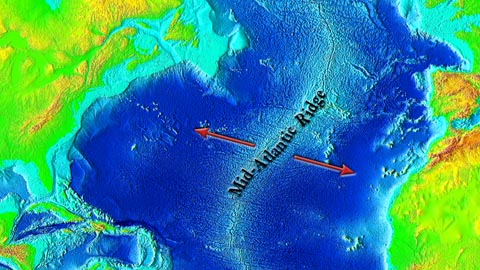
A type of rock made from molten lava
igneous rock
sedimentary rock
metamorphic rock
fossil
Rock formed from particles in the environment that settle to form layers
igneous rock
sedimentary rock
metamorphic rock
fossil
A type of rock formed by great pressure and very high temperatures
igneous rock
sedimentary rock
metamorphic rock
fossil
In some areas of the world, like California and Japan, earthquakes are a common occurrence. How can this best be explained?
The strong ocean currents are undermining both areas causing earthquakes.
Both areas are located near the edge of the Pacific Ocean, the unstable sand causes earthquakes.
Both areas are subjected to strong ocean wind and waves that causes earthquakes.
Both areas are on the boundary of active plates, the motion of the plates causes earthquakes.
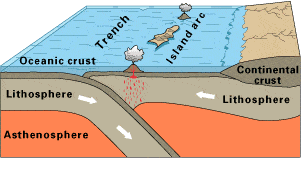
Observe this diagram of a plate boundary. One statement BEST describes what is happening. It is that
the oceanic crust is melting.
the denser ceanic crust is subducting under the less dense oceanic crust
volcanic islands are forming.
the tectonic plates are moving away from each other.
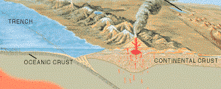
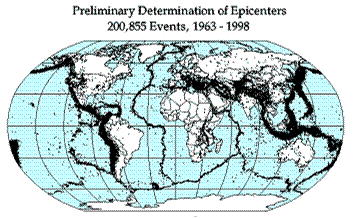
Earthquake epicenters (center of where the earthquakes started) were mapped for a 35 year period in the diagram above. The black dots indicate these epicenters. The black dots appear along what feature on Earth?
hot spots
plate boundaries
rift zones
sea floor spreading
The 2004 Indian Ocean tsunami was caused by a shift in two plates that pushed one section of the sea floor under another section of the sea floor by 5 meters. What type of boundary is this?
divergent
convergent
transform
metamorphic
The San Andreas Fault in California is known as an active earthquake area. What type of
boundary is it?
Converging
Diverging
Transform
Sea Floor Spreading
What is a tectonic plate?
A huge chunk of dense ice that slowly moves.
A rapidly rotating column of air that moves through a storm and destroys things in its path.
A storm with violent wind that travels through the ocean and destroys things in its path.
A large division of Earth’s crust that moves over time.
A rigid layer made up of the uppermost part of the mantle and the crust.
lithosphere
asthenosphere
outer core
inner core
The layer of hot, solid material between Earth's crust and core.
mantle
crust
outer core
inner core
The soft layer of the mantle on which the lithosphere floats.
asthenosphere
lithosphere
crust
outer core
A layer of molten iron and nickel that surrounds the inner core of Earth
outer core
asthenosphere
crust
lithosphere
A dense sphere of solid iron and nickel at the center of Earth
inner core
outer core
asthenosphere
lithosphere
The name of the single landmass that broke apart 200 million years ago and gave rise to today's continents
Pangaea
continental drift
tectonic plate
plate tectonics
The hypothesis that states that the continents once formed a single landmass, broke up, and drifted to their present locations
continental drift
tectonic plate
asthenosphere
rock cycle
The theory that pieces of Earth's lithosphere are in constant motion, driven by convection currents in the mantle.
plate tectonics
continental drift
transform boundary
rock cycle
A block of lithosphere that consists of the crust and the rigid, outermost part of the mantle.
tectonic plate
crust
rock cycle
igneous rock
A tectonic plate boundary where two plates collide, come together, or crash into each other.
convergent boundary
divergent boundary
transform boundary
A plate boundary where two plates move away from each other.
divergent boundary
convergent boundary
transform boundary
The boundary between tectonic plates that are sliding past each other.
transform boundary
convergent boundary
divergent boundary
The process by which oceanic crust sinks beneath a deep-ocean trench and back into the mantle at a convergent plate boundary.
subduction
transform boundary
divergent boundary
seafloor spreading

The most destructive type of wave is a
P-wave
S-wave
Surface wave
transverse wave

What is a tracing of an earthquake's motion that is created by a seismometer?
Seismograph
Seismogram
Seismologist
Elastic Rebound
Which wave can travel through solids, liquids, and gases?
P-Waves
S-Waves
Surface (L) Waves

Which is the fastest type of seismic wave?
p-waves
s-waves
surface waves

The place where the earthquake is felt on the Earth's surface is called the...
Epicenter
Hypocenter (focus)
Surface
Crust

What is the instrument used to measure earthquakes?
Seismograph
Sling Psychrometer
Spring Scale
Balance
Anemometer
What is the minimum number of seismograph stations needed to locate an earthquake epicenter?
2
3
4
5
6

Which image models secondary waves?
Top
Bottom
Both

Which type of seismic wave can travel all the way from on side of the Earth to the other?
P-Waves
S-Waves
L-Waves (Surface Waves)
None

